
Most traders still stare at price charts and Twitter. Meanwhile, the real alpha often hides one layer deeper — in smart contract event logs.
Below I’ll walk through how to use those logs for market signals, what’s realistically possible in 2025, and where people actually make money with this stuff (and where they don’t).
—
Why smart contract event logs matter for traders
Most on-chain activity that moves a token’s price leaves a footprint in event logs: swaps, mints, liquidations, staking, votes, NFT mints — all of it fires events.
On Ethereum alone, daily transaction counts have hovered between 900k and 1.3M from 2022 to 2024, but the number of events is several times higher because a single transaction can emit dozens of logs. That’s an insane amount of raw material for blockchain data analytics for trading signals — if you can structure it.
In the last three years, more and more funds and sophisticated retail have shifted from just “chart + news” to using on-chain smart contract data for crypto market analysis. That shift is why you see entire desks dedicated to “on-chain research” at large crypto funds now, which simply didn’t exist at this scale in 2020–2021.
—
What exactly is an event log (in trader terms)
In plain language: an event log is a structured message that a smart contract writes to the blockchain when something happens.
Short version:
Every interesting DeFi action you care about is an event.
Longer version below.
> Technical block: Anatomy of an Ethereum event log
>
> – Each log entry contains:
> – `address`: the contract that emitted the event (e.g., UniswapV3Pool)
> – `topics`: indexed parameters, including the event signature hash
> – `data`: non-indexed parameters (amounts, prices, flags, etc.)
> – `blockNumber`, `transactionHash`, `logIndex`: when and where it happened
> – ABI (Application Binary Interface) tells you how to decode those topics + data fields into human-readable objects like:
> `Swap(trader, amount0In, amount1In, amount0Out, amount1Out, sqrtPriceX96, liquidity, tick)`
Once you can decode, a “log” turns into something tradable: “wallet X just borrowed Y USDC against Z WETH at time T.”
—
Key event types that actually move markets
1. DEX swaps and liquidity events
Swaps, liquidity adds/removes, and pool creation events on DEXes like Uniswap, Curve, PancakeSwap are the bread and butter of on-chain signals.
From 2022 to 2024, Uniswap v2 + v3 alone consistently processed between $800M and $1.5B in daily volume across chains. Every one of those swaps emitted at least one event. When serious size moves, it’s visible within seconds — long before centralized exchanges adjust.
Examples of actionable logs:
– Huge buys of a low-cap token in a short window
– Rapid pull of liquidity (large LP removal) before news hits
– Volume/volatility spikes on a previously dead pool
> Technical block: Common DEX events
>
> – Uniswap V2/V3:
> – `Swap(sender, amount0In, amount1In, amount0Out, amount1Out, to)`
> – `Mint(sender, amount0, amount1)`
> – `Burn(sender, amount0, amount1)`
> – Curve-style pools:
> – `TokenExchange(buyer, sold_id, tokens_sold, bought_id, tokens_bought)`
> – `RemoveLiquidity(provider, token_amounts, fees)`
>
> These events give:
> – trade direction (buy/sell vs. base token)
> – size (exact amounts swapped)
> – address (who did it, if not proxied)
> – pool (which token pair)
—
2. Lending and liquidation events
Liquidation cascades often precede or accelerate sharp price moves.
On Aave, Compound and similar protocols, events like `Borrow`, `Repay`, `LiquidationCall`, `ReserveUsedAsCollateralEnabled` tell you when leverage builds up or gets wiped out.
From 2022–2024, during major drawdowns (e.g., FTX collapse in late 2022, regional banking stress in early 2023, and the BTC pullback after ETF euphoria in mid‑2024), large DeFi protocols regularly saw >$100M in DeFi liquidations in a single day, all perfectly traceable via event logs.
> Technical block: Liquidation signals
>
> On Aave v3 (simplified):
> – `ReserveDataUpdated(reserve, liquidityRate, stableBorrowRate, variableBorrowRate, liquidityIndex, variableBorrowIndex)`
> – `Borrow(reserve, user, onBehalfOf, amount, borrowRateMode, borrowRate, referralCode)`
> – `LiquidationCall(collateralAsset, debtAsset, user, debtToCover, liquidatedCollateralAmount, liquidator, receiveAToken)`
>
> From these you can build:
> – live open-interest proxies (total borrowed vs. total supplied)
> – liquidation thresholds per asset
> – count and size of liquidations per hour
—
3. Token mint/burn and vesting unlocks
Inflation and unlocks are classic fundamentals, but the nuance is in *when* and *how* they hit the market.
From 2022 to 2024, token unlock trackers became mainstream because cliffs and linear vesting schedules kept causing 10–40% drawdowns on illiquid mid-caps. Most of those unlocks are driven by vesting contracts that emit `Transfer`, `TokensReleased`, or custom `Unlock` events when tokens become accessible.
The trick: bots monitor these logs in real time and front-run likely sell pressure.
—
4. Governance and protocol upgrade events
Governance used to be “nice to have.” Now, a passed proposal can introduce fee switches, token burns, or emissions cuts — all instantly reflected in event logs.
Between 2022 and 2024, several large-cap governance proposals (Uniswap fee switch experiments, Lido governance around stETH, Curve and Frax emissions changes) resulted in double-digit percentage moves within days. Every stage — proposal creation, votes, queues, execution — is an event.
For narrative traders, this is pure gold: you don’t need insider info if you watch the governance contracts directly.
—
How to turn event logs into market signals
Let’s go step by step from “logs are raw noise” to “logs are structured signals.”
Step 1. Pick your hunting grounds
You don’t need the whole chain. You need the contracts that actually move the bags you care about:
1. Identify:
– Major DEX pools for your target tokens
– Lending markets where they’re used as collateral
– Staking or rewards contracts
– Governance contracts and timelocks
2. List the contract addresses and ABIs
3. Decide what event types matter for *your* style:
– scalper → big swaps, MEV patterns
– swing trader → unlocks, emissions, governance
– longer-term → protocol usage, recurring revenue on-chain
This is where good crypto trading tools using smart contract event logs save months of engineering.
—
Step 2. Decide your data access model
You have three realistic options:
1. Node + custom indexer
– Run your own archive node or pay for node access.
– Use `eth_getLogs` or WebSocket subscriptions to stream events.
– Pros: maximum control, lowest latency.
– Cons: heavy engineering, maintenance.
2. Indexing/analytics services (SaaS)
– Use Dune, Flipside, The Graph, Covalent, etc.
– They pre-index logs into tables / APIs.
– Pros: fastest to start, great for research and backtests.
– Cons: latency, rate limits, sometimes missing edge-cases.
3. Hybrid (what most serious traders do)
– Use SaaS for backtesting and research.
– Build a thin real-time layer on top (lightweight indexer) for live trading.
If you’re in the “I’d rather trade than build infra” camp, you basically want to buy blockchain analytics software for market signals instead of reinventing the indexer wheel.
—
Step 3. Transform events into features
Raw logs aren’t signals yet. You need to aggregate them into features your models or eyeballs can understand.
> Technical block: Example feature engineering from logs
>
> For a given token’s main Uniswap v3 pool:
> – From `Swap` events:
> – `net_buy_volume_5m` = sum(buys − sells over last 5 minutes)
> – `whale_trades_5m` = count(swaps with USD value > $100k)
> – `swap_wallet_entropy` = number of unique traders per 15 minutes
> – From `Mint` / `Burn` (liquidity):
> – `liquidity_change_30m` = (current TVL − TVL 30 minutes ago) / TVL
> – `lp_churn_rate` = unique LPs adding/removing per hour
>
> Combined, these become:
> – “whale accumulation score”
> – “liquidity risk score”
> – “retail frenzy score”
This is the core of blockchain data analytics for trading signals: consistent, well-defined features that you can test.
—
Step 4. Backtest across the last 3 years
If it doesn’t work on 2022–2024 data, it probably won’t work in 2025.
Why those years matter:
– 2022 – Brutal bear, multiple blow-ups (Luna, Celsius, FTX). Massive deleveraging. Perfect for testing downside risk signals: liquidations, unlocks, liquidity pulls.
– 2023 – Range-bound, “builder market”, memecoins popping in short bursts. Great for testing on-chain momentum and whale accumulation strategies.
– 2024 – ETF approvals, BTC halving, renewed alt activity. Strong uptrends mixed with violent corrections. Ideal for testing trend-following plus crash detection.
Using on-chain smart contract data for crypto market analysis across these regimes lets you see where your signal breaks: does it only work in bull phases? Does it flip you short at the worst possible time during news events?
Most teams I’ve seen who are profitable with this stuff spent *months* just cleaning and backtesting 2022–2024 logs before putting a dollar of real risk behind a strategy.
—
Step 5. Wire into your execution stack
Once you trust a signal, you need it live and tradeable.
A typical simple flow:
1. Listener picks up new block → decodes relevant event logs.
2. Event stream feeds a small feature-engineering service.
3. Features update the signal (e.g., “whale accumulation score”).
4. When threshold is hit:
– send alert (Telegram, Slack, email)
– or fire an order via CEX API / on-chain contract / bot.
> Technical block: Latency considerations
>
> – Ethereum block time 2022–2024: ~12s → ~12s+ per confirmation.
> – L2s (Arbitrum, Optimism, Base): 1–2s block times but with L1 finality lag.
> – A 1–3 block delay is normal when using third-party APIs.
>
> For most swing or intra-day strategies, minute-level latency is fine.
> For pure MEV / arbitrage, you need sub-second infra and likely direct mempool access, which is a different game.
—
Concrete examples of signals that actually worked
Example 1: Whale accumulation in DEX pools
A mid-sized fund I worked with in 2023–2024 ran a simple but effective idea:
– Track `Swap` events across main pools for 50 mid-cap tokens.
– Label “whale” trades as swaps > $200k per txn.
– Compute a rolling 6-hour whale net-flow per token.
Rules:
1. If whale net-flow over 6 hours > +$1M and liquidity is stable or increasing, mark token as “accumulation candidate.”
2. Require:
– No major upcoming unlock within 7 days (checked via vesting contract events).
– No obvious one-off OTC being bridged in (filtered via known bridge contracts).
They backtested 2022–2024 and found:
– In strong uptrend months (e.g., Q1 2024), a basket of “accumulation candidates” outperformed the overall mid-cap index by ~12–20% over the next 7 days.
– In deep bear months (late 2022), the same signal was noisy but still helped *avoid* some rugs by flagging when whales quietly exited.
Was it perfect? No. But it clearly beat random, and they used it as one of several inputs to size positions.
—
Example 2: Liquidation cluster detection
Another desk focused heavily on lending events from 2022–2023.
Their logic:
– Monitor Aave, Compound, and a couple of newer lending markets.
– Track `Borrow` plus `Liquidation` events for majors (ETH, BTC, stables).
– Model per-asset liquidation walls: “If ETH drops to $X, we expect ~$Y in forced selling.”
They discovered:
– During sharp market moves (e.g., FTX collapse week in November 2022), on-chain lending liquidations often accelerated price moves by 3–8% beyond what centralized order books alone suggested.
– By mid-2023, this kind of visibility let them either:
– step in as buyers when walls were about to clear, or
– reduce leverage right before the worst of the cascade.
This isn’t magical prediction. It’s just reading the exact rules of the game (in smart contracts) and how much ammo is loaded where.
—
Example 3: Governance + timelock frontrunning
A more niche but powerful strategy from 2023–2024:
– Track `ProposalCreated`, `VoteCast`, `ProposalQueued`, and `ProposalExecuted` for key governance contracts.
– Pay special attention to proposals that:
– redirect emissions
– enable protocol fees
– change collateral parameters
For example, when emissions for a stablecoin pool were set to be cut by ~40% in 2023, the relevant governance and timelock events fired days before any centralized exchange news headline.
Traders who watched those contracts:
– Reduced exposure to the farm token before yield farmers dumped rewards.
– Shorted or hedged the farm token going into the change.
– Bought the “winner” pools whose yields were about to rise.
No rumors, no Discord leaks — just reading the chain.
—
Choosing tools and platforms (without drowning in options)
By 2024, the tooling landscape exploded. You don’t need to build everything from scratch, but you should be deliberate.
What you’re looking for:
1. Data coverage
– EVM chains you care about.
– Full historical event logs back to at least 2021.
– Lending, DEX, NFT, and governance protocols indexed.
2. Latency & reliability
– Sub-minute data for live signals is usually enough.
– Clear SLAs if you automate trades.
3. Feature access
– Easy way to query and aggregate logs (SQL, APIs, Python clients).
– Built-in analytics geared towards traders, not just dashboards.
Many teams explore multiple options before settling on the best on-chain analytics platform for trading strategies that fits their stack. Some even combine two: one for exploratory research, another purely for low-latency execution.
If you’re early in the journey, it can make more sense to start with a SaaS and only later build your own narrow indexer once you know exactly what signals you want.
—
Typical pitfalls and how to avoid them
1. Confusing activity with alpha
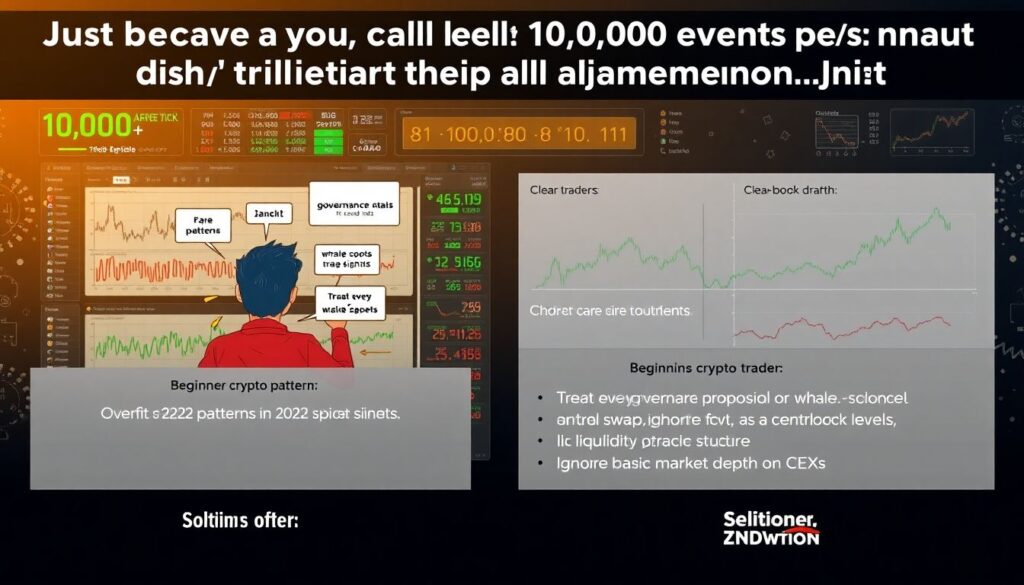
Just because you can see 10,000 events per minute doesn’t mean they’re all meaningful.
Beginners often:
– Overfit to rare patterns in 2022 crash data.
– Treat every governance proposal or whale swap as a trade signal.
– Ignore basic market structure like order-book depth on CEXs.
Solution:
Start with *one* hypothesis and ruthlessly test it. For example: “Net whale DEX inflows over 6 hours predict 24-hour relative performance.” Everything else is noise until proven otherwise.
—
2. Ignoring off-chain context
On-chain logs tell you *what happens*, not *why*.
If a token unlocks and nobody cares (because unlock recipients are long-term aligned), the raw `TokensReleased` event will mislead you. Conversely, small governance changes can matter hugely if they alter real revenue flows.
Blend:
– smart contract logs,
– basic social + news context, and
– CEX volume and open interest.
Signals are strongest when multiple channels agree.
—
3. Not accounting for structural change 2022–2024
The market in late 2024 is not the market of early 2022:
– L2 adoption changed where activity lives.
– New DEX designs (concentrated liquidity, intents, RFQ) changed event patterns.
– ETF flows and more institutional players changed liquidity rhythms.
When you backtest, segment:
– pre‑FTX vs. post‑FTX (late 2022)
– pre‑L2‑boom vs. post‑L2‑boom (roughly mid‑2023 onward)
– pre‑ETF vs. post‑ETF approvals (late 2023 / early 2024)
A signal that shined in 2022 may be dead now; another might only emerge in 2023–2024 data.
—
Putting it all together
If you want a practical path and not a research rabbit hole, you can think of it as a 5‑step roadmap:
1. Pick a niche
– One chain, a handful of tokens, and 3–5 core contracts (DEX, lending, vesting, governance).
2. Get structured access to logs
– Either through a node + lightweight indexer or by leaning on off-the-shelf crypto trading tools using smart contract event logs.
3. Engineer a small set of features
– Whale flows, liquidity changes, liquidation risk, governance impact.
4. Backtest on 2022–2024
– At least a few dozen trades per regime (bear, range, bull).
– Track basic metrics: hit rate, average R, max drawdown.
5. Go live slowly
– Start with alerts and paper trading.
– Then small real positions.
– Scale only after 3–6 months of consistent behavior.
In 2025, the edge isn’t just in seeing the chain — everyone *can* see it. The edge is in deciding *which* smart contract event logs matter for your style, turning them into clean, testable signals, and ruthlessly validating them on the chaos of the last three years.
Do that well, and the blockchain stops being a blur of hex data and starts becoming what you actually want: a real-time feed of tradable information.