

Why On-Chain Privacy Risk Assessment Became Non‑Optional by 2025
By 2025, on-chain privacy is no longer just a geeky concern for cypherpunks; it’s a boardroom topic. Regulators are watching, institutional money is everywhere, and every big exploit or sanctions violation is dissected on Twitter within minutes. In this environment, a structured on-chain privacy risk assessment isn’t a “nice-to-have” process; it’s the minimum bar to stay operational.
At the same time, blockchains are getting *more* complex: L2 rollups, cross‑chain bridges, privacy-preserving smart contracts, restaking layers, and semi‑anonymous stablecoin rails. That combination—regulatory pressure plus technical complexity—makes a rigorous, repeatable approach to privacy risk assessment absolutely critical.
—
Step 1: Define What “Privacy Risk” Means for *Your* Use Case
Before opening any dashboard or running any trace, you need a clear scope. “Privacy risk” is not universal; it changes dramatically depending on who you are and what you do.
For a DeFi protocol, privacy risk might mean:
– Users can be deanonymized and linked to sensitive trading strategies.
– Liquidity pools get contaminated by sanctioned or high‑risk funds.
For a centralized exchange:
– Incoming deposits might originate from mixing services, darknet markets, or ransomware wallets.
– KYC data might be indirectly tied to wallets with politically exposed persons (PEPs).
For an enterprise using a consortium chain:
– Transaction flows could reveal business relationships, pricing, or supply chain secrets to competitors.
In 2025, mature teams bake this into formal risk taxonomies: financial crime risk, reputational risk, regulatory risk, and user safety risk. Without that classification, any analysis degenerates into dashboard voyeurism instead of a proper on-chain privacy risk assessment.
—
Step 2: Map Data Flows Across Chains, Layers, and Off‑Chain Systems
This is the part most teams still underestimate. Real‑world activity is rarely confined to a single chain anymore. A typical transaction path might look like:
1. Fiat on‑ramp → custodial wallet
2. Custodial wallet → L1 deposit → bridge to L2
3. L2 DEX → cross‑chain bridge → another L1
4. Withdrawal to a self‑custodial wallet → centralized exchange B
Each hop changes what can be observed and what can be inferred.
To perform a solid on-chain privacy risk assessment in 2025, teams usually:
1. List all entry and exit points (on‑ramps, off‑ramps, bridges, smart contracts, MPC wallets).
2. Document what identifiers exist at each point (KYC data, IP logs, device fingerprints, wallet labels).
3. Identify potential linkability:
– Can an observer correlate deposit and withdrawal amounts?
– Do timing patterns connect wallets across chains?
– Are there reused addresses or deterministic patterns in nonce usage?
The output is essentially a “graph of graphs”: a mental (and often visual) model of how value, metadata, and identity traces move through your architecture.
—
Step 3: Select the Right Analytics Stack
Now you’re ready to pick the tooling. The market matured a lot by 2025, and you’ll usually combine external and internal tools rather than rely on a single vendor.
Longer term, most organizations end up using a mix of:
– Vendor platforms for address clustering, sanctions lists, and risk scoring. These are particularly relevant if you offer blockchain privacy risk assessment services to third parties and need consistent, auditable outputs across many clients.
– In‑house graph and trace analytics, especially for large DeFi protocols and exchanges that want deeper customization or can’t share all data with vendors.
– Domain‑specific add‑ons (e.g., NFT‑focused analytics, MEV / mempool analytics, or bridge‑trace tools for specific ecosystems).
What changed in 2025 is the quality of on-chain transaction monitoring and compliance tools. They now commonly support L2 rollups, bridges, and mixers out of the box, and integrate with ticketing, case management, and even automated on‑chain responses (like pausing contracts or blocking deposits) when thresholds are hit.
—
The Core Workflow: How to Perform On-Chain Privacy Risk Assessment

Let’s walk through a pragmatic, repeatable workflow that teams actually use today.
1. Establish a Baseline Risk Model
Start with a quantitative baseline. For example:
– What percentage of daily volume touches “high‑risk” counterparties (as defined by your policy)?
– How many user addresses are one or two hops away from sanctioned or OFAC‑listed wallets?
– How often are privacy‑enhancing technologies (mixers, stealth addresses, shielded pools) used?
Modern cryptocurrency compliance software for on-chain risk analysis usually exposes these metrics through dashboards and APIs. The biggest shift in 2025: these tools increasingly support custom categorization, so you can treat, say, Tornado Cash relayers, Chain‑hopping arbitrageurs, and OTC desks very differently.
Keep this baseline; it becomes your reference when you tweak policies or roll out new features.
—
2. Trace Transaction Flows and Identify Deanonymization Vectors
Here the goal is to understand how and where users (or entities) can be deanonymized, directly or indirectly.
You typically:
1. Run multi‑hop traces from your key contracts and wallets to see:
– Where funds are coming from.
– Where they typically go next.
2. Overlay labeling data from crypto aml and kyc blockchain analytics solutions:
– Exchange clusters, OTC desks, mixers, darknet services, institutional wallets, MEV bots, NFT marketplaces, etc.
3. Look for deterministic patterns:
– Same-address reuse for deposits and withdrawals.
– Fixed‑time withdrawal schedules.
– Amount patterns (e.g., repeated round numbers, identical splits).
A common trap in 2025 is assuming that just because zk‑based tools or mixers were used, privacy is guaranteed. In practice, chainlink-style oracle calls, mempool leaks, and bridge timing often reintroduce correlation vectors that a determined analyst—or regulator—can exploit.
—
3. Assess Regulatory and Jurisdictional Exposure
Privacy risk is tied tightly to where you operate and where your users live.
You should:
– Map your user base by jurisdiction, even if roughly (based on KYC, IPs, or partner data).
– Overlay that with usage of high‑risk tools (mixers, sanctioned protocols, heavily flagged NFT collections, etc.).
– Check alignment with local regulations:
– FATF Travel Rule requirements.
– EU MiCA and AMLR expectations.
– U.S. guidance around mixing and “unhosted wallets.”
– Regional privacy and data‑protection rules (GDPR, PDPA, LGPD, etc.).
Many organizations now engage enterprise blockchain privacy and security consulting firms to translate this mess of regulations into concrete, chain‑level requirements, like: “We will auto‑flag any transaction 2+ hops from a designated sanctioned cluster, and require enhanced due diligence before allowing withdrawals.”
—
4. Quantify Economic Impact
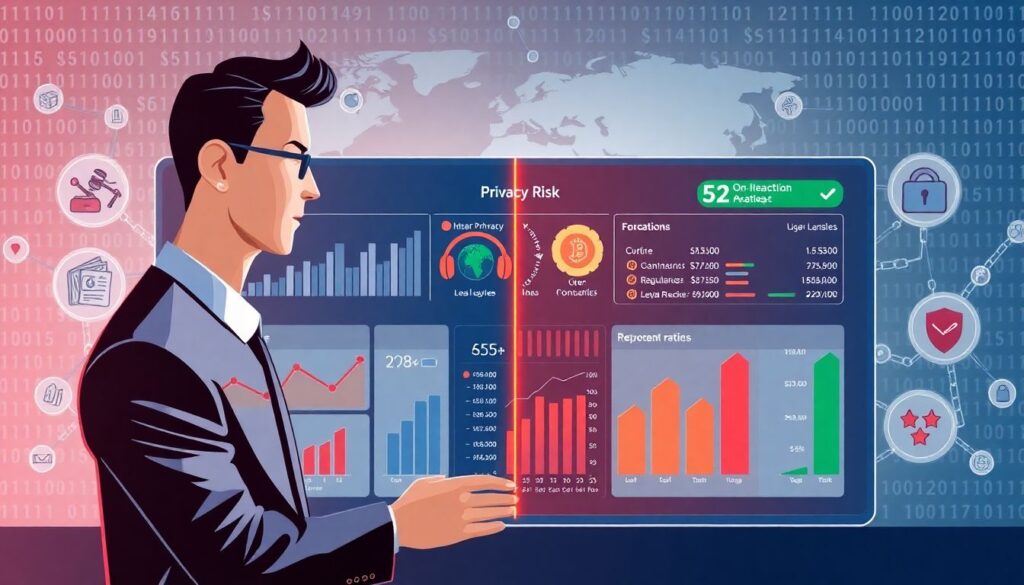
An on-chain privacy risk assessment shouldn’t end in abstract heatmaps; it should connect to money.
You want to answer:
– What is the expected loss from privacy‑related incidents (sanctions violations, regulatory fines, user lawsuits, reputational crashes)?
– How would tightening privacy controls affect user acquisition, fees, and liquidity?
– What are you spending on tooling vs. what you’re saving by preventing incidents?
Some 2024–2025 industry data points (aggregated from public reports and industry surveys):
– Over 60% of large exchanges that experienced serious compliance incidents saw a temporary drop of 20–40% in spot trading volume within a few weeks.
– Insurance underwriters for custodial platforms report that robust privacy and AML controls can shave 10–30% off premiums for crime and cyber policies.
– Several high‑profile enforcement actions in 2023–2024 resulted in nine‑figure settlements, making even expensive end‑to‑end assessments trivially cheap by comparison.
The economic story in 2025 is clear: sound privacy and compliance design is a revenue enabler, not a drag. It unlocks new institutional partnerships and lowers your cost of capital.
—
5. Integrate Controls and Feedback Loops
Once you’ve assessed risk, you need to act on it.
Typical control levers:
1. Policy‑level
– Define which counterparties and tools are allowed, restricted, or banned.
– Set thresholds for manual review vs. automatic blocking.
2. Product‑level
– Increase default account‑level privacy (e.g., address rotation, withdrawal batching).
– Offer advanced privacy modes for sophisticated users, with clear tradeoffs.
3. Operational
– Combine on‑chain alerts with internal case‑management.
– Set SLAs for incident triage and regulatory reporting when needed.
The best teams treat this as a closed loop: monitoring → assessment → control change → re‑assessment. Metrics from your on-chain transaction monitoring and compliance tools feed into updated risk scores and new product experiments, which then get measured against your baseline.
—
Where the Market Is in 2025: Stats and Trends
The last two years have been transformative:
– The share of institutional volume in major crypto markets is estimated above 45–50%, up from roughly 30% in early 2022.
– Over 70% of top‑tier centralized exchanges (by volume) now publish at least some information about their on‑chain monitoring and AML capabilities.
– A growing chunk of DeFi TVL (total value locked) is now subject to soft or hard compliance logic—e.g., allow‑lists, deny‑lists, or oracle‑driven risk gates.
Major trends reshaping privacy risk work:
1. Shift from static blacklists to behavioral models.
Tools don’t just say “this address is bad”; they score entire transaction patterns, looking at flow structures, timing, and relationship graphs.
2. Greater scrutiny of cross‑chain bridges.
Bridges have become prime attack and laundering vectors. Assessment efforts now routinely treat bridge edges as first‑class elements in risk models.
3. “Composable compliance” for DeFi.
Protocols can plug in modular compliance components—risk oracles, signature-based allow‑lists, decentralized identity checks—without centralizing custody.
4. Privacy‑enhancing tech meets compliance.
Zero‑knowledge proofs, selective disclosure, and anonymous credentials are increasingly integrated into commercial stacks, pairing privacy with provable compliance.
Forecasts from industry analysts suggest the broader market for blockchain analytics and compliance could surpass $5–7B annually by 2028, with double‑digit compound annual growth driven by institutional adoption, cross‑border regulation, and the expansion of tokenized real‑world assets.
—
Economic and Strategic Dimensions of Privacy Risk
The economics of privacy and compliance in crypto have become more nuanced:
– Capital access. Institutions and banks often require robust monitoring and reporting before offering credit lines or custody relationships.
– User segmentation. Retail users may accept lower privacy for seamless access, while funds and whales demand stronger privacy guarantees—and are willing to pay for it.
– Competitive positioning. Being “compliant by design” can attract conservative capital; being “privacy‑first but well‑structured” appeals to sophisticated DeFi natives.
That’s why many service providers now bundle analytics, reporting, and advisory into full‑stack blockchain privacy risk assessment services, offering clients ongoing monitoring rather than one‑off audits. The recurring nature of on‑chain risk (new tokens, new bridges, new regulations) makes this a classic subscription play, with high switching costs and sticky margins.
—
Impact on the Wider Industry
On-chain privacy risk assessment is reshaping the crypto landscape in several ways:
– Protocol design. New protocols are being architected with compliance hooks: optional KYC layers, access‑control modules, zk‑based proof systems, and fine‑grained permissioning where it matters.
– Standardization. Industry bodies are pushing standards for wallet labels, risk scores, and reporting formats, making it easier to plug different providers and tools together.
– Talent mix. Teams are hiring people who understand both graphs and law: data scientists who can talk FATF, compliance officers who can read a smart contract, and developers who understand information leakage.
The rise of sophisticated enterprise blockchain privacy and security consulting shows that the industry now views privacy risk as a multidisciplinary problem, blending cryptography, regulation, UX, and game theory.
—
Putting It All Together: A Practical Checklist
To wrap it up, here’s a streamlined, realistic checklist you can adapt:
1. Clarify scope and risk appetite
– Define what privacy risk means for your business model and jurisdictions.
– Decide which tradeoffs you’re willing to make between privacy, UX, and compliance.
2. Map data and value flows
– Trace on‑ and off‑chain paths: wallets, contracts, bridges, KYC systems.
– Identify all points where identities or patterns can leak.
3. Assemble your analytics stack
– Choose external vendors and internal tools.
– Ensure support for the chains, L2s, and privacy tools you rely on.
4. Quantify and monitor
– Establish baseline risk metrics.
– Build dashboards and alerts using your preferred cryptocurrency compliance software for on-chain risk analysis.
5. Integrate controls and iterate
– Implement product, policy, and operational controls.
– Re-assess regularly as new features, chains, and regulations emerge.
In 2025, the teams that treat on-chain privacy risk assessment as an ongoing product function—not an annual compliance chore—are the ones that secure institutional trust, protect users, and stay far ahead of the next enforcement headline.
Комментарии