

Most people first meet liquidity mining through a flashy APY screenshot on Twitter, ape in, and only then wonder what signals they should have checked beforehand. Detecting good liquidity mining setups is less about magic indicators and more about reading a few core data points in the right order. Think of it as a checklist: where is the yield really coming from, how long can it last, who else is in the pool, and what can go wrong if things move against you. In this guide we’ll walk step by step through a practical defi liquidity mining signals strategy, mixing analytics with real‑world style cases so you can recognize both promising setups and obvious traps before you lock your capital into any new pool or farm.
Step 1: Map the yield — what exactly is paying you
Before looking at charts or fancy dashboards, decompose the APY. In most pools, your return is a mix of trading fees, token incentives, and sometimes lending/leveraging layers on top. Signals only make sense when you know which of these pieces dominates. For example, a Uniswap V3 ETH–USDC pool might earn mainly from fees, while a new farm on an unknown chain might be 90% based on emissions from a highly inflationary governance token. The first can be relatively sustainable if volume is healthy; the second can collapse the moment the token dumps. A basic rule: if you cannot explain where the yield comes from in two sentences, you don’t have a signal — you have a gamble dressed up as DeFi.
Now a quick case. In early 2022, a mid‑cap DeFi protocol launched a pool with “2,000% APY” in its native token. Traders piled in without checking that trading volume in the underlying pair was tiny. Fees were negligible; emissions were huge. As the market cooled, sell pressure from farmers crushed the token price by more than 80% in weeks. The real yield, denominated in stablecoins, went from “2,000%” on paper to negative once price impact and impermanent loss were accounted for. The only “signal” that mattered — emissions dwarfing real demand — was visible from day one, but most ignored it.
Step 2: Read on‑chain volume and liquidity depth
Once you know the yield components, look at whether the pool actually does business. Healthy liquidity mining signals usually appear where there is consistent trading volume relative to total value locked (TVL). A pool with $10m TVL and $5m–$8m daily volume is very different from one with $50m TVL and $200k volume. In the first case, fee APR could stay meaningful even if incentives slowly decline; in the second, your main counterparty is other farmers trying to exit. That’s how “high APY” turns into a game of musical chairs. For concentrated liquidity pools (like Uniswap V3), also check how narrow ranges are set: tight ranges can boost fees but also raise rebalancing risk.
Case from practice: a team noticed a stablecoin‑to‑stablecoin pool on a sidechain showing quietly high but not insane APR, around 25%. TVL was modest, yet volume/TVL hovered near 0.5–0.7 daily — excellent turnover. There was no hype campaign, just sticky flows from a local lending protocol that routed swaps through this pool. Those who read the on‑chain data instead of chasing banner APYs ended up with months of relatively stable returns, while headline farms on the same chain spiked to triple‑digit APRs for a week and then flatlined as incentives dried up.
Step 3: Inspect token economics and unlock schedules
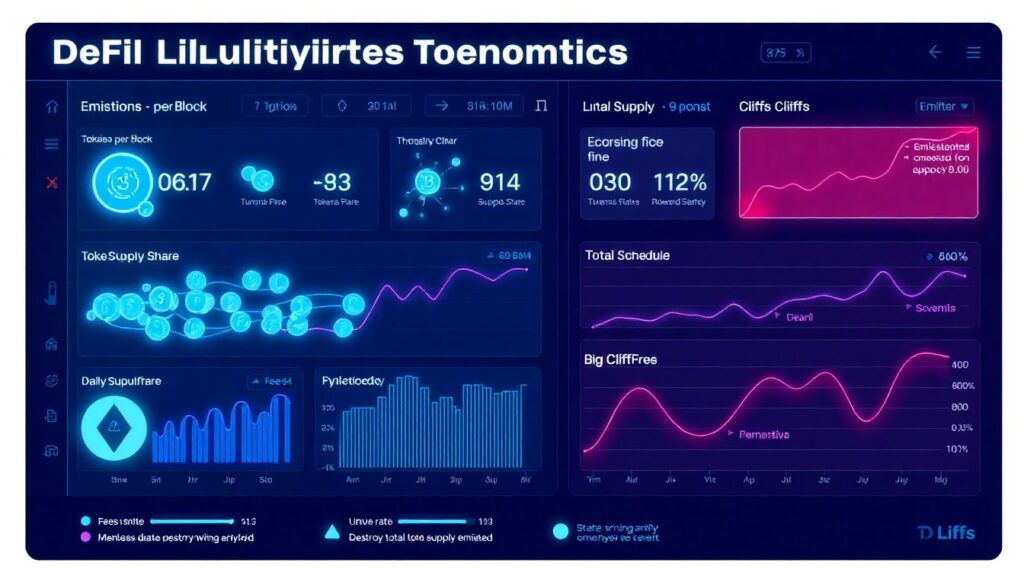
The next layer of a serious defi liquidity mining signals strategy is tokenomics. Even if fees look fine today, emissions can destroy the value of reward tokens. Check how many tokens are emitted per block or per day, what share of total supply this represents, and when big cliffs or unlocks happen. Also note whether rewards are paid in a single governance token, a mix of tokens, or even in stablecoins. Projects that reward in their native token only, with no burn or significant sink, typically rely on constant new inflows of buyers — a big red flag for sustainability. Don’t ignore vesting rules: locked rewards may reduce immediate sell pressure but expose you to long‑term protocol risk.
There’s a telling example from a 2021 farm where rewards looked modest — 60–70% APY — and many assumed it was safer than 1,000% offers. But a deeper look at the vesting schedule showed that nearly 40% of the supply would unlock for early investors within three months, almost matching the entire circulating supply at launch. When the cliff hit, those investors sold heavily, dragging down both the reward token and the pool’s other asset through correlated panic selling. Farmers who had checked the vesting calendar beforehand simply rotated out a few weeks early, turning what became a disaster for late entrants into a decent, if short‑lived, yield trade.
Step 4: Use analytics tools — but know what they can’t tell you
You don’t need to reinvent Dune dashboards from scratch. A pragmatic approach is to rely on the best tools to analyze defi liquidity mining, then layer your own judgment on top. Common building blocks include explorers like Etherscan for holder distribution, DeFiLlama for TVL and yield history, and specialized dashboards for specific DEXs. A solid defi analytics platform for liquidity mining signals will usually show you APR breakdown, historical changes in liquidity, and user concentration data at a glance. Yet tools are descriptive, not predictive. They tell you what has happened and what is happening now, not what the protocol will do next week.
A quick reality check: many beginners subscribe to a shiny liquidity mining signal service for crypto traders, expecting automated alerts to replace their own analysis. In practice, these services can be useful for discovery — surfacing new pools, chains, or incentive programs — but they typically lag by hours or days. By the time an alert fires on a “new hot pool,” the best risk‑adjusted window may have passed, and insiders or early community members are already positioned. Treat such services as a radar, not as an autopilot. Your edge comes from interpreting the signals in context, not from getting the same push notification as thousands of others.
Step 5: Spot red flags and common rookie mistakes
Some warning signs are so common that you can almost filter them mechanically. Anonymous or opaque teams running complex contracts without external audits; admin wallets with god‑mode permissions; liquidity pools where more than 70–80% of the TVL belongs to the deployer or a single whale; and reward schedules that drop sharply after a teaser period — all of these should trigger deeper inspection or an instant pass, depending on your risk tolerance. Another frequent mistake is ignoring chain‑specific risks, like weak bridges or fragile oracles; a juicy farm on a marginal chain can be wiped out not by market moves, but by infrastructure failure or a bridge exploit upstream.
For beginners, the biggest trap is confusing raw APR with risk‑adjusted return. Many newcomers manually chase every pool that flashes over 300% APY, only to watch their rewards collapse as price dumps or as emissions halve. A more disciplined approach is to define a personal risk band — for example, “I mostly want 15–60% APR in blue‑chip or stablecoin pairs, with perhaps 10% of my portfolio in high‑risk experimental farms.” Then any pool outside that template earns extra scrutiny. Learning to say “no” quickly, even when numbers look seductive, is what separates sustainable DeFi yield strategies from expensive tuition fees paid to the market.
Step 6: Build a signal checklist for yield farming opportunities
To make this process repeatable, convert it into a short checklist you can run in 5–10 minutes before committing capital. This is where you operationalize how to identify profitable defi yield farming opportunities. A simple order: verify the protocol (team, audits, age), decompose yield (fees vs emissions), check TVL and volume trends, inspect tokenomics and unlocks, scan holder distribution and top wallets, and finally model your downside — impermanent loss, slippage, and potential drawdowns if the reward token drops 50–80%. With practice, each step becomes faster, and you start recognizing familiar patterns: sustainable fee‑driven pools, hype‑driven farm‑and‑dump schemes, or quiet “sleepers” with improving fundamentals.
A short case of a “sleeper”: a USDC–chain‑native stablecoin pool on a second‑tier DEX showed only 12–18% APR on most trackers, so it flew under the radar of aggressive farmers. But a closer read of the signals showed that the chain’s main money market began requiring this stablecoin as collateral, which steadily increased organic demand. Volume crept up, TVL grew without a spike, and rewards were partially paid in USDC. Early farmers who noticed these slow, consistent improvements ended up compounding moderate yields over many months with little drama, beating many that chased headline APRs that evaporated within days.
Step 7: Case study — entering and exiting a short‑term farm
Let’s walk through a stylized trade based on real patterns. Imagine a new DEX launches on a popular L2 with a governance token and a 10‑day “liquidity bootstrapping” campaign. On day one, a community member notices that the ETH–DEX token pool offers 400% APR, while volume/TVL is already at 0.4 and rising. Emissions are heavy but front‑loaded, with a clear schedule and no massive private investor unlocks in the same window. The team is semi‑doxxed, contracts forked from audited code, and admin keys are timelocked. The farmer enters with a small allocation, plans exit scenarios, and monitors holder concentration and price action daily.
After five days, APR has dropped to 180%, but the token price is holding because incentives are attracting both traders and liquidity providers. At the same time, whales start to accumulate, and on‑chain data shows a few large wallets unstaking ahead of the emission drop on day eight. This is a clear signal that the easy phase might be ending. Our farmer exits on day seven: rewards harvested, liquidity removed, and a portion of the governance tokens kept as a speculative moon‑bag. Those who ignored the signals and stayed through day ten experienced a steep APR drop and a 50% price decline as emissions continued but new demand slowed. The difference in outcomes came from actively reading and acting on evolving signals, not from any secret alpha.
Step 8: Case study — avoiding a rug and learning from near‑misses
Another instructive scenario comes from a chain where a flashy farm promised massive yields on an exotic token pair. Everything looked designed to impress beginners: slick landing page, bright “audited” badges with no links, and a counter showing “$50m TVL” shortly after launch. A closer check revealed that the majority of liquidity came from one wallet, which also owned the deployer address. The contract allowed that wallet to withdraw pool liquidity and alter fees at will. A seasoned farmer saw these red flags through a block explorer, passed on the farm, and warned friends; a week later, TVL abruptly dropped to near zero as the deployer drained the pool and disappeared — a classic rug pull that was, in hindsight, fully visible in the on‑chain signals.
Beginners often look back at such stories and think, “I would have seen that,” but in the heat of the moment, FOMO is strong. A practical safeguard is to adopt a hard rule: no matter how tempting the APY, never deposit in a protocol where you have not checked admin permissions and the distribution of LP tokens. This single habit would have saved thousands of users significant sums across dozens of rugs. Over time, each near‑miss where you correctly step aside reinforces your discipline and sharpens your intuition, turning on‑chain data from an overwhelming flood of numbers into a clear, narrative picture of what is really happening under the surface.
Step 9: Putting it all together for a personal strategy

Ultimately, detecting liquidity mining signals in DeFi is about building a lightweight but consistent process that you can run before every new position and while you’re in it. Combine structured data from a defi analytics platform for liquidity mining signals with your own qualitative judgment about teams, narratives, and market cycles. Decide in advance how much capital you allocate to stable, fee‑driven pools versus experimental farms, how often you rebalance, and what your exit triggers look like when APRs, prices, or tokenomics change. This makes your activity closer to running a small on‑chain treasury than to chasing the next hype wave.
If you want to add more automation, selectively using a liquidity mining signal service for crypto traders can help you discover pools that pass your initial filters, but keep final decisions human and rules‑based. Over time, you’ll see repeating patterns: emissions spikes around governance votes, liquidity rotations when narratives shift, or yield opportunities appearing where infrastructure projects quietly route large flows. With each cycle, refine your rules, document your wins and losses, and you’ll gradually move from impulsive farming to an intentional, data‑driven approach that treats liquidity mining as a systematic strategy rather than a series of isolated bets.
Комментарии