

Why Reputation Suddenly Matters So Much in Token Ecosystems
If you’ve been around crypto for a while, you’ve watched the cycle: hype, pump, drama, rug, repeat. By 2025 it’s obvious that pure tokenomics and cool branding are no longer enough. People are tired of guessing who to trust. That’s where reputation systems for crypto token ecosystems step in: they turn vague “vibes” into something you can actually measure, track and build over time.
At a high level, the role of reputation is simple: separate signal from noise. But once you look closer, you see that reputation becomes a core layer of how users, developers, DAOs and protocols interact. It influences governance, access, collaboration, and even which projects get funded. Let’s walk through this step by step, focusing on how these systems actually work, where they break, and what’s likely to happen next.
—
Step 1: Understanding What “Reputation” Really Means in Token Ecosystems
On-chain behavior instead of vague promises
In traditional finance, your “reputation” might be your credit score, your job title, or your LinkedIn profile. In token ecosystems, reputation is increasingly built out of your verifiable actions: which protocols you’ve used, how you vote in governance, whether your smart contracts have exploits, how often you dump tokens you receive, and so on. A good web3 reputation system solution for dapps looks at this on-chain footprint and translates it into structured signals.
Instead of trusting a slick website or a hyped X thread, you can check: does this address behave like a long-term participant or a mercenary? Has this team shipped audited code? Do they keep interacting with their community even in bear markets? Reputation is what converts a messy transaction history into a narrative you can reason about.
Reputation is contextual, not universal
Crucially, there’s no single “universal score” that fits every use case. Someone might be a great DeFi liquidity provider but a terrible governance participant. A developer might have a spotless security record but no experience in community building. Good reputation systems allow for multiple dimensions: technical reliability, social trust, long-term alignment, and even risk appetite.
This is where blockchain reputation scoring tools for token projects are evolving fast: instead of pretending there’s one magic number, they start to expose richer profiles—something closer to “reputation graphs” than to a simple leaderboard.
—
Step 2: Why Reputation Systems Became Critical by 2025
From speculative trading to long-term coordination
The first crypto cycles were dominated by speculation. By 2025, more capital, more institutions, and more real-world assets have entered the space. That changes the game: long-term coordination matters more than quick flips. DAOs need contributors they can trust, protocols need reliable governance participants, and users want to avoid scams without becoming full-time auditors.
Reputation systems fill this gap. They help protocols reward long-term alignment instead of short-term extraction. They also reduce the cost of due diligence: you no longer need to manually dig through Etherscan and GitHub every time you interact with a new project.
Higher stakes, more regulation, more expectations
Regulators, funds, and serious builders have different expectations in 2025 compared to 2018. If your token-based reputation management platform is just a thin layer over a meme coin casino, nobody institutional will touch it. But if you can demonstrate consistent behavior, transparent governance and resilience under stress, that’s a different story.
Reputation isn’t just “nice branding”; it becomes a quasi-infrastructure layer. Projects plug into decentralized identity and reputation services to satisfy compliance requirements, apply risk-based access controls, and filter out obvious bad actors—while still keeping the composability and permissionlessness that make web3 interesting.
—
Step 3: How Reputation Systems Actually Work (in Practice, Not Slides)
Core components you’ll see in modern systems
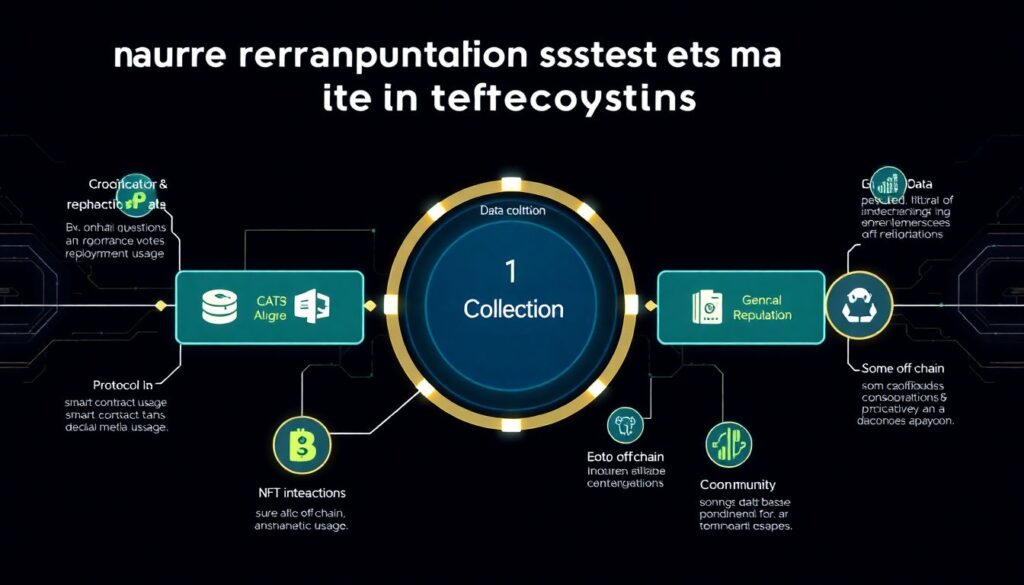
Most mature reputation systems in token ecosystems, even if they look different on the surface, rely on a similar set of building blocks:
1. Data collection – On-chain transactions, governance votes, protocol usage, smart contract deployments, NFT interactions, and sometimes off-chain events (like GitHub contributions) are aggregated.
2. Identity linking – Wallets, ENS names, social accounts, and sometimes KYC identities are linked—carefully—into a graph. This is where many users worry about privacy.
3. Scoring or labeling – Different behaviors are weighed and turned into either scores (e.g., “DeFi reliability: 78/100”) or badges (e.g., “Early LP in Protocol X”, “Audited smart contract dev”).
4. Access rules – Protocols use these scores or badges to define access: who can vote, who can borrow, who gets early access to a new feature or token drop.
5. Feedback and updates – Scores change as new data arrives. Some systems decay old behavior, others keep a permanent record but mark the timeline.
The better-designed systems are transparent about how each step works. If you’re using or building such tools, always ask: what exactly goes into this score, and can users verify or contest it?
Where token-based reputation platforms plug into dApps
A robust token-based reputation management platform usually exposes APIs or smart contracts dApps can integrate. This allows a lending protocol, for example, to offer lower collateral ratios to addresses with strong repayment history and no exploit links. A DAO can require a minimum “governance participation score” to propose changes, reducing spam and hostile takeovers.
In 2025, we’re seeing more dApps treat reputation as a modular input, just like price oracles. It’s no longer a bespoke feature; it’s becoming a standardized plug-in you can swap and compare, similar to how you might compare oracle providers or RPC endpoints.
—
Step 4: Key Use Cases Where Reputation Systems Shine
Governance: filtering noise without killing openness
Token governance has struggled with voter apathy, whales abusing power, and Sybil attacks. A thoughtful web3 reputation system solution for dapps can mitigate these problems without fully closing the gates. Instead of “1 token = 1 vote,” you might see “1 token × reputation multiplier = effective vote,” where the multiplier is based on your historic participation and alignment with the protocol’s goals.
This keeps the door open to new participants but rewards those who actually stick around, read proposals, and bear some cost for their choices. Over time, this makes governance less of a popularity contest and more of a meritocratic process—if the metrics are designed well.
DeFi risk management and credit scoring
On the lending side, reputation systems are starting to act as on-chain equivalents of credit scores, with a twist. Instead of relying on opaque bureaus, protocols analyze your repayment history, duration of positions, association with high-risk contracts, and even whether you’ve interacted with sanctioned addresses.
A user with a long track record of clean, responsible DeFi behavior may unlock undercollateralized loans, better yield, or privileged rates. This is where blockchain reputation scoring tools for token projects change the economics: “anonymous but trustworthy” becomes a usable category, not a contradiction.
Incentives and rewards that don’t just farm mercenaries
AirDrops and liquidity mining taught the industry an expensive lesson: without reputation filters, you mainly attract opportunists. Reputation lets projects target reward programs at people who are likely to add value over time: builders who submitted meaningful pull requests, community members who consistently answer questions, or LPs who provided depth during volatile periods.
This kind of targeting doesn’t have to be centralized. DAOs can compose multiple decentralized identity and reputation services to build a multi-dimensional picture, then vote on how to use it for distribution.
—
Step 5: Common Mistakes When Designing or Using Reputation Systems
1. Treating reputation as a single magic number
One of the biggest design traps is collapsing complex behavior into a single “reputation score.” This tempts everyone to overuse it as a universal filter. In reality, people have different strengths and roles: researchers, coders, risk takers, moderators. Reducing all that to a generic 0–100 number captures almost nothing meaningful and can be gamed easily.
Tip for beginners: If you’re evaluating a project’s reputation framework, look for multiple dimensions and clear explanations of what each one measures. Avoid systems that push a single opaque score as the truth.
2. Ignoring Sybil resistance and gaming
If creating a new wallet is cheap, any naive scoring approach will be attacked. Farming “good behavior” on many fresh wallets, wash trading to appear active, or splitting a reputation across multiple addresses are all common tactics.
Warning: If your design doesn’t explicitly consider how easy it is to fake activity, assume it will be abused. Combine reputation signals with proven Sybil-resistance techniques: social graphs, proof-of-personhood schemes (with privacy safeguards), or economic costs for spawning identities.
3. Forgetting about privacy and data minimization
Reputation systems sit at the intersection of analytics and identity, which is a risky place. Overzealous linking of wallets, emails, and real-world data can easily turn into surveillance. That’s not just ethically problematic; it can also alienate users and invite regulatory headaches.
Practical advice: Favor designs that use zero-knowledge proofs or selective disclosure, where users can prove they meet certain criteria (“I have a DeFi score above X”) without revealing the raw underlying data.
4. Making scores impossible to contest
Reputation is not static, and any algorithm can be wrong. If there’s no appeals process or transparency, you effectively create a shadow blacklist that nobody can challenge.
For protocol designers: Build in mechanisms for dispute resolution. At a minimum, log how a score was computed and allow users to see and correct underlying data where appropriate.
—
Step 6: Practical Tips for Newcomers Working with Reputation Systems
If you’re a user: how to build and protect your on-chain reputation
1. Stick to wallets with a clear “public persona” role. Separate speculative degen activity from your long-term identity. Many systems don’t distinguish yet, but the more serious your usage, the more you’ll appreciate clean separation.
2. Engage in governance, don’t just farm yields. Voting, proposing, and participating in community discussions is increasingly tracked by reputation systems for crypto token ecosystems. Over time, this makes your address more valuable in the eyes of serious protocols.
3. Avoid obvious red flags. Interacting with known exploit contracts, sanctioned addresses, or “too good to be true” schemes might not hurt today, but by 2025 more tools flag such patterns. Think twice before chasing that last 5000% APY.
4. Prefer systems that respect your privacy. When connecting wallets or linking social accounts, ask: is this necessary, and can I revoke it? Reputation should empower you, not lock you into a data prison.
If you’re a builder: integrating reputation the right way
1. Start with clear objectives. Are you trying to reduce spam, improve governance quality, or manage financial risk? Don’t throw in scores “because it’s trendy.”
2. Use multiple data sources. Don’t depend on a single token-based reputation management platform. Aggregate different providers and signals, and make your scoring logic auditable.
3. Design for reversibility and iteration. Early models will be wrong. Make sure you can tweak weights, remove bad metrics, or add new ones without breaking your ecosystem.
4. Communicate how reputation influences decisions. Users should know why they were denied access or received different terms. Hidden logic erodes trust fast.
—
Step 7: How Reputation Systems Interact with Decentralized Identity
DID + reputation = a new trust layer
The big evolution in 2024–2025 is the tighter coupling between decentralized identity and reputation services. Decentralized identifiers (DIDs), verifiable credentials, and soulbound or non-transferable tokens allow you to express aspects of identity—skills, licenses, memberships—without ceding control to a central platform.
Reputation layered on top of this stack means you can prove things like “I’m an experienced security auditor,” “I’m a long-term contributor to Protocol Y,” or “I maintain a clean DeFi track record” using cryptographic proofs rather than screenshots or PDFs. This makes composable trust possible: any dApp can plug into that layer and apply its own policies.
Risks of ossified or permanent labels
But there’s a dark side: if everything is permanent and easily linkable, you risk creating a chain-based caste system where early mistakes haunt you forever. Good systems counter this by:
– Adding time decay to certain signals
– Supporting context-specific reputations (e.g., DeFi vs. NFT reputation)
– Allowing revocation or re-issuance of credentials when appropriate
From a design perspective, the goal is to remember enough to be useful, but not so much that people lose the chance to change or improve.
—
Step 8: Where the Tech Is Heading After 2025
Short-term (2025–2027): consolidation and standardization
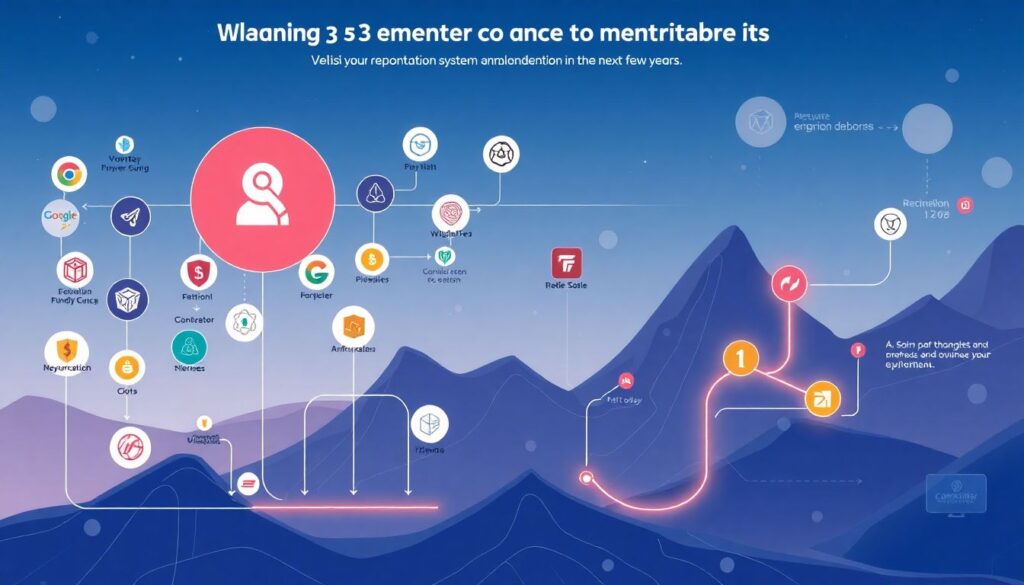
Over the next couple of years, expect a wave of consolidation. We already see numerous providers competing to be the “default” web3 reputation system solution for dapps. Many won’t survive; those that do will standardize formats and interfaces in a way that feels similar to ERC token standards.
We’re likely to see:
– Widely accepted schemas for reputation credentials
– Interoperable APIs between major reputation providers
– More on-chain registries of scoring methodologies, making them transparent and auditable
For token projects, this means you’ll be able to mix and match providers more easily, rather than being locked into one closed ecosystem.
Medium-term (2027–2030): AI-assisted, context-aware reputation

As data grows, purely rule-based scoring becomes less effective. Expect more AI-assisted analysis, not in a “black box decides your fate” sense, but in the sense of pattern detection: unusual governance behavior, coordinated Sybil campaigns, emerging exploit vectors.
Combined with human oversight, these tools will catch nuance that static heuristics miss. For example, a system might flag that a wallet is part of a subtle governance capture attempt, even if its individual transactions look benign.
At the same time, user agents—wallets with built-in intelligence—will negotiate on your behalf using your reputation: choosing protocols that treat your track record fairly, warning you when an interaction might harm your score, or suggesting actions to strengthen it.
Longer-term vision: a “reputation substrate” under the token economy
If things continue on the current trajectory, reputation becomes a substrate—an underlying fabric—of the token economy. Most serious dApps will treat reputation like they treat price feeds today: essential infrastructure. New protocols will launch with built-in hooks to reputation layers from day one, not as an afterthought.
A realistic scenario for the 2030s is that many “permissioned” and “permissionless” systems blur together. Instead of static KYC gates, you’ll see dynamic, reputation-driven access rules that satisfy regulatory constraints while preserving pseudonymity. Users might move between consumer apps, DeFi protocols, social platforms and DAOs with a portable, privacy-preserving reputation profile that replaces accounts and forms.
The key tension will remain: harnessing the benefits of reputation without re-creating web2-style surveillance and score-based discrimination. Designs that bake in user control, transparency, and the right to evolve will be the ones that last.
—
Conclusion: Using Reputation Wisely in a Tokenized World
By 2025, the role of reputation systems in token ecosystems has shifted from an experimental add-on to a central mechanism for trust, coordination, and risk management. They help align incentives, reward real contribution, and make complex networks legible enough to operate at scale.
But they are double-edged tools. Oversimplified scores, opaque algorithms, and careless identity linking can easily reproduce the problems we were trying to escape from web2. The challenge for the next wave of builders and users is to push for systems that are transparent, pluralistic, and privacy-preserving.
If you’re just getting into this space, think of your reputation as a long-term asset: build it deliberately, protect it from spammy interactions, and favor ecosystems that let you see—and shape—how you’re being judged. If you’re building, treat reputation not as a gimmick but as core infrastructure: design carefully, iterate in the open, and assume your choices will shape not just your app, but the broader trust architecture of web3.