

Scenario analysis in crypto sounds fancy, but in practice it’s just a disciplined way of asking: “What happens to my money if things go very right, very wrong, or just weird?” The goal is not to predict the future, but to map a few realistic futures and see how your positions behave in each. Done well, it stops you from overreacting to volatility and gives structure to your decisions, instead of trading on gut feeling or Twitter noise.
—
Understanding Scenario Analysis in Crypto
At its core, crypto scenario analysis is a structured stress test for your assumptions. You take your current positions, define drivers like BTC price, volatility, funding rates, correlation between coins, regulation shocks, then build multiple paths for these variables. You’re not trying to find “the” correct path; you’re measuring how fragile or robust your portfolio is across different environments. This is where cryptocurrency portfolio risk management shifts from vague intuition to numbers you can actually argue about.
—
Comparing Approaches to Crypto Scenario Analysis
Deterministic “What‑If” Scenarios
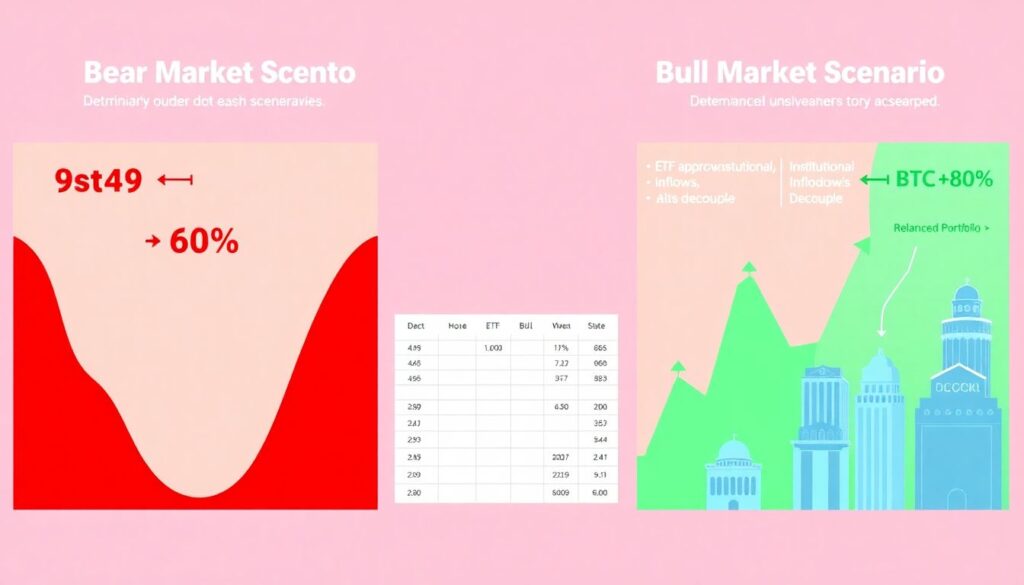
The simplest approach is deterministic: you pick a few states of the world and hard‑code them. For example: “BTC ‑40%, majors ‑60%, DeFi TVL ‑30%,” or “ETF approvals + institutional inflows, BTC +80%, alts decouple.” You then revalue your portfolio under each state. This style is transparent and easy to explain to non‑quants, which is why many desks still rely on it. The downside is obvious: you only see the worlds you remembered to imagine, and reality loves to land in the blind spots.
—
Probabilistic and Monte Carlo Methods

A more advanced path is probabilistic modelling. You estimate distributions for returns, volatilities and correlations, and let Monte Carlo engines simulate thousands of price paths. Modern crypto market analysis software can do this on the fly, showing how your PnL behaves across a cloud of possible futures. You gain a richer view of tail risks and path‑dependent pain points like cascading liquidations. The trade‑off is complexity: garbage inputs or over‑fitted parameters can give an illusion of precision while still being badly wrong.
—
Stress Tests and Regime Shifts
The third major approach focuses on regimes: bull, bear, sideways, crisis, regulatory shock, liquidity crunch. Instead of treating history as one big pool, you split data into regimes and build scenarios from the worst parts of each. This is closer to how real crypto crises unfold: spreads blow out, correlations spike to one, and liquidity evaporates right when you want out. For many teams, combining regime‑based stress tests with lighter Monte Carlo runs gives one of the best crypto risk management strategies currently available.
—
Technologies, Tools and Their Trade‑offs
Today’s crypto risk analysis tools range from Excel sheets with manual inputs to specialized Python frameworks, and up to institutional‑grade risk engines. Lightweight web dashboards are quick to adopt but often hide assumptions and offer shallow modelling. More advanced platforms integrate order book depth, funding, options surfaces and on‑chain data, but require time to configure and validate. When choosing crypto market analysis software, the key check is not the number of charts, but whether you can trace, tweak and audit the underlying scenario logic.
—
Step‑by‑Step: How to Conduct a Robust Scenario Analysis
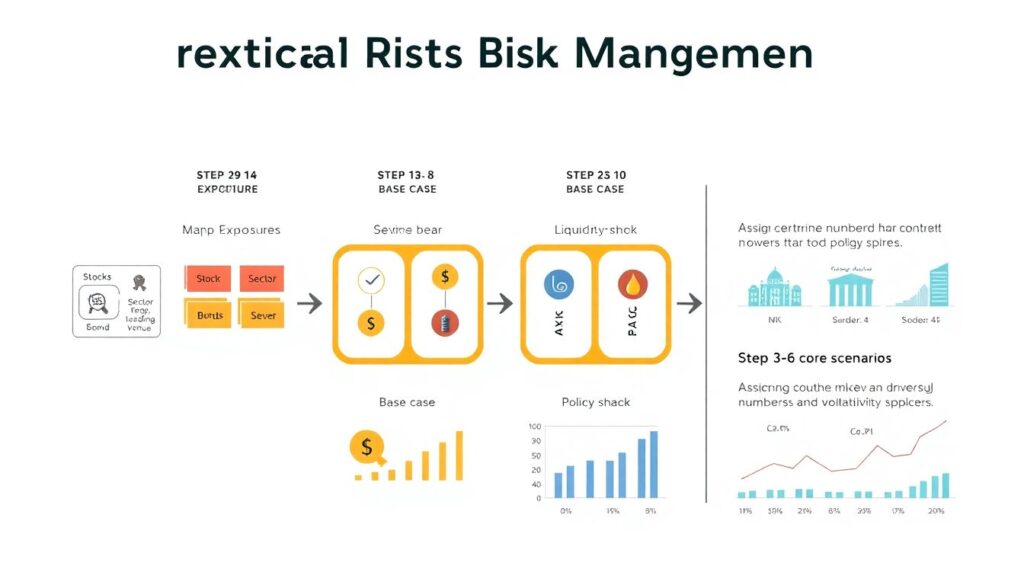
A practical workflow usually looks like this: first, map your exposures by asset, sector, venue, leverage and counterparty. Second, define 3–6 core scenarios: base case, optimistic, severe bear, liquidity shock, policy shock. Third, assign concrete numbers to drivers: price moves, volatility spikes, fee changes, slippage. Fourth, revalue your portfolio in each scenario and track PnL, margin usage, liquidation levels and drawdowns. Finally, adjust sizing and hedges based on these findings and revisit scenarios regularly, especially after major market structure changes.
—
Using Scenarios to Design Hedges
Scenario analysis becomes powerful once you connect it to action. After mapping losses in a crash scenario, you can explore how to hedge risk in cryptocurrency trading without just “buying random puts.” For instance, you might:
– Short a correlated futures basket instead of your illiquid alt bag
– Buy out‑of‑the‑money options precisely at levels where scenarios show liquidations
– Diversify venue risk by mirroring critical positions across exchanges
The point is targeted hedging guided by quantified pain points, not blanket over‑insurance.
—
Common Beginner Mistakes
Newcomers often treat scenarios as a one‑time school project instead of a living process. Typical errors include: building only bullish and mildly bearish paths, ignoring liquidity and slippage, and assuming they can actually exit before the crowd. Another frequent trap: copying institutional templates without adapting them to a highly concentrated, leverage‑heavy personal portfolio. Many beginners also lean on free dashboards as if they were professional crypto risk analysis tools, never checking data quality or hidden assumptions baked into default models.
—
More Pitfalls to Avoid
A subtle but dangerous mistake is using inconsistent time horizons: simulating a one‑day crash on a portfolio funded with 90‑day loans, or vice versa. People also over‑trust backtests that cherry‑pick recent bull markets, forgetting how vicious multi‑month drawdowns feel. Other issues include:
– Treating stablecoins as risk‑free in every scenario
– Ignoring smart‑contract and bridge risk for DeFi positions
– Failing to model exchange failure or withdrawal freezes
Robust scenarios deliberately include messy operational and structural risks, not just price moves.
—
How to Choose an Approach in 2025
By 2025, there’s no single “best” framework; the right one depends on capital size, strategy and tooling. A small discretionary trader can do well with a lean setup: a few clear deterministic scenarios plus basic Monte Carlo runs from open‑source notebooks. A desk managing institutional cryptocurrency portfolio risk management will usually blend all three methods: deterministic shocks for communication, regime‑based stresses for governance, and probabilistic models for daily monitoring. The important part is internal consistency and regular updates, not sophistication for its own sake.
—
Trends Shaping Crypto Scenario Analysis in 2025
Two strong trends stand out. First, the integration of on‑chain and off‑chain data into unified engines, allowing scenarios to reflect liquidity pools, staking flows and derivatives simultaneously. Second, more accessible scripting layers on top of commercial crypto risk analysis tools, so analysts can encode their own assumptions instead of waiting for vendor updates. As regulation tightens and markets institutionalize, scenario analysis is quietly moving from “nice add‑on” to a core pillar of disciplined crypto trading and long‑term risk culture.
Комментарии