

Why sentiment matters in crypto (and why bias ruins it)
In crypto, sentiment moves faster than fundamentals: a single tweet, hack, or regulatory rumor can move billions in minutes. That’s why investors turned to market mood early, long before it was fashionable in equities. Forums like Bitcointalk and Reddit were primitive, but they showed that retail emotions often front-ran price. As capital flowed in after 2017, firms started building structured datasets from Twitter, Telegram, and news feeds, trying to quantify fear, greed, and apathy. The problem is that raw opinion is messy: bots distort volume, influencers create feedback loops, and analysts cherry-pick narratives that fit their bags. Modern sentiment work in crypto is really about one thing: separating signal from your own biases, so you don’t mistake loud noise for informed conviction or confuse your hopes with what the crowd actually believes.
Seasoned quant researchers will tell you that sentiment is not a magic oracle; it’s just another input into a broader framework. Historically, the biggest edge came when sentiment data was rare and markets were thin. Today, everyone sees the same headlines, so naïve “Twitter is bullish, buy” approaches get arbitraged away quickly. Where sentiment still shines is at extremes and inflection points: panic during crashes, complacency near tops, or sharp divergence between narrative and on‑chain reality. To use it responsibly, you need clear hypotheses, rigorous validation, and a willingness to accept when crowd mood contradicts your thesis. Otherwise, you risk building beautifully engineered dashboards that simply mirror your pre‑existing beliefs back to you.
Core principles: using sentiment without fooling yourself

The first principle experts emphasize is separation of roles: data collection, modeling, and interpretation must be treated as distinct steps with explicit assumptions. When everything is blended, confirmation bias sneaks in unnoticed. You start dropping data sources that “don’t feel right” or overfit models to periods where your favorite coins performed well. A better approach starts with defining what you’re trying to measure: fear versus optimism, attention versus conviction, or short‑term hype versus long‑term belief. Each requires different inputs and timeframes. On top of that, senior researchers insist on maintaining a bias log: every time you exclude data, change labels, or adjust features, you document the reason before you check results. It sounds tedious, but it’s one of the few practical defenses against self‑deception.
Another key principle is triangulation. No serious team relies on a single sentiment feed or one index of “market mood.” Instead, they blend social chatter, derivatives positioning, and realized flows, then look for alignment or tension between them. For example, if Twitter looks euphoric but perpetual funding rates are stable and spot volumes are muted, you might be seeing mostly bots or retail noise. By contrast, if Reddit turns bearish, funding flips negative, and stablecoins flow into exchanges, that confluence is harder to dismiss. Triangulation also helps neutralize biases baked into individual sources: influencer‑dominated platforms overweight big accounts, while smaller communities capture localized micro‑sentiment. When signals disagree, the default should be caution, not over‑interpretation; often, the right move is to down‑weight sentiment entirely until the picture becomes clearer.
Tools, indicators, and the trap of “easy” dashboards
Most people first encounter sentiment through slick dashboards and colorful gauges, but experienced analysts treat them as starting points, not decision engines. Off‑the‑shelf crypto sentiment analysis tools compress massive data flows into single scores that look objective yet hide fragile assumptions: language models trained on non‑crypto text, poor bot filtering, or naive weighting of hashtags. Experts recommend interrogating any vendor: What are the raw sources? How is spam removed? Are large accounts over‑weighted? How often are models re‑trained? If answers are vague, assume the product is closer to marketing than research. Even with good tooling, sentiment should never run unattended; you still need to sanity‑check spikes against actual news, on‑chain events, and liquidity conditions, or you’ll mistake coordinated shills for genuine shifts in crowd psychology.
When people talk about the best crypto market sentiment indicators, they often mean composite indices that mix price volatility, volume, social data, and derivatives metrics. These can be useful, but only if you understand their construction and limitations. An index heavily driven by price volatility can look “fearful” during healthy pullbacks and falsely contrarian at the worst possible time. Veteran traders therefore break sentiment down into layers: attention (mentions, clicks), stance (bullish versus bearish language), and positioning (funding, options skew, long‑short ratios). Indicators at each layer are inspected separately before being synthesized into a view. This structured decomposition makes it harder for your brain to jump from “mentions up” to “bullish conviction” without evidence and reduces the risk of acting on vague, emotionally charged dashboards.
From research to trading: using sentiment in practice
Applying sentiment in real decisions forces you to answer a tough question: is this information leading, coincident, or lagging? Many traders learn the hard way that social buzz often lags early price moves, especially in thin altcoins. To avoid that trap, professionals backtest how to use sentiment data for crypto trading across multiple cycles, checking whether extreme readings reliably precede, accompany, or follow large moves. They also define regime filters, for example, using sentiment only during high‑liquidity hours or excluding periods of major macro news. The practical rule that comes up in interviews with funds is simple: if a sentiment signal doesn’t hold up when you shuffle time windows, assets, and volatility regimes, you treat it as narrative fuel, not a trading edge.
Building robust crypto trading strategies based on sentiment analysis almost always involves combining qualitative review with quantitative rules. A common institutional workflow looks like this: quants maintain a library of sentiment factors with documented performance; discretionary PMs review aggregated outputs alongside order books and on‑chain dashboards; risk managers enforce caps on how much exposure can be justified by sentiment alone. Experts insist on one additional safeguard: post‑trade attribution. After each trade, teams record how much weight they gave sentiment versus fundamentals, technicals, or flow data, then review outcomes monthly. This feedback loop quickly exposes where bias creeps in: perhaps you’re over‑reacting to negative headlines in coins you dislike, or selectively trusting bullish social data for projects you already hold, even when models say otherwise.
AI, automation, and new sources of bias
The rise of AI sentiment analysis for cryptocurrency markets promised a cleaner, more scalable read of crowd mood, but it also introduced subtler forms of bias. Language models can misinterpret crypto‑native slang, underestimate sarcasm, or systematically mislabel aggressive trading banter as fear. They also inherit biases from training data that is often dominated by non‑financial text. Senior data scientists address this by building domain‑specific lexicons, manually labeling edge cases, and running regular audits where human reviewers check model outputs on fresh samples. Another practical safeguard is model diversity: running more than one classifier, trained on different datasets and architectures, then focusing on stable patterns they agree on. Automation should narrow the space of plausible interpretations, not give you an excuse to stop thinking critically about what the crowd is actually saying.
Expert teams also warn against “automation complacency”: the tendency to trust neatly packaged AI scores more than messy raw data. To counter this, they keep a habit of periodically going back to source: reading full Reddit threads, joining Discord channels, or observing Telegram groups in real time during market stress. This qualitative immersion serves as a calibration check on their models: if the score says “moderate fear” but the live chat looks like capitulation, something is misaligned. In addition, governance processes matter: who is allowed to tweak sentiment models, on what evidence, and how are changes rolled out? Treat model updates like code deployments with versioning and rollback plans. Otherwise, you’ll never know whether performance changes are due to markets evolving or quiet shifts in how sentiment is measured.
Common misconceptions and how professionals avoid them
One of the most dangerous misconceptions is that sentiment is primarily about prediction. Seasoned researchers see it more as context: it explains why certain price moves accelerate or stall, highlights crowded trades, and reveals asymmetric reaction risk to new information. Another myth is that bullish sentiment is always a sell signal and bearish mood is always contrarian bullish. In practice, extended bull runs have stayed euphoric for months, and deep bear markets remained despondent despite improving fundamentals. Professionals therefore anchor sentiment to structural variables: funding costs, realized volatility, liquidity depth, and macro backdrop. Extreme optimism in a regime of tight liquidity is very different from the same readings during a QE‑driven boom. Stripping away these nuances to chase simple “buy fear, sell greed” rules is just bias dressed up as sophistication.
A second widespread error is treating social sentiment as representative of the entire market. Public platforms heavily overweight retail voices, English‑speaking communities, and specific geographies, while large holders often express their views through flows, not posts. To correct for this, experienced desks align social metrics with on‑chain and exchange data: stablecoin inflows, large block trades, and changes in open interest by size bucket. If Reddit is euphoric but big wallets are quietly distributing, they trust the latter more. Finally, many beginners overlook the meta layer: once everyone watches the same sentiment dashboards, they become part of the game, used for spoofing and crowd herding. The most durable edge comes from understanding not just what the crowd feels, but how other participants are likely to react to that emotion under different stress scenarios.
Bringing it together: a bias‑aware sentiment playbook
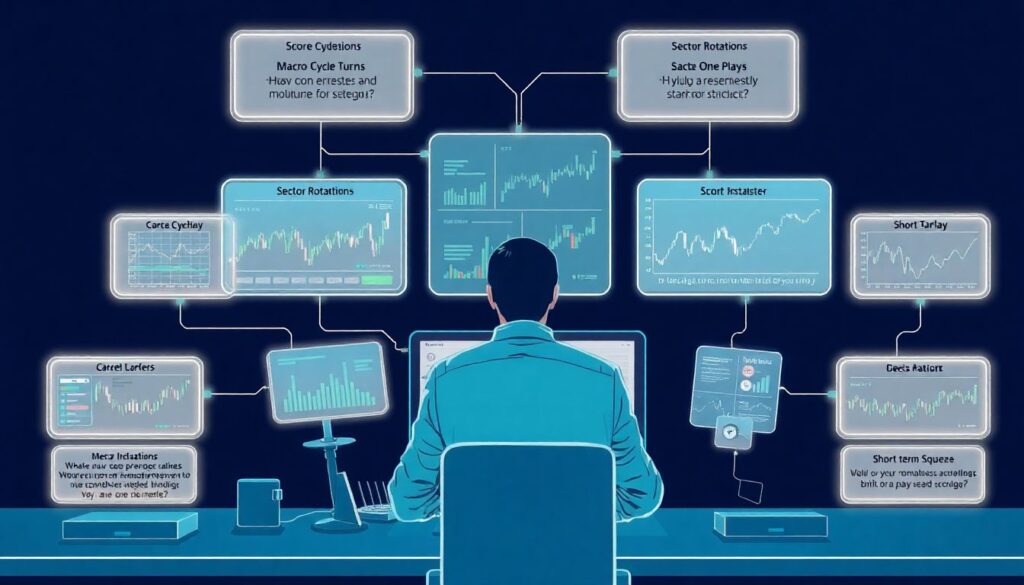
Putting all of this into a workable routine means accepting that there is no plug‑and‑play shortcut. A practical, bias‑aware playbook starts with clearly scoped questions: Are you tracking macro cycle turns, sector rotations, or short‑term squeezes? Next, you assemble a minimal, well‑understood stack: a few vetted data sources, documented processing steps, and a small set of interpretable indicators instead of a jungle of overlapping scores. You periodically stress‑test your framework across different regimes, logging where it fails and resisting the urge to immediately “fix” every blemish via backfitting. Above all, you treat your own intuition as just another signal that must be tested, not obeyed. When your gut and your models disagree, you write down why, decide deliberately, and review the outcome later. That habit, more than any fancy dashboard, is what keeps sentiment useful instead of turning it into an echo chamber for your biases.