

Why performance attribution in crypto finally matters in 2025
Until a few years ago, most crypto investors were happy just knowing their PnL: “Up or down? How much?”
In 2025, that’s not even close to enough.
When you run a serious crypto portfolio — whether as an individual quant, a family office, or an institution — you need to know *why* you earned or lost money. That’s exactly what performance attribution does: it takes your total return and explains where it actually came from.
Not just “we made +18% this quarter,” but:
– Was it market beta to BTC and ETH?
– Was it idiosyncratic altcoin selection?
– Was it leverage and derivatives?
– Was it yield strategies, staking, or funding arbitrage?
– Or… was it just random volatility you happened to surf?
Let’s unpack how to do performance attribution in crypto without turning it into a 300-page quant textbook.
The basics: what “performance attribution” means in crypto
From “number go up” to structured explanations
In traditional finance, performance attribution is old news. Equity and bond managers have been decomposing returns for decades — sector vs stock selection, duration vs credit, currency vs local returns, and so on.
Crypto is catching up fast.
Performance attribution in crypto portfolios typically tries to answer four core questions:
– How much of my return was just overall crypto market exposure?
– How much came from my specific asset picks?
– How much came from leverage, derivatives, and complex structures?
– How much was due to timing and active decisions (rebalancing, hedging, rotating narratives)?
Different managers slice it differently, but the logic is always the same: break total return into understandable, *actionable* components.
Why crypto attribution is harder than in equities
Crypto adds a few complications that make attribution more interesting — and trickier:
– 24/7 markets and high intraday volatility
– Dozens of exchanges with different liquidity, fees, and slippage
– On-chain positions (staking, LPing, restaking) mixed with off-chain CEX balances
– Derivatives (perps, options, structured products) glued on top of spot
– Multiple benchmarks: BTC, ETH, “overall crypto market,” or custom indices
So a clean guide to performance attribution in crypto portfolios needs to account for all of that, not just end-of-day prices from a single venue.
The core components of crypto performance attribution
1. Market (beta) versus selection (alpha)
This is the starting point: how much of your return is simple exposure to the market vs your actual skill.
In practice:
– Market / beta effect: How you performed just by being exposed to broad crypto risk (e.g., BTC + ETH, or a total market index).
– Selection / alpha effect: The extra return you made (or lost) by deviating from that broad market.
Example:
If the overall market (your benchmark) is +20% and your portfolio is +30%, you can’t call the whole +30% “alpha.” A large chunk is just beta to the market; maybe genuine selection alpha is only +5–8% after adjusting for risk.
In 2024–2025, more institutional allocators are asking how to measure crypto portfolio manager performance exactly along these lines. A 50% year looks very different if the benchmark did +45% versus +5%.
2. Asset, sector, and narrative attribution
Crypto isn’t just “coins.” It’s:
– L1s vs L2s
– DeFi vs infra vs gaming
– RWA tokens vs meme coins vs restaking plays
Attribution here asks: which *buckets* drove performance?
A typical breakdown might include:
– Sector effect: You overweighted DeFi and underweighted memecoins. Did that help or hurt?
– Asset effect: Within DeFi, was it a good idea to own that specific protocol token instead of its competitors?
– Narrative effect: Did you correctly rotate from “L2 season” to “restaking season” before or after the move?
This is where a good crypto portfolio tracking and attribution platform becomes indispensable. Manually tracking 40 tokens, 5 sectors, 3 L2 ecosystems, and multiple staking strategies in spreadsheets quickly becomes unmanageable.
3. Derivatives, leverage, and hedging
Crypto portfolios rarely stop at spot holdings. Perps, futures, options, and structured products often play a key role.
Attribution should isolate:
– Leverage impact: How much extra return (or extra loss) came from leverage?
– Hedge impact: Did your hedges protect you or just eat carry?
– Basis & funding impact: Did you earn (or lose) from funding rates and basis trades?
For example, imagine you ran neutral delta but long funding-basis arbitrage. Total PnL might have been modest, but attribution might show:
– +6% from basis and funding capture
– −3% from adverse exchange fees and slippage
– −1% from mis-timed hedge adjustments
That breakdown tells you much more than a simple +2% return for the month.
4. Yield, staking, and on-chain strategies
In crypto, “income” is not just coupons or dividends. It’s:
– Staking rewards
– Validator commissions
– LP fees
– Incentive programs and airdrops
– Real-yield protocols and restaking
A robust attribution approach will separate:
– Pure price return (token went from $10 to $12)
– Yield / reward return (you earned extra tokens or fees)
– Reinvestment effect (compounding of rewards and auto-staking)
In practice, a significant component of DeFi portfolios’ return in 2022–2025 came from yield rather than price appreciation. If you don’t track that separately, you’ll under- or overestimate your genuine selection skill.
Data: the unglamorous backbone of crypto attribution
Why clean data is the hardest part
In traditional securities, you often rely on a single prime broker or custodian for clean, consolidated data. In crypto, the picture is very different:
– Multiple CEX accounts (Binance, OKX, Coinbase, Bybit, etc.)
– On-chain wallets across multiple networks (EVM, Solana, Cosmos, etc.)
– Complex DeFi positions (LP tokens, vault shares, restaking wrappers)
– OTC deals, private rounds, vesting contracts
For accurate attribution, you need:
– Precise position history: what you held at each point in time
– Accurate pricing: including off-peak times and illiquid tokens
– Transaction-level detail: fees, slippage, funding, and rebates
This is exactly why crypto portfolio performance attribution software has become a growing product category since 2023. What was once a niche “Excel plus APIs” problem is now a full-blown infrastructure market, especially for institutions.
A quick reality check with stats (as of 2025)
Industry surveys and market research between 2023 and early 2025 suggest:
– Over 60% of crypto hedge funds now use some dedicated portfolio or risk system rather than just custom spreadsheets.
– Roughly 30–35% of institutional allocators require some form of formal performance attribution in due diligence, up from ~10% in 2021.
– Crypto data and analytics providers’ revenue has been growing at 20–30% annually, with performance and risk analytics one of the fastest-growing segments.
The bottom line: attribution moved from “nice to have” to “entry ticket” surprisingly quickly.
Practical guide: how to set up attribution for a crypto portfolio
Step 1: Define your benchmark and risk model
Before any math, you need a reference point. Without a benchmark, everything looks like alpha.
Some common choices in 2025:
– Simple benchmarks:
– 100% BTC
– 50% BTC / 50% ETH
– Market-cap weighted indices:
– Top 10 or Top 50 coins
– Custom indices ex-stablecoins
– Strategy-aligned benchmarks:
– Only DeFi tokens
– Only L1/L2 infrastructure
– Benchmarks with a target volatility level
For institutional managers, how to measure crypto portfolio manager performance usually starts here: pick a benchmark that reflects the mandate and then decompose active returns relative to it.
Step 2: Segment your portfolio into meaningful buckets
Next, decide how granular you want to be. Start simple, refine over time.
You might group by:
– Asset type: BTC, ETH, majors, long-tail alts
– Sector: DeFi, infra, gaming, memes, RWA
– Strategy: spot, perps, options, yield strategies, liquidity provision
– Region / exchange cluster: centralized exchanges vs on-chain vs OTC
For most managers, the best tools for crypto portfolio performance analysis allow flexible grouping rules so you can look at the same portfolio from different angles (by strategy, by sector, by chain, by risk bucket) without rebuilding everything from scratch.
Step 3: Choose your attribution methodology
You don’t need to reinvent finance here. Crypto can leverage approaches from equities and multi-asset portfolios, like:
– Brinson-style attribution for spot and sector effects
– Factor-based attribution using risk factors (market, size, DeFi beta, etc.)
– Transaction-based attribution that decomposes each trade’s contribution, including fees and slippage
In practice, most managers mix:
– A relatively standard Brinson-like framework for asset and sector allocation
– A factor model for broader market exposures (e.g., BTC beta, DeFi factor, L2 factor)
– A separate module for derivatives and yield strategies
Step 4: Integrate tools instead of fighting with spreadsheets
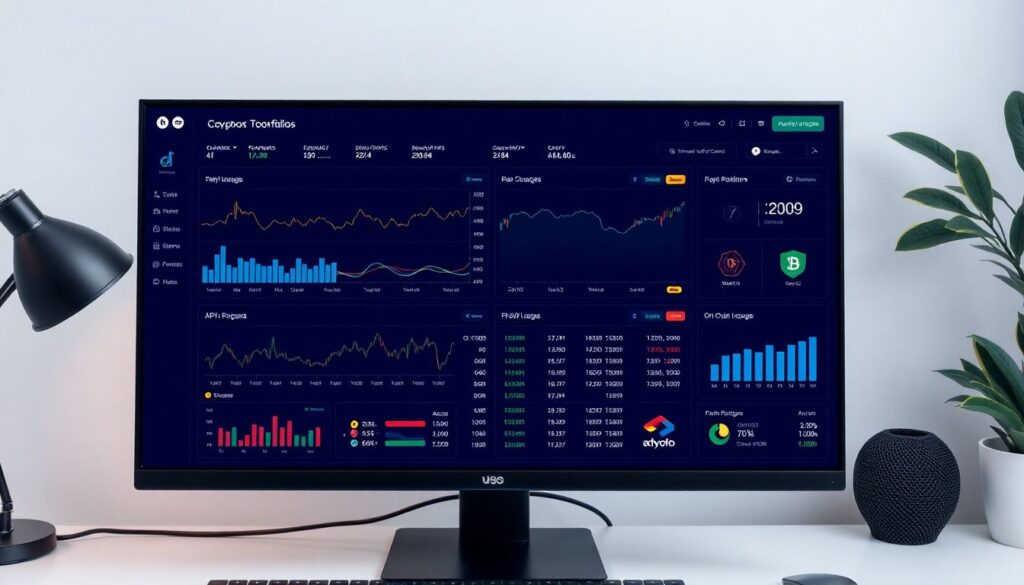
For a small personal portfolio, a spreadsheet might still work. But once you cross, say, 100–200 trades per month or a few dozen positions across multiple venues, it becomes fragile.
A modern crypto portfolio tracking and attribution platform typically offers:
– API and on-chain wallet integrations
– Position and PnL reconciliation across exchanges and protocols
– Multiple attribution views (asset, sector, strategy, factor)
– Exportable reports for LPs, ICs, auditors
Many of the institutional crypto portfolio analytics solutions launched since 2022 have converged on this model: a unified dashboard for performance, risk, and attribution, aimed at hedge funds, prop firms, and asset managers that need audit-ready data and documented methodology.
Economic and strategic value of attribution
Better capital allocation and risk budgeting
Attribution is not an academic exercise. Done right, it feeds directly into how you allocate capital.
Three concrete ways it helps:
– Capital reallocation: If attribution shows most of your alpha is coming from DeFi options strategies and very little from meme coin punts, you know where to concentrate your risk.
– Risk budgeting: You can size strategies based on their historical contribution to risk-adjusted returns, not just their absolute PnL.
– Cost control: Transaction-based attribution can show when high turnover and fees are quietly eating into your edge.
Over time, a manager with clear attribution can evolve from a “collection of trades” to a coherent portfolio of *validated* edges.
LP relationships and fundraising
As more institutional capital flows into digital assets, the ability to articulate your performance story has real economic value.
– LPs want to know: Is this manager just long beta, or is there genuine, repeatable alpha?
– Consultants and boards ask detailed questions about drawdowns, factor exposures, and regime sensitivity.
– Regulators and auditors are increasingly focused on how risk is measured and communicated.
Managers who can show robust performance attribution — backed by credible crypto portfolio performance attribution software — have an easier time raising sticky capital in 2025 than those who rely on “trust me, I’m a genius” narratives.
Impact on the wider crypto industry
As attribution gets more sophisticated, it changes behavior across the ecosystem:
– Exchanges and venues: pressured to improve data quality, historical fills, and fee transparency, because poor data breaks attribution models.
– Protocols: more conscious of how their tokens and yield structures show up in institutional analytics (e.g., making on-chain position data easier to index and interpret).
– Service providers: growth of third-party risk models, benchmarks, and factor libraries specific to digital assets.
The net effect: the crypto asset class slowly begins to look and behave more like a mature part of global capital markets, instead of a loosely organized casino.
Forecast: where crypto performance attribution is heading (2025–2030)
Trend 1: From single-asset beta to multi-chain, multi-factor models
By 2030, it’s unlikely that “BTC beta + some noise” will be the standard narrative. The market is already evolving toward richer factor structures, including:
– L1 vs L2 beta
– DeFi vs CeFi vs infra factors
– Regulatory regime factors (US-centric vs global flows)
– Liquidity and funding stress factors
We should expect more Factor-style models for crypto, similar to equity styles (value, momentum, quality), to be embedded directly into attribution tools and risk systems.
Trend 2: On-chain data fully integrated into attribution
Right now, many managers still treat on-chain DeFi strategies as a black box: “We farmed this vault and got +12%.” That won’t cut it for long.
By the late 2020s, a standard attribution report for a professional manager will likely show:
– Performance broken down by protocol and vault
– Risk contributions from smart contract clusters and bridge exposure
– Yield decomposed into fees, incentives, and structural edges
We’re already seeing early versions of this in some advanced institutional crypto portfolio analytics solutions that combine CEX data with deep on-chain parsing.
Trend 3: AI-enhanced, scenario-based attribution

As data volumes explode, AI and machine learning will likely be deployed not just for trading, but for attribution and risk explanation.
You can expect:
– Dynamic clustering of assets and strategies based on behavior, not just labels
– “What-if” attribution: how your portfolio would have behaved under historical stress scenarios (LUNA, FTX, March 2020, etc.)
– Automated narrative generation: machine-written performance summaries that LPs can read without needing to parse raw numbers
This won’t replace human judgment, but it will make complex attribution digestible and timely.
Trend 4: Attribution as part of regulatory and compliance standards
As crypto integrates with mainstream finance, regulators will push for:
– Standardized reporting of performance and risk
– Clear documentation of methodology
– Independent verification of data and calculations
For serious managers, having battle-tested attribution systems will move from competitive advantage to bare minimum compliance — very much like it did in traditional hedge funds and asset managers.
How to start today, without a PhD or a quant team
If you’re running or planning to run a crypto portfolio in 2025, you don’t need to implement every advanced concept on day one. A practical approach could look like this:
– Phase 1: Basic hygiene
– Consolidate all your data (exchanges + wallets)
– Track position history, fees, and PnL reliably
– Benchmark yourself versus a simple BTC/ETH or market-cap index
– Phase 2: Simple attribution
– Split returns into market beta vs selection
– Break down by sector and strategy
– Track contribution from derivatives and yield separately
– Phase 3: Institutional-grade
– Introduce factor models
– Integrate on-chain analytics
– Formalize methodology and reporting for LPs and regulators
The good news: you don’t have to build all the plumbing yourself. A new generation of best tools for crypto portfolio performance analysis has emerged specifically to handle the annoying parts — data ingestion, reconciliation, factor models — so you can focus on actual investment decisions.
Closing thoughts
Performance attribution in crypto portfolios is no longer academic theory or a luxury for big firms. In 2025, it’s becoming the language of professional crypto investing.
Whether you’re a solo quant, a DAO treasury, or a multi-billion AUM manager, the ability to say *why* you made or lost money — in a structured, repeatable way — is turning into a core competency.
Those who adopt proper attribution early will:
– Make better allocation decisions
– Communicate more clearly with stakeholders
– Survive regime shifts and regulatory scrutiny more easily
And over the next five years, as crypto continues to merge with traditional finance, the gap between “we have clean attribution” and “we’re guessing” will likely define who’s treated as a serious market participant — and who isn’t.