
Why data licensing in crypto research suddenly got complicated

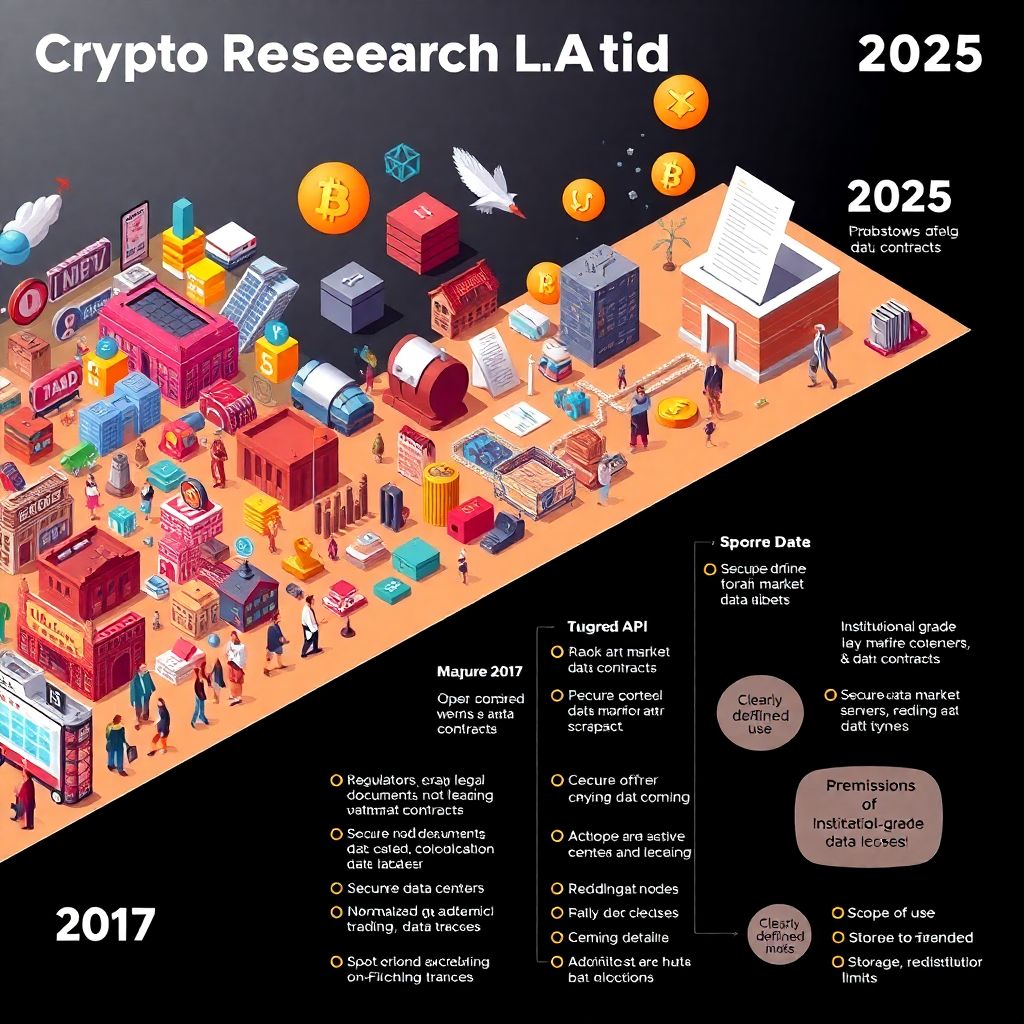
If you were doing crypto research back in 2017–2019, you probably remember the wild west: dozens of free APIs, barely any rate limits, and essentially zero conversations about licensing. Fast‑forward to 2025 and the mood has changed dramatically. Exchanges delist coins overnight, regulators ask who owns which dataset, and even open‑source projects worry about whether they can legally redistribute candles or on‑chain traces. What used to be “just grab an API key and go” has turned into careful navigation of contracts, terms of service and jurisdictional quirks. The upside is that the ecosystem has matured: professional crypto market data licensing is now a real discipline, and if you understand its rules you can build much more robust, publishable, and defensible research.
How we got here: a short history of crypto data and licenses

In the early Bitcoin era, practically all market data came straight from individual exchanges, usually via public websocket or REST endpoints. Nobody talked about licensing because nobody thought of tick data as an asset class; the focus was on growing liquidity. As trading volumes ballooned, data started to acquire real monetary value. By the DeFi summer of 2020 and the NFT wave of 2021, both centralized and decentralized venues realized that historical order books, perpetual swaps funding rates and detailed on‑chain traces could be monetized just like equities or FX data. At the same time, hedge funds and high‑frequency shops brought their expectations from traditional finance, asking for SLAs, redistribution clauses and clear rights for internal models, pushing vendors to formalize their crypto market data licensing frameworks instead of relying on fuzzy “fair use” interpretations of web APIs.
Basic principles: what “licensed” actually means in crypto
At its core, licensing answers three questions: who can use the data, for what, and how far it can travel. In crypto, the “who” ranges from lone PhD students to large quant shops, DAO research committees and on‑chain analytics startups. The “what” might cover non‑commercial academic work, internal trading models, client reports or resale of enriched feeds. Finally, the “how far” points to redistribution: can you share raw ticks, only aggregates, or just derived signals? In 2025 most serious providers spell this out explicitly, often with separate tracks for research, commercial, and platform use. A cryptocurrency data feed license for research will typically allow you to download large volumes, build models, and publish charts, but will stop you from repackaging the raw stream into a competing data product or embedding it into a public API that anyone can scrape.
Key dimensions of a crypto data license
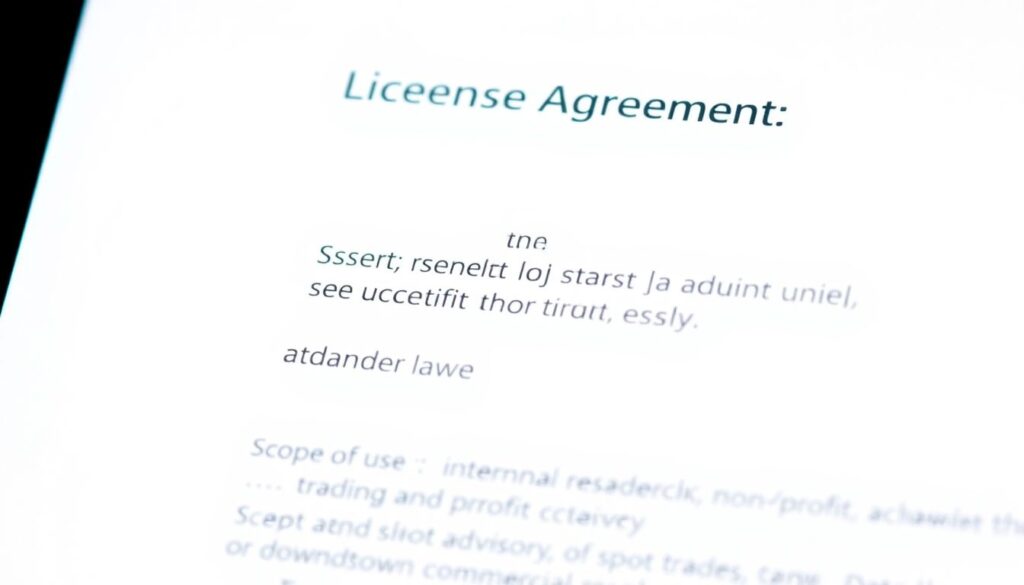
When you read a license today, you usually see the same recurring dimensions, even if the wording differs across providers and exchanges:
– Scope of use: internal research only, academic non‑profit, trading and execution, client advisory, or downstream commercial resale.
– Data types: spot trades, order book snapshots, derivatives, options, NFT floor prices, DeFi lending, on‑chain traces and address labels.
– Technical permissions: storage duration, archival rights, ability to backfill using a historical crypto data API for quantitative research, and whether you may cache data on third‑party cloud infrastructure.
These elements might sound bureaucratic, but they directly control what you can do with your models. For example, if your license bans redistribution of back‑adjusted OHLCV data, posting your clean price series to a public GitHub repository might violate terms, even if your intention is purely scientific or educational.
Modern trends in 2025: from “free APIs” to data as regulated infrastructure
The biggest shift of the last few years is that regulators now see crypto market structure as close cousins to traditional exchanges. As the EU’s MiCA regime and US enforcement actions bite, exchanges and aggregators are being pushed to prove that their data is consistent, timestamped correctly and not selectively disclosed. This naturally feeds into licensing: providers want explicit contracts that say when they must deliver, what happens during outages, and how liability is limited. At the same time, asset managers integrating tokenized treasuries, RWA pools and institutional DeFi need audit trails to show that their backtests used legally obtained datasets. Data vendors respond by offering tiered licenses: basic research packages for universities, enhanced feeds for registered funds, and bespoke “reg‑ready” bundles where every dataset can be traced to a specific licensed blockchain data provider for analytics with clear provenance and retention rules.
The rising role of specialized data vendors
Where early crypto researchers stitched together their own infrastructure from dozens of exchange endpoints, 2025 is dominated by aggregators and index‑grade data companies. A crypto market data vendor for institutional research might maintain its own colocation nodes, normalize trade IDs across venues, detect wash trading, and attach standardized metadata for rolling audits. For a quant team, the decision is no longer “free Binance API vs paid feed”, but “cheap, opaque raw data vs curated, legally clean history”. This has changed the economics: some vendors now offer “research‑only” pricing with generous quotas but strict rules against real‑money trading, while others allow full commercial use but charge steeply for low‑latency and tick‑level depth.
Finding and using historical data without stepping on landmines
For most researchers, historical time series are the starting point: prices, volumes, volatility, funding, liquidations and on‑chain state at fine granularity. In 2025 there are dozens of services advertising themselves as a historical crypto data API for quantitative research, but their licensing approaches differ wildly. Some treat their API as a public commons with permissive terms; others assert strong proprietary rights even over data collected from public blockchains, restricting redistribution of coin‑level flows or address clusters. Navigating this landscape means reading not just marketing pages, but the actual terms of service, privacy policies and sometimes separate “research addenda”. Universities increasingly negotiate site‑wide agreements so that students and faculty avoid grey‑area scraping and can publish confidently, while independent quants often use hybrid stacks: free sources for hypothesis generation, then licensed feeds for production‑grade backtesting.
Practical workflows for compliant crypto research
To keep your research workflow clean in 2025, it helps to treat legal constraints the same way you treat model assumptions: explicit and documented. A simple approach looks like this:
– Maintain a short “data registry” file in your repo listing each dataset, its source, the applicable license type, and any redistribution or publication limits.
– When building dashboards or notebooks that will be public, ensure that they either aggregate metrics beyond what the license considers “raw” data or rely only on sources whose terms allow republication of underlying series.
– For joint projects with industry partners, ask upfront whether the shared datasets are covered by a crypto market data licensing agreement that permits your intended academic or open‑source outputs.
This light‑weight discipline avoids the common scenario where a project matures, a paper is nearly ready, and someone finally notices that the flashy backtest or richly annotated transaction graph is built on top of a dataset whose vendor forbids public sharing of even partial excerpts.
Examples of licensing models in real‑world crypto research
In applied work, licenses are not abstract; they show up as very concrete constraints on what a lab, DAO or firm may do. Consider an academic center studying MEV and sandwich attacks on DEXes. They might combine public node data with a grant‑funded package from an on‑chain analytics firm that provides labeled mempool and validator behavior. The grant agreement could specify that raw transaction‑level data stays on secured servers, while only aggregated statistics and anonymized examples appear in publications. A different example is an asset manager backtesting a cross‑exchange arbitrage strategy: they might sign a cryptocurrency data feed license for research with a vendor, granting rights for internal strategy development but forbidding use of the same API keys in production trading bots, forcing an upgrade to a commercial license for live deployment.
Research collaborations and shared infrastructure
In 2025, collaborative crypto research often lives in shared notebooks, public repos and multi‑institution consortia. Licensing choices ripple through all of that. A DAO‑funded working group might sponsor a shared data lake for its contributors, but to stay compliant it needs to ensure that its agreements with upstream exchanges and data vendors permit this kind of redistribution inside a loosely defined “community”. Similarly, cross‑university collaborations may pool budgets to pay a single vendor, only to discover that their contract technically prohibits cross‑institution data sharing. Successful projects now treat the data layer as shared infrastructure: they negotiate licenses that explicitly list participating institutions and include language permitting cloud‑based collaboration tools, rather than relying on informal “everyone uses the same password” arrangements that are harder to justify if the work later leads to a high‑profile publication or a spin‑out company.
Frequent misconceptions about crypto data licensing
One of the most persistent myths is that “blockchain data is public, so nobody can license it”. It is true that base‑layer transactions and state are openly readable, but value in 2025 lies in cleaned, indexed, labeled and correlated data products. Providers do not claim ownership over raw bytes; they license the packaged service and associated intellectual effort. Another misconception is that “non‑commercial equals free”. Many vendors differentiate academic from commercial use, but academic does not automatically mean cost‑less. Some offer discounted or sponsored access under strict conditions, while others treat hedge‑fund‑adjacent labs and industry‑funded chairs as commercial users. Finally, researchers sometimes assume that switching from raw download to a charting interface bypasses licensing, but screenshots and exports from those tools are often covered by the same terms, especially once you start embedding them in widely distributed reports.
Why “everyone else is doing it” is a weak defense
A subtler misunderstanding stems from social proof. When GitHub is full of repos with bundled historical tick data, or Kaggle hosts datasets scraped from major exchanges, it is tempting to treat that as implicit permission. In reality, most exchanges’ terms of service still restrict mass scraping, bulk redistribution and resale, even if enforcement has historically been light. As regulators pay more attention to market data integrity and systemic risk in crypto, vendors are under pressure to show they have tried to protect their commercial rights consistently. This does not mean every small research project will be targeted, but counting on “they won’t notice” is a fragile strategy for anyone building a serious, long‑lived research program or a product that might spin out of it. A modest investment in understanding and aligning with licenses is usually cheaper than refactoring an entire data stack after a takedown notice.
Balancing openness, innovation and compliance in 2025
What makes navigating data licensing in crypto research tricky today is that two cultures collide: the open‑source, fork‑first ethos of Web3 and the contract‑heavy, risk‑managed tradition of institutional finance. The frontier in 2025 is about reconciling them rather than letting one extinguish the other. We see more vendors adopting transparent “research charters”, DAOs funding open datasets with explicit permissive licenses, and regulators signaling that they value both innovation and traceable accountability. For individual researchers and teams, the path forward is pragmatic: treat data rights as part of your methodology, pick providers whose terms match your ambitions, and document what you can and cannot share. That way, when your results begin to matter—to journals, to investors, or to the protocols you study—you are not only methodologically sound but also standing on solid legal and ethical ground.