

Why measuring on‑chain governance effectiveness actually matters in 2025
If you work with DAOs or protocol governance in 2025, you’ve probably noticed a shift: raw decentralization is no longer enough, investors and contributors expect evidence that the system actually works. That means you can’t limit yourself to “we have token‑weighted voting and a forum” and call it a day. You need a practical way to measure outcomes: are proposals high quality, are decisions executed, does the protocol evolve in the right direction, and are contributors sticking around? Measuring the effectiveness of on‑chain governance is about turning those fuzzy questions into observable patterns. Instead of obsessing purely over vote counts, you’ll be looking at participation behavior, proposal lifecycle health, execution reliability and, increasingly, whether governance decisions correlate with protocol resilience, revenue, or user growth over time.
Necessary tools and data sources for on‑chain governance analysis

To move from vibes to evidence, you’ll need a basic toolkit. At the core are on-chain governance analytics tools that can pull data from smart contracts, decode proposal events and track voting histories across time. In 2025, many teams combine a general‑purpose blockchain data indexer or subgraph with a specialized dao governance monitoring platform tailored to their governance framework (Governor, OpenZeppelin, Cosmos SDK, Substrate, etc.). On top of that, you typically add spreadsheet or notebook environments for quick experiments, plus a more polished on-chain governance dashboard software instance for stakeholders who just want to see key indicators at a glance. When your DAO or protocol reaches a certain size, it also becomes common to bring in blockchain governance consulting services to help design metrics frameworks and validate your assumptions, especially if you’re aligning governance with token economics, treasury risk management or regulatory expectations.
Defining what “effective” governance means for your protocol
Before you dive into dashboards, you need a local definition of success. Different systems have different goals: a DeFi protocol might care about upgrade agility and risk control, a public goods DAO might prioritize fairness and representation, while an NFT community could focus on creator alignment and brand consistency. Start by translating your values into measurable blockchain governance performance metrics. For example, if “participation” is a value, what’s your target voter turnout relative to circulating tokens or active addresses? If “stability” matters, how often should you be changing core parameters? If “inclusiveness” is important, what minimum number of distinct delegates or voter cohorts should regularly shape outcomes? Modern practice in 2025 is to pair hard, numeric metrics with a few qualitative indicators—like periodic contributor surveys or post‑mortems after contentious votes—so that your picture of governance effectiveness reflects both data and lived experience from core contributors, delegates and long‑term tokenholders.
Step‑by‑step process: measuring governance effectiveness from scratch
Once you’ve clarified goals, you can move through a structured process instead of randomly pulling charts. A practical approach in 2025 usually looks like this:
1. Map your governance architecture. Identify which smart contracts handle proposals, votes and execution, and list any off‑chain components like forums or snapshot‑style signaling votes that feed into binding on‑chain actions.
2. Set up data ingestion. Connect your indexer or on‑chain governance analytics tools to capture proposal creation events, vote casts, execution calls and cancellations. Make sure to tag each proposal by type (parameter change, treasury spend, advisory, emergency) so you can later slice results by category.
3. Define a minimal metric set. Start with five to ten core indicators: proposal volume, approval rate, unique voters per proposal, execution success rate, average time from proposal creation to execution, and share of voting power controlled by top delegates or wallets. This gives you a baseline view before you get fancy.
4. Build an operational dashboard. Use on-chain governance dashboard software to surface these metrics for your team and community. Include time‑series graphs and simple distribution charts so trends and concentration patterns are obvious even to non‑analysts.
5. Close the loop. Schedule regular reviews—monthly or quarterly—where you walk through the numbers, compare them to your targets, and adjust governance process: quorum thresholds, delegation design, proposal templates or contributor incentives. Over time, this review cadence turns metrics into a living part of how your protocol steers itself, instead of being a one‑off analytics side project that nobody checks.
Key metrics to track and interpret in 2025
When people talk about blockchain governance performance metrics today, they are usually looking beyond surface indicators like “how many proposals passed last month.” In practice, you’ll want to track several layers. Participation metrics include voter turnout relative to eligible voting power, rate of delegation adoption, retention of active voters across multiple cycles and the share of proposals that receive comments or discussion before voting starts. Quality metrics touch proposal clarity (templates completed, presence of risk assessments), rate of proposal amendments before final vote, and proportion of proposals originating from non‑core teams. Execution metrics follow how many passed proposals are actually executed on-chain, how often timelocks expire without action, and whether execution correlates with measurable protocol outcomes like reduced exploits, more stable collateral ratios, improved fee capture or higher user retention. The trick is to avoid overfitting to a single number; effective on-chain governance is a balanced pattern of healthy participation, informed deliberation and reliable execution that aligns with your protocol’s roadmap and risk appetite.
Modern trends in on‑chain governance measurement in 2025

Compared to a few years ago, the 2025 landscape is much more data‑driven and, frankly, less naive. DAOs and protocols increasingly treat governance as a product that can be A/B tested and optimized rather than a sacred static design. One big trend is behavioral analytics: instead of just counting wallets, teams analyze voting clusters, delegate blocs and cross‑protocol governance activity to spot coordination patterns, cartels or sybil‑like behavior. Another shift is outcome‑sensitive design, where risk teams feed simulation results and stress tests directly into governance reports so voters see the projected impact of parameter changes before casting a vote. Many projects also tie governance KPIs to contributor compensation, so delegates or councils are evaluated on metrics like proposal follow‑through, responsiveness to community input and performance during market stress events. Finally, AI‑assisted tools are creeping in: summarizers that convert long forum threads into concise briefs for voters, anomaly detectors that flag suspicious voting behavior, and assistants that auto‑classify proposals, making long‑term trend analysis easier and more precise.
Using specialized platforms and external expertise
As your governance footprint grows, managing metrics with ad‑hoc scripts becomes painful. That’s where a dedicated dao governance monitoring platform adds real leverage: it can automatically consolidate data across L1s, L2s and sidechains, visualize delegation networks and integrate forum, Discord or Discourse data alongside on‑chain events. Mature projects also invest in custom modules on top of their on-chain governance dashboard software to track experiment outcomes, like how a shift from pure token‑weighted voting to quadratic or delegated voting changes participation distribution. For DAOs with complex treasuries, launching major product lines or navigating regulatory gray zones, bringing in blockchain governance consulting services can accelerate the learning curve. External experts help benchmark your metrics against peers, design stress‑tested voting procedures for crises, and align your governance data with investor reporting or legal risk frameworks—all of which makes your system more credible and robust to external scrutiny.
Troubleshooting: what to do when your metrics look bad
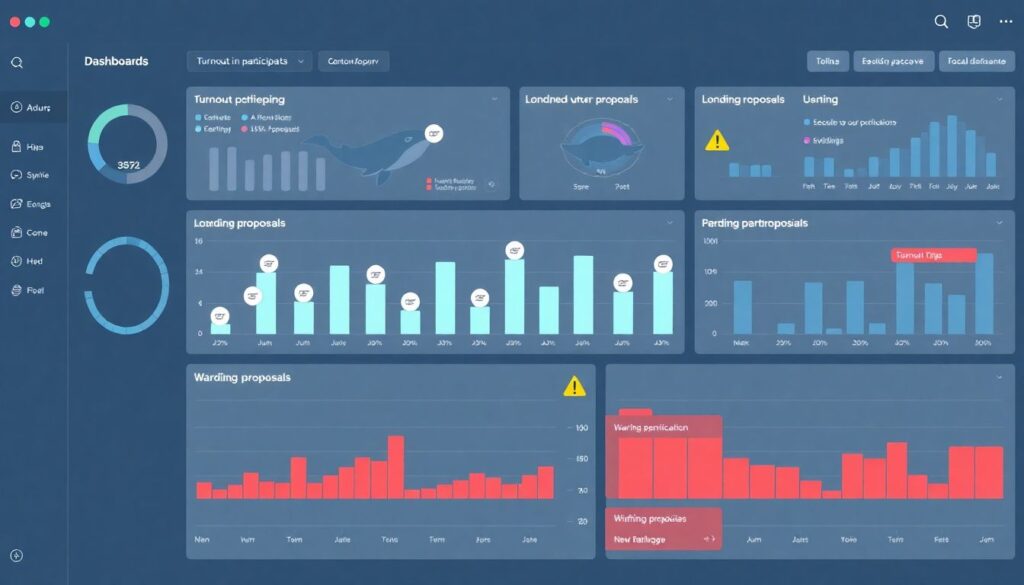
At some point, your dashboards will show something uncomfortable: turnout is collapsing, whales dominate decisions or proposals pile up without execution. The worst move is to ignore it and hope the numbers “normalize.” Instead, treat troubling signals as feedback about system design. If participation is low, investigate friction: is the voting UI clunky, are gas costs prohibitive, or is there simply no clear incentive for people to care? Consider delegation campaigns, better notifications, or batching proposals into predictable cycles so voters can plan. If you see extreme voting power concentration, dig into whether delegation campaigns are inclusive or if a few early influencers accidentally became gatekeepers; you may need clearer delegate transparency, soft term limits, or even voting power caps in future contract versions. When execution rates lag, trace where proposals die: stuck in multisigs, outdated timelocks, or overly complex implementation steps. Often, small fixes like explicit execution owners, clearer runbooks and automated reminders dramatically improve reliability. Treat every recurring metric issue as a governance design bug rather than a community failure and iterate accordingly.
Common pitfalls and how to avoid misreading the data
Even with well‑designed dashboards, it’s easy to misinterpret governance data. One frequent trap is assuming more proposals automatically mean healthier governance; in reality, a flood of low‑impact or duplicative proposals can signal a lack of curation or unclear thresholds, overwhelming voters and dragging down engagement. Another mistake is treating quorum attainment as a binary victory, without considering who actually voted—if a handful of large holders alone are showing up, you might hit targets on paper while failing at legitimacy. Short timeframes also mislead: governance often responds to market cycles, exploits or tech milestones, so you should compare metrics across enough history to understand seasonal effects and one‑off shocks. Finally, remember that some of the most important governance work happens in the “gray space” before proposals are posted—research, negotiation, risk reviews—so try to complement on‑chain numbers with signals from working group activity, call attendance and forum depth. The goal isn’t to worship metrics, but to use them as a compass that helps your community refine processes and keep power accountable over the long haul.
Комментарии