

Why a DeFi Backtesting Engine Is Your Secret Superpower
Before you try to build automated DeFi trading bot setups and deploy capital on-chain, you need one thing: a safe playground.
That playground is your backtesting engine.
A proper defi backtesting platform lets you answer a blunt question: “If I had run this strategy last year, would I be richer or broke today?” Without that answer, everything else is guesswork and hype.
Let’s walk through how to build a backtesting engine for DeFi strategies — in real‑world, practical terms — with expert recommendations, inspiring examples, and clear next steps.
Step 1: Define What “Backtesting” Actually Means for DeFi
Вacktesting in DeFi is not just “take a price chart and run some code.” Protocols behave differently from centralized exchanges. You deal with:
– AMM curves instead of order books
– Impermanent loss instead of simple PnL
– Gas fees and MEV instead of fixed commissions
– Liquidations and collateral instead of isolated positions
So your engine must simulate:
1. Prices and liquidity (e.g., Uniswap, Curve, Balancer pools)
2. Protocol logic (swaps, lending, borrowing, staking, rewards)
3. Transaction costs (gas, slippage, fees, possible failed tx)
4. Portfolio state over time (assets, debt, yields, risks)
If your backtest ignores any of these, you’re not doing DeFi backtesting; you’re doing a pleasant fantasy with nice charts.
Step 2: Get the Right On‑Chain Data (Without Drowning in It)
Here’s where many devs stall: data. On‑chain data is messy, verbose, and often incomplete if you only look at prices.
You’ll need on chain data analytics tools for defi to reconstruct what *actually* happened on-chain:
– Block explorers and APIs (Etherscan, SnowTrace, etc.)
– Node providers (Alchemy, Infura, QuickNode, Ankr) for raw logs
– Indexing solutions (The Graph, Dune, Flipside, Tenderly, Covalent)
Expert tip:
Start from events, not state. For example, for Uniswap V2/V3:
– Use Swap, Mint, Burn events to rebuild pool state
– Use block timestamps to align events with your strategy timeline
– Recompute pool reserves and prices at every interaction
You don’t need every token and every protocol from day one. Pick:
– 1–2 AMMs (Uniswap, Sushi, Pancake)
– 1 lending platform (Aave, Compound)
– 1 chain (Ethereum mainnet or a major L2)
Get that solid, then expand.
Step 3: Design the Core Architecture of Your Engine
Your backtesting engine shouldn’t be a one‑off script. Build it like a small framework you can extend later.
At a minimum, you want three core layers:
1. Data Layer
– Reads historical data from APIs, CSVs, or your own indexed DB
– Exposes clean objects: `PoolState`, `AccountState`, `MarketSnapshot`
2. Simulation Engine
– Steps through time: block by block, or “event by event”
– Applies protocol logic: swap curves, interest accrual, liquidations
– Simulates transactions and gas costs
3. Strategy Layer
– Your custom decision logic (e.g., “if APY > X, move from pool A to B”)
– Receives market state, returns “actions” (swap, borrow, repay, stake)
– Isolated from data storage so you can reuse it in live bots later
Keep the design composable. If your simulation engine is tightly coupled with one protocol, you’ll regret it when you add the second.
Step 4: Start Simple: Reproduce a Known Strategy First
Don’t begin with some exotic cross‑chain leverage‑on‑leverage thing.
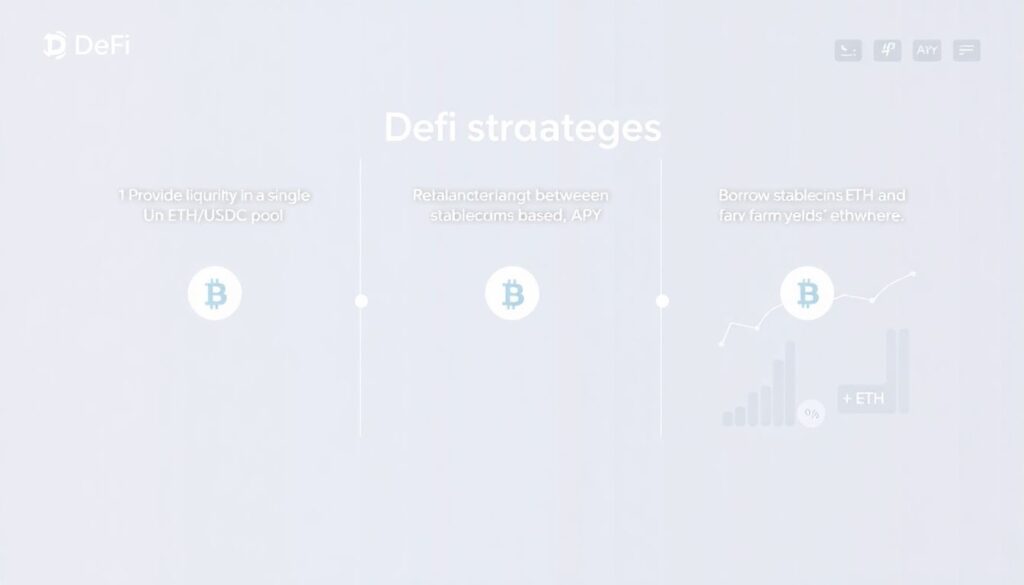
Instead, reproduce a simple, well‑understood strategy, for example:
– Provide liquidity in a single Uniswap V2 ETH/USDC pool
– Rebalance between stablecoin farms based on APY
– Borrow stablecoins against ETH and farm yields elsewhere
Aim to implement:
1. A basic portfolio: wallet + balances
2. A simple trading rule: “If price goes up X%, do Y”
3. A single protocol adapter (e.g., Uniswap client in your engine)
Once you can reproduce a known strategy result that roughly matches a public blog post or research paper, your foundation is good enough to expand.
Step 5: Plug In Risk and Portfolio Management from Day One
Many devs only track PnL. That’s a trap. What you really need is something close to the best defi portfolio and risk management tools, but for historical data.
Add risk metrics early:
– Drawdown: how much the portfolio dropped from its peak
– Volatility: how wild the returns were
– Exposure: % of portfolio in each asset or protocol
– Leverage: realized leverage, not just nominal
A minimal but meaningful metric set for your engine:
1. Total return and CAGR (compounded annual growth rate)
2. Max drawdown
3. Sharpe or Sortino ratio
4. Worst daily/weekly loss
5. Liquidity concentration (how many protocols, chains)
This doesn’t need to be fancy, but it must be consistent across strategies so you can compare apples to apples.
Step 6: Learn from Existing Crypto Backtesting Software (Without Copying It Blindly)
Traditional crypto trading strategy backtesting software like Backtrader, Zipline, or commercial platforms can teach you solid patterns:
– Event‑driven architecture (handle events like “new bar”, “order filled”)
– Order objects with clear lifecycle states
– Separation of data, execution, and strategy logic
However, these tools are usually built for order‑book CEXs, not AMMs and lending markets. Use them as conceptual inspiration, not literal templates.
Expert recommendation:
Take a day to skim through the code of an open‑source trading backtester. Notice how they:
– Represent positions
– Handle cash and collateral
– Log every order and fill
Then adapt those ideas to DeFi specifics: pool shares, LP tokens, collateral ratios, health factor, liquidations.
Step 7: Simulate Real Execution, Not Just “Magic Fills”
If your engine assumes every swap happens at the mid‑price with zero slip and gas, your results will look incredible — and completely fake.
You should:
– Use pool reserves to compute the actual AMM output via the formula (e.g., x*y=k for Uniswap V2; more complex curves for V3, Curve, Balancer)
– Add price impact based on trade size relative to liquidity
– Estimate gas usage per interaction and apply historical gas prices
– Account for transaction failure (optional but powerful)
A practical approach:
1. For each “action” from your strategy, build a virtual transaction
2. Pass it through your protocol adapter to get exact output, cost, and possible failure flags
3. Update the portfolio only if the transaction “succeeds” under your assumed conditions
You’re not rebuilding Ethereum. You’re just modeling enough of it to avoid fantasy‑level performance.
Step 8: Make the Engine Reusable for Live Bots
If you plan to build automated defi trading bot systems later, design your backtesting engine as the first step of that pipeline.
Ideal flow:
– Strategy interface is identical in backtest and live trade modes
– Only the “data provider” and “execution adapter” change
– Same code decides “what to do” both in historical and real‑time
In practice:
– In backtesting, your “execution adapter” calls the simulation engine
– In production, it signs and sends real transactions to the blockchain
– Risk limits, position sizing, and portfolio constraints stay the same
This approach saves you from rewriting logic three times and makes your research immediately deployable when results look good.
Step 9: Learn from Real‑World Success Cases
Let’s look at the *patterns* you can adopt, even if the exact projects differ.
Case 1: Yield Aggregators
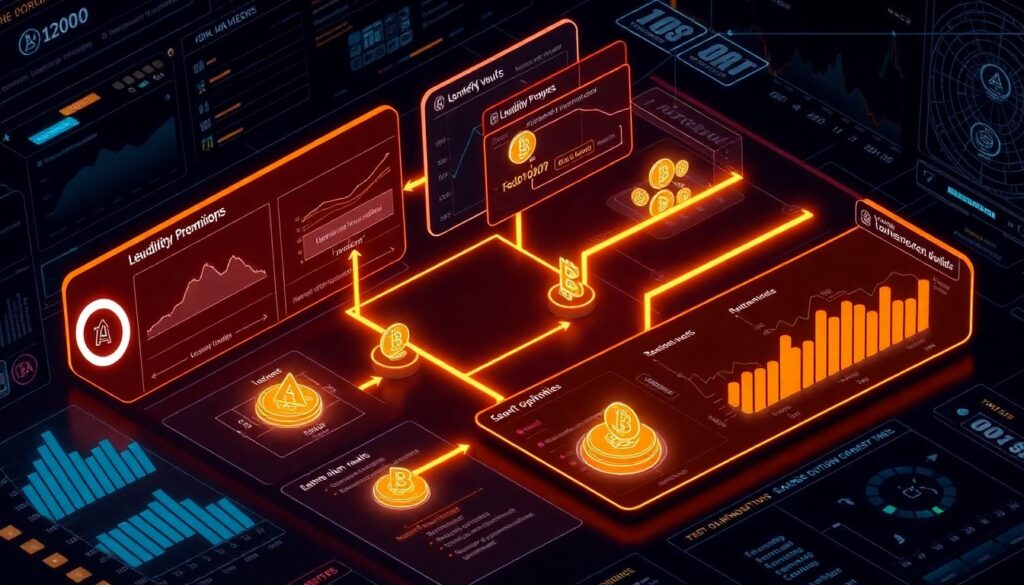
Most major DeFi yield aggregators (like Yearn‑style vaults or smaller, niche optimizers) rely heavily on simulation:
– They model different routes between lending, liquidity provision, and staking.
– They test rebalancing frequencies and conditions: “Reinvest when rewards reach X% of TVL”, “exit pool if APY falls below benchmark.”
– They simulate fee structures to understand whether a strategy is only good on paper or still attractive after performance and management fees.
The lesson for you:
Any time you think, “Let’s move funds from Aave to a new farm,” your backtesting engine should be the first to see it, not mainnet.
Case 2: On‑Chain Market Makers
Teams building on‑chain market‑making strategies (custom AMMs, concentrated liquidity, or cross‑DEX arbitrage) typically:
– Reconstruct full trade history of target pools
– Simulate different tick ranges or parameter sets
– Account for impermanent loss under many market scenarios
One public pattern you’ll see described by experienced quant teams: before pushing any new liquidity strategy, they run scenario tests — bull, bear, chop, flash crashes — all inside their backtesting environment.
Step 10: Build Your Own Learning Track (So You Don’t Stall)
There’s no official DeFi backtesting university, but you can assemble one yourself.
1. Programming & Architecture
– Learn one language deeply for this: Python, TypeScript, or Rust are common choices.
– Study event‑driven systems and simulations (games, financial engines, even physics sims).
2. DeFi Concepts
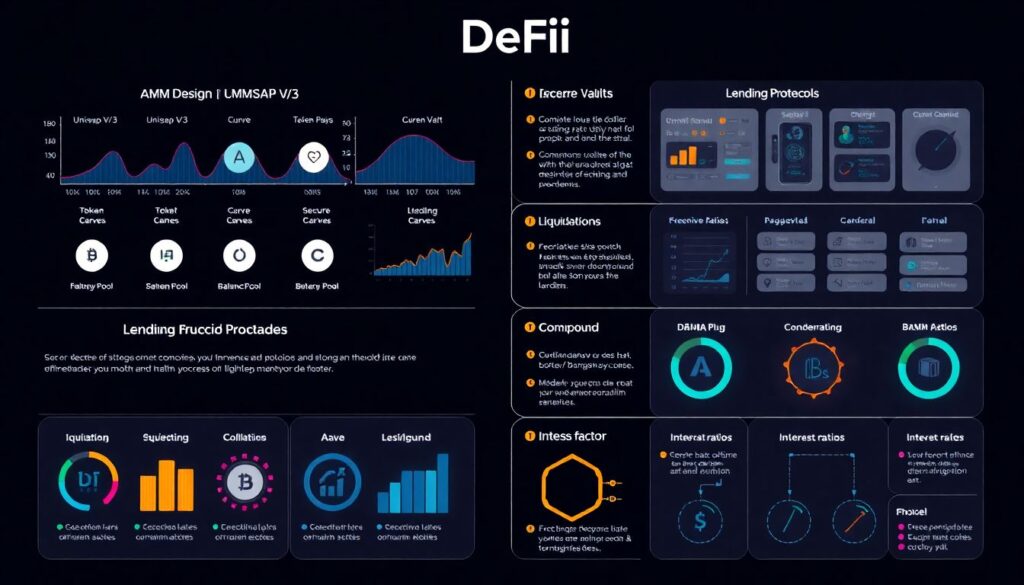
– AMM design: Uniswap V2/V3, Curve, Balancer docs
– Lending protocols: Aave, Compound, Maker
– Liquidations, collateral ratios, health factor, interest rate models
3. Data and Research
– Use public dashboards as a mental model for on chain data analytics tools for defi (Dune, Nansen, Flipside).
– Read protocol research reports and audits; they often show edge cases you’ll want to simulate.
4. Community & Feedback
– Join dev‑oriented Discords of indexing tools, DeFi protocols, and analytics platforms.
– Share your early engine with other builders; feedback usually reveals missing edge cases fast.
A Simple Roadmap You Can Actually Follow
To keep this actionable, here’s a straightforward order of attack:
1. Pick a stack
– Example: Python + PostgreSQL for data + web3.py for chain access.
2. Index minimal data
– One chain, one AMM, one lending protocol.
– Store swaps, mints, burns, lending/borrowing events.
3. Build a minimal simulation loop
– Step through blocks or events.
– Recreate pool and account states.
4. Implement a toy strategy
– E.g., “Provide liquidity in ETH/USDC, exit if price drops 20%.”
5. Add portfolio and risk metrics
– PnL, drawdown, exposure, leverage.
6. Validate against a public example
– Check if your results loosely match a known case (don’t chase perfect equality; focus on logic).
7. Refine & modularize
– Turn ad‑hoc code into reusable modules for data, simulation, strategy, and reporting.
Do this, and you’re no longer “just writing scripts”; you’re building your own internal defi backtesting platform.
Final Expert Recommendations
Let’s wrap with a few direct, experience‑driven suggestions:
1. Model fewer things, but model them correctly.
Better to simulate 2–3 protocols with realistic mechanics than 15 protocols with cartoon logic.
2. Log everything.
Every action, every simulated swap, every gas cost. Bugs hide in the details; logs are where you catch them.
3. Stress‑test, don’t curve‑fit.
Don’t tweak parameters until last year looks amazing. Instead, run your strategy across multiple time windows, chains, and volatility regimes.
4. Keep latency in mind early.
If your backtest takes hours, you’ll run fewer experiments and learn slower. Cache aggressively, pre‑compute heavy stuff, and profile bottlenecks.
5. Integrate risk thinking from day zero.
You’re not just building a performance engine but a research tool that can inform real capital allocation, side by side with the best defi portfolio and risk management tools in the ecosystem.
If you treat your backtesting engine as a serious product — not a weekend toy — it becomes your edge: a private research lab for strategies that will never be described in public threads.
Start small, keep improving, and let the engine tell you, with cold honesty, which DeFi ideas deserve your capital and which belong only in a notebook.