
Why bother measuring token burns at all
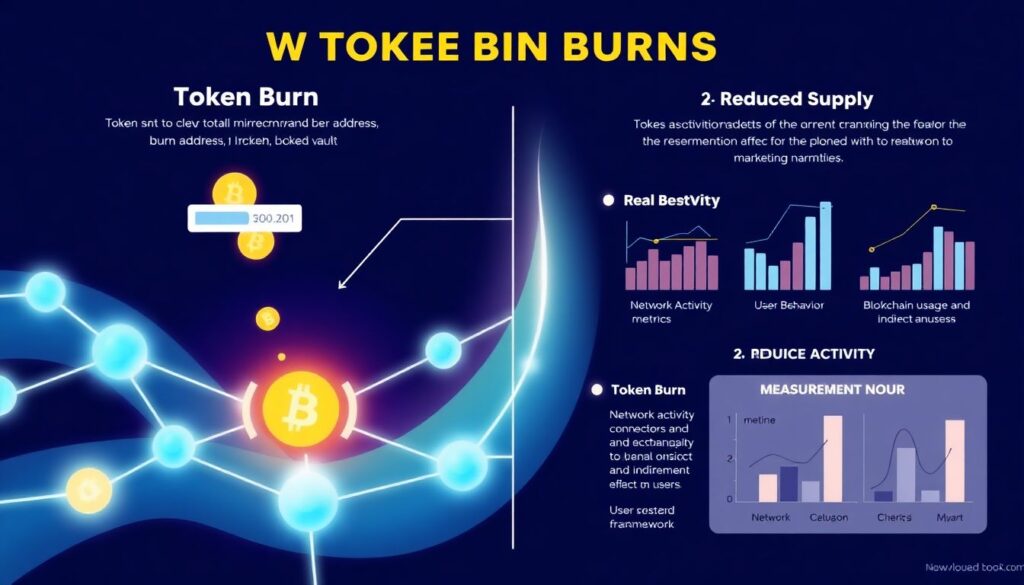
Token burns sound simple: send tokens to an irrecoverable address, reduce supply, enjoy the upside. In practice, if you want real data instead of narratives, you need a measurement framework that explains how token burns affect blockchain network activity and, indirectly, user behaviour. Step 1 is to treat burns as an experiment: you define a time window, list the protocol changes around it, and decide which metrics should react if the burn actually matters. Without that rigor, every pump looks like “burn alpha” and every dump is “macro”. A solid baseline of historical activity, clear hypotheses, and transparent assumptions is what separates analysis from storytelling in this domain.
Step 1: Formulate a falsifiable hypothesis
Before touching dashboards, phrase your hypothesis like an engineer, not a marketer: “If the burn rate doubles, average daily active addresses should rise by X% within Y days” or “Large one-off burns should not change median transaction fee levels.” This gives you a target to test instead of retrofitting explanations to noisy charts.
Step 2: Define the right network activity metrics
To measure the impact, you first need a clean definition of “network activity.” For token burns, relevant dimensions usually include transaction count, unique active addresses, contract calls touching the token contract, DEX volumes, bridge inflows and outflows, and gas usage patterns. Step 2 is mapping each dimension to a behavioral question: more transactions may signal speculative churn, while more distinct addresses may hint at broadened adoption. It also helps to segment metrics by user type: retail wallets, known CEX hot wallets, MEV bots, and smart contracts. That way you can see whether burns mostly trigger arbitrage and repositioning by sophisticated actors or actually pull new participants onto the chain.
Step 3: Build pre‑ and post‑burn comparison windows
Treat each burn or change in burn schedule as an event with a clear “before” and “after.” Use symmetric windows (for example, 30 days pre‑event and 30 days post‑event), and then test shorter and longer windows to see how quickly any effect decays. This simple event-study structure already filters out a lot of noise.
Step 4: Isolate token burns from other confounding events
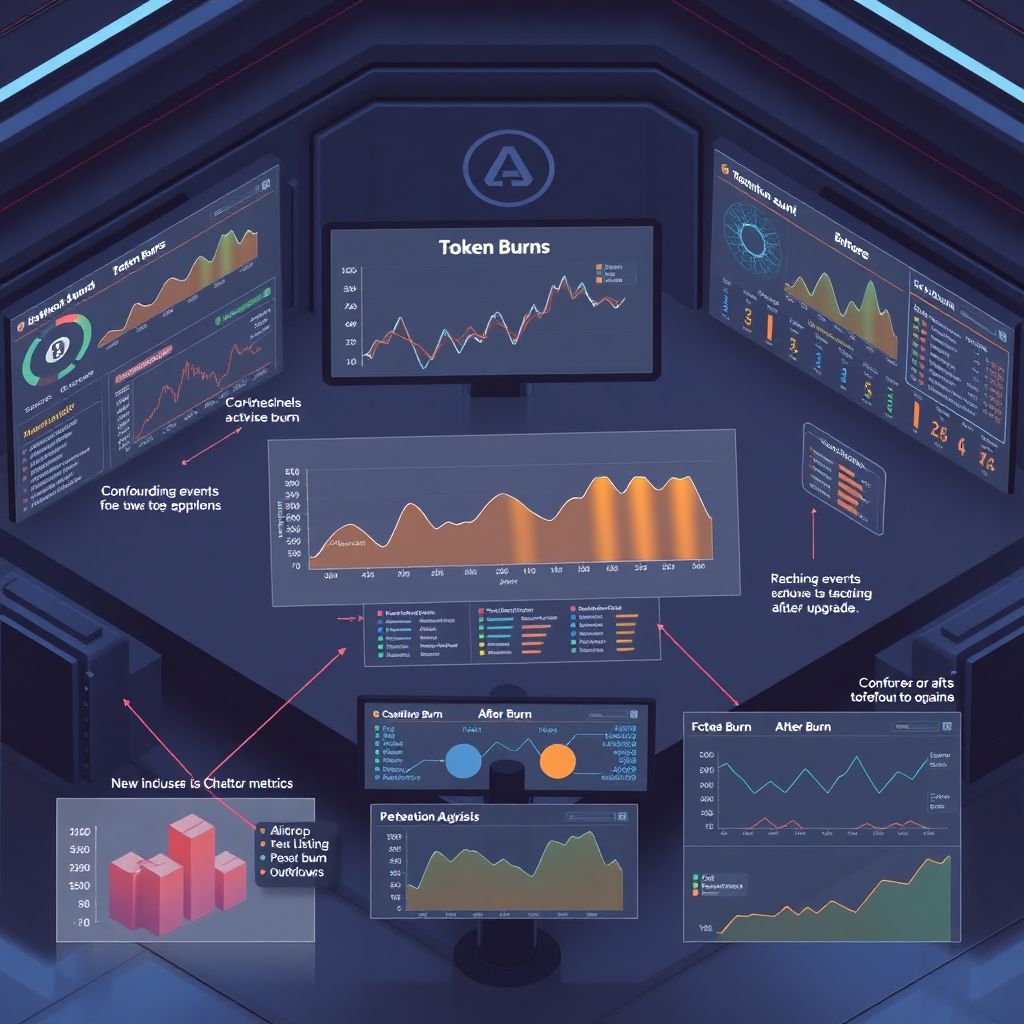
Even the best chart is useless if you attribute the wrong cause. Token burns rarely happen in isolation; they are announced alongside listings, incentive programs, or protocol upgrades. Step 3 in a strict workflow is cataloguing confounders: marketing campaigns, airdrops, major partnerships, macro news, or regulatory shocks. For each event window, you list co-occurring factors and mark them directly on your time series, so anyone reading your analysis can see where attribution becomes shaky. A practical trick is to build a “control” sample: comparable tokens or similar periods with no burn activity. By contrasting those baselines with your burn windows, you get a rough sense of what network activity would have looked like without the burn.
Step 5: Choose data sources and tooling
At this stage, pick a crypto on-chain analysis service for tracking token burns that gives you raw event logs, not just shiny charts. You want explicit access to transfer events to the burn address, historical total supply, and granular activity metrics. Many teams mix a general-purpose data warehouse with one or two specialized dashboards so that quick visual checks and deeper SQL-level queries share the same underlying truth.
Step 6: Apply suitable statistical methods
With metrics and windows defined, Step 4 is running basic statistics rather than eyeballing charts. Compute percentage changes, moving averages, and volatility bands around the burn date. For more rigorous work, use interrupted time series analysis, where you model network activity as a function of time and include the burn as an intervention variable. Autocorrelation checks help reveal whether “post-burn” bumps are just normal cyclic behavior. For large ecosystems, cohort analysis is invaluable: track users who interacted with the token for the first time after the burn and compare their retention and transaction frequency with older cohorts. This indicates whether the burn simply excites existing holders or genuinely reshapes the user base.
Step 7: Link supply changes to market variables
Network activity is only half the picture; most stakeholders care directly about token burn impact on crypto price. Experts consistently warn against assuming a one-to-one mapping between reduced supply and higher price. Instead, they look for joint patterns: does a structural increase in burn rate coincide with shrinking circulating supply, rising on-chain volumes, and deeper liquidity on DEXs and CEXs? When those elements align, it’s more credible that burns are part of the pricing story, rather than a decorative narrative attached to an unrelated trend.
Step 8: Pick the best analytics tools to measure token burn effects
Professional teams tend to standardize their stack. They combine the best analytics tools to measure token burn effects with custom scripts: one instrument for quick dashboards, another for raw chain queries, and sometimes a homegrown ETL pipeline. The key is reproducibility: if another analyst reruns your query next month, they should get the same numbers, not fuzzy approximations.
Step 9: Design better burn mechanisms with expert input
Once you know what works and what is noise, you can feed those insights back into design. That’s where tokenomics consulting for designing token burn mechanisms becomes useful. Seasoned token economists will examine your historical burn data, correlation with user activity, and liquidity constraints, then suggest rule-based burns (for example, fee-based or revenue-based) instead of arbitrary manual decisions. Their priority is usually sustainability: avoiding burn schedules that look spectacular in marketing decks but starve the protocol of future flexibility or push transaction fees to unusable levels just to maintain a headline burn rate.
Step 10: Frequent mistakes and tips for beginners
New analysts often make three critical errors: first, treating a single burn as a structural change instead of a short-lived signal; second, confusing speculative spikes in transactions with healthy, recurring usage; third, ignoring that some burns are purely accounting maneuvers that do not change effective float. Veterans recommend starting small: focus on one chain, one token, and one or two burns, document every assumption, and iterate. Keep raw notebooks with failed hypotheses, and explicitly state where your attribution confidence is low. Over time, your workflow will evolve from ad hoc chart watching into a disciplined measurement process that withstands peer review and helps your team make defensible decisions about future burn policies.
Комментарии
Мы недавно делали проект через ребят из студии: они сразу заложили структуру под SEO, сделали отдельные посадочные под каждый курс, подключили CRM и интеграцию с GetCourse, плюс подготовили полный пакет документов под 152‑ФЗ. В итоге заявки с органики пошли почти сразу после запуска.
Посмотрите их услуги тут: https://amaxschool.ru — специализируются именно на сайтах для онлайн‑школ и работают по договору, что тоже большой плюс.