

Why survivorship bias quietly ruins a lot of crypto research

When people talk about “researching crypto”, they usually mean scrolling through charts of coins that are still alive. That’s exactly where survivorship bias sneaks in. You only see the tokens that survived long enough to show up on CoinGecko, in YouTube reviews or in your favorite dashboard. Projects that rugged, got delisted, or faded into illiquidity simply vanish from the visible dataset, and your brain makes the wrong inference: “Most coins eventually recover”, “DeFi always outperforms”, “holding blue chips is safe”. In reality, thousands of dead or abandoned tokens are quietly missing from your sample, and any conclusion built on that truncated history is mathematically distorted and economically dangerous for long‑term strategies.
What survivorship bias actually is in a crypto context
Survivorship bias is a statistical distortion that appears when you only analyze outcomes of “survivors” and ignore those that disappeared. In traditional finance, that’s like backtesting a stock strategy only on today’s S&P 500 constituents and pretending bankrupt companies never existed. In crypto, the effect is even stronger because the asset universe is extremely dynamic: according to various aggregators, more than 20,000 tokens have been listed over the last years, yet a large share either lost over 95% of peak value, were abandoned, or became untradeable. If your dataset includes only the top 200 by market cap today, you effectively discard thousands of failed experiments and massively overestimate expected returns, Sharpe ratios, and the robustness of your crypto investment research strategies.
Concrete examples of survivorship bias in crypto data
Think about someone who claims: “If you just held a diversified basket of altcoins from 2018, you’d be up huge now.” If they built that argument using only coins still in the top‑100, they’re missing a long tail of delisted assets and rug pulls. Another example: DeFi yield strategies backtested only on protocols that remain active today ignore those that were hacked or drained. The result is a backward‑looking fantasy world where liquidity mining always wins and protocol risk looks negligible. These blind spots affect how you analyze crypto projects before investing and contaminate dashboards, backtests, and even professional investor reports that don’t explicitly model project death, delisting risk, and liquidity decay as part of the sample.
Why survivorship bias is especially severe in crypto
Crypto markets have high turnover, low entry barriers and weak listing standards on many exchanges. That combination amplifies survivorship bias. In equities, indexes are curated and delistings are recorded; you can buy historical datasets with dead tickers included. In crypto, delisted markets quietly vanish from many APIs, and new tickers constantly replace old ones. On top of that, bull markets create long stretches where even bad projects pump, so casual observers confuse temporary liquidity and speculative mania with sustainable performance. When you later pull data from a top‑coins list, you are implicitly saying: “Only winners count.” For economic modeling this is fatal: it inflates historical returns, underestimates drawdowns and makes risk‑adjusted performance metrics look deceptively attractive, encouraging over‑leveraged positioning and under‑diversified portfolios.
Statistical red flags that show survivorship bias is present

There are several quantitative hints that your dataset or backtest is suffering from survivorship bias. For example, if you see unrealistically high compound annual growth rates for altcoin baskets over long periods, with relatively few full‑portfolio wipeouts, that’s suspicious. Studies that use “top market cap” snapshots from the present and project them backward almost always overstate the long‑term performance of buy‑and‑hold strategies. In a healthier dataset, where dead projects remain included, you should see many assets going to zero, extreme left‑skewed distributions of returns, and high variance. If your research shows that most tokens have positive long‑run expected returns, you can be almost certain that the sample is selectively missing big groups of losers and failed experiments that represent the actual structural risk of this ecosystem.
Different approaches to fighting survivorship bias
There isn’t a single magic trick to remove survivorship bias from crypto research; instead, you combine methodological approaches. Broadly, you can look at three categories: data‑centric solutions, model‑centric solutions, and behavior‑centric (process) solutions. Each has strengths and weaknesses. Data‑centric approaches try to explicitly collect and preserve dead coins and delisted markets. Model‑centric approaches acknowledge that the data will always be noisy and instead structurally build in project death and regime changes into your quantitative methods. Finally, behavior‑centric approaches focus on how you as an analyst or investor interpret incomplete data, design crypto risk management strategies for investors, and update your priors when information is missing or unreliable in fast‑moving markets.
Approach 1: Historical universe reconstruction
The most direct way to limit survivorship bias is to reconstruct the full asset universe for each point in time you analyze. Instead of starting with today’s coins, you gather listings and delistings from historical exchange snapshots, archived API responses, or blockchain explorers. Then, when you do backtests or study past performance, you simulate buying from the universe that existed back then, including tokens that later died. The advantage is conceptual clarity: you get much closer to the actual opportunity set an investor faced in 2017, 2019, or 2021. However, implementation is painful: many APIs don’t retain dead markets, some order book data is missing, and you may have to rely on community archives or paid providers. On top of that, small‑cap coins often had negligible liquidity, so even if they appear in your dataset, modeling realistic slippage and trade execution becomes non‑trivial.
Approach 2: Hazard‑rate and delisting models
Another route is to accept that you will never see all data and instead model project death statistically using hazard rates. Here you treat each token like an entity with a probability of “failure” over time, based on characteristics such as age, liquidity, team activity, tokenomics or on‑chain usage. In your simulations, you then explicitly introduce a random chance that a coin becomes untradeable and goes to zero, even if your raw price history does not show a delisting event. This method comes from credit risk modeling and survival analysis in traditional finance. The advantage is flexibility: you can run scenario analysis and stress tests under different assumed failure rates. The drawback is that model quality heavily depends on the historical calibration data you use; if the sample itself is already biased (missing many dead small‑caps), you can still underestimate true hazard rates and remain over‑optimistic about long‑term outcomes.
Approach 3: Factor‑based and basket‑level analysis
Instead of obsessing about every single token, some researchers shift perspective to factor‑based or basket‑level analysis. Here you analyze groups (e.g., DeFi, L1, GameFi, NFTs, infrastructure) and focus on how whole segments behave across cycles. The idea is that even if individual members die, the factor persists, and you can design strategies around rebalancing or tilting toward certain sectors. This approach reduces exposure to idiosyncratic survivorship, but not entirely: if your data vendor removes dead tokens from sector indexes, your estimates for factor returns will still be biased upwards. To make factor‑based analysis effective, you should manually maintain sector definitions and keep dead tokens inside the historical index, with their price going to zero after death dates, so sector performance metrics mirror the true economic experience of a real‑world investor over a full market cycle.
Approach 4: Behavioral and procedural safeguards
Beyond formal modeling, some of the most robust defenses against survivorship bias are simply disciplined habits. For instance, when you evaluate performance screenshots, you automatically ask: “What’s missing from this graph?” You track every project you ever considered—winners and losers—in a research log and periodically review the dead ones. You also intentionally study failure cases: protocols that were hacked, teams that disappeared, tokenomics that collapsed. This qualitative database of failures counterbalances your brain’s tendency to remember only the big winners. Additionally, you bake in conservative assumptions to all forecasts, for example capping expected returns, applying haircut factors to reported yields, and building risk buffers into your portfolio sizing. These process‑level protections don’t remove statistical bias in the data, but they protect real capital from the decision errors that survivorship bias tends to produce.
Integrating anti‑bias methods into crypto research workflows
If you want practical, repeatable crypto investment research strategies, you need to integrate these approaches into your workflow instead of treating them as academic details. An effective routine might start with a clear data sourcing policy: you prefer providers that explicitly include delisted markets historically, and you document any gaps. You then run comparative backtests: one using full historical universes when available, another using only current survivors, to quantify the distortion. Along the way, you maintain a watchlist of failed or abandoned projects relevant to your niche, revisiting them when similar patterns appear in new tokens. When evaluating new opportunities, you use conservative parameter choices derived from failure‑aware models, not from cherry‑picked bull market snapshots. Over time, this layered design reduces the gap between paper strategies and real‑world performance, which is where most survivorship‑driven blow‑ups happen.
Using tools without letting them mislead you
Modern dashboards, screeners and analytics platforms are powerful, but they often reinforce survivorship bias by default. Many of the best crypto research tools for investors filter out “inactive” or “illiquid” coins as noise, which feels convenient but systematically hides the historical graveyard. When you rely on heatmaps of the current top‑100, automatic portfolio builders tied to major exchanges, or performance charts that start when each token was listed rather than from a fixed calendar date, you’re letting the tool silently define the sample. To counter this, you can deliberately explore delisted or micro‑cap sections where available, enable options to include dead tickers in your historical queries, and export raw data for your own cleaning. On top of that, you should treat polished performance graphs as marketing material unless you know exactly how the constituent universe and rebalancing rules were defined through time.
How survivorship bias distorts economic conclusions
The impact of survivorship bias goes beyond bad backtests; it warps your understanding of the underlying economics of crypto systems. If your dataset systematically under‑represents failures, you might infer that token‑based bootstrapping is an efficient mechanism across the board, that most ecosystems converge to sustainable fee capture, or that governance tokens reliably accrue value. In reality, empirical data that includes dead projects often shows that only a minority of experiments reach durable equilibrium, while many succumb to reflexive leverage, declining user activity or governance capture. For macro‑level modeling, this means that estimates of sectoral capital efficiency, average project lifetime, and the true cost of capital for protocols are understated. The result is over‑optimistic valuations, inflated expectations around total addressable market, and mispriced emission schedules that assume endless demand for liquidity and governance tokens.
Impact on risk‑adjusted returns and capital allocation
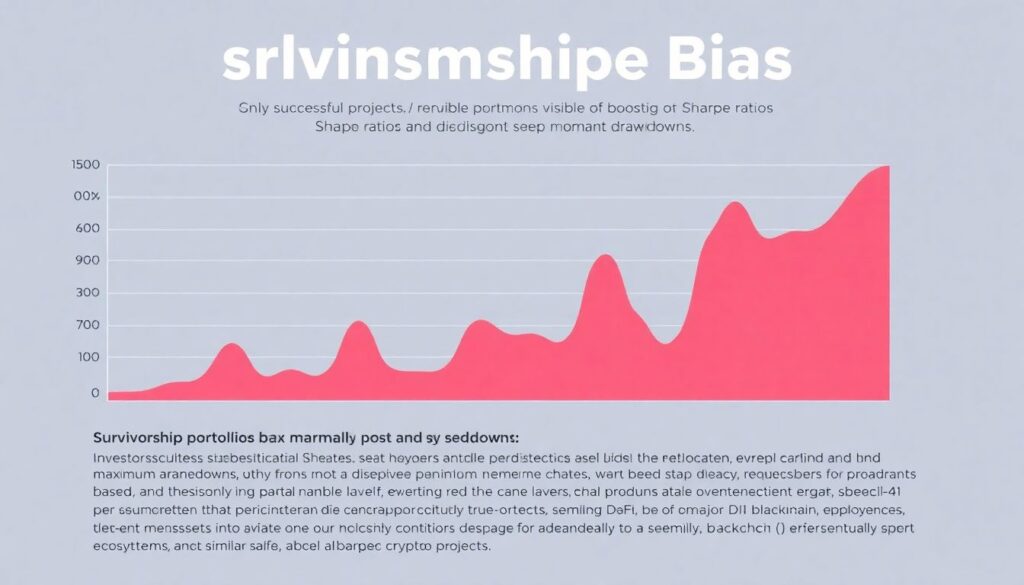
From a portfolio perspective, survivorship bias systematically overstates Sharpe ratios and underestimates maximum drawdowns. When investors allocate based on such distorted metrics, capital gets over‑concentrated in segments that looked historically “safe”: blue‑chip DeFi, large L1 ecosystems, or popular staking derivatives. But if the sample omitted previous large‑cap failures, systemic hacks or governance breakdowns, then real risk is higher than the backtest suggests. Over time, this can lead to crowded trades, compressed risk premia and fragile capital structures. In addition, mismeasured downside risk undermines rational portfolio construction: investors underinsure, use excessive leverage, or skip hedging because historical data appeared benign. Adjusting research methods to fully reflect project death and tail events leads to more realistic expected returns and encourages a healthier spread of capital across innovation layers instead of concentrating it solely in currently fashionable narratives.
Practical checklist for individual investors
If you’re not running a quant fund and just want to avoid being tricked by survivorship bias in your own research, you can embed a few simple safeguards in your daily routine. Whenever you read a thread about “if you’d bought X five years ago”, ask what else was available to buy back then and how many of those assets are now worthless. When a portfolio screenshot shows amazing gains, consider whether that portfolio included any losers that got quietly dropped. And when you evaluate a new sector—say, GameFi or modular infrastructure—actively search for historical failures in that exact niche and treat them as part of your baseline probability distribution, not as irrelevant anomalies that “don’t apply this time” because the branding looks different or the narrative sounds smarter.
Research routines to embed in your day‑to‑day work
Some simple, low‑overhead practices can dramatically reduce bias in how you analyze crypto projects before investing, even if you’re doing this part‑time. You can, for example, maintain a private note where you log every project you consider with date, thesis, and eventual outcome, keeping the bad decisions visible instead of deleting them. You might also set up reminders to re‑check older calls every few months, so you see how often once‑promising names slide into irrelevance. Similarly, when reading whitepapers or tokenomics breakdowns, you can compare them with prior projects that had similar designs and failed, extracting failure modes rather than only success patterns. These behavioral habits won’t fix incomplete datasets, but they change how your brain weighs information: you stop imagining yourself holding only the future winners and start modeling the far more realistic scenario of owning a messy mix of winners and losers.
Where crypto education helps—and where it falls short
A lot of people hope that taking a crypto trading education course online will automatically fix cognitive errors like survivorship bias. Education certainly helps—structured materials can explain concepts like selection bias, look‑ahead bias, and base rates in an accessible way. But many courses themselves suffer from survivorship bias by focusing teaching examples on famous winners, ignoring the countless anonymous failed tokens that could provide more realistic case studies. The more marketing‑driven the course, the more likely it is to highlight exceptional success stories rather than statistically typical outcomes. When choosing educational material, it’s worth checking whether the curriculum explicitly covers failed projects, delisted tokens, and full‑cycle analyses that include both bull and bear regimes. If it doesn’t, you’ll need to supplement it with your own failure‑focused research to counterbalance the natural cherry‑picking of survivorship.
Aligning education with robust risk management
To make learning actually translate into better decisions, you want your education material to link theory with concrete crypto risk management strategies for investors. That means not only teaching how to set stop losses or size positions, but also how to interpret historical performance data in the presence of survivorship bias. For example, risk management modules should demonstrate how portfolio volatility and drawdowns change once you re‑insert dead tokens into backtests, or how expected value calculations shift when you assume realistic project failure rates rather than zero defaults. Courses that incorporate these elements produce students who are less impressed by cherry‑picked charts and more focused on robust downside protection, realistic expectations, and systematic hypothesis testing. In the long run, that kind of mindset is far more protective than any single technical pattern or on‑chain metric you might learn.
Forecasts: how this issue will evolve with crypto’s maturation
Looking forward, survivorship bias in crypto research is likely to become both more subtle and more consequential. On one hand, the market is maturing: centralized exchanges are raising listing standards, regulators are pushing for better disclosure, and institutional‑grade data vendors are preserving more historical information, including delistings and dead markets. That should gradually reduce the cruder forms of survivorship bias. On the other hand, as the ecosystem grows into tens or hundreds of thousands of tokens and synthetic assets, the complexity of the universe will make it harder for individual analysts to see the full picture. Automated indexing, smart‑beta products, and AI‑powered dashboards will become the norm, and each of those layers can introduce its own selection filters. If left unexamined, these filters could invisibly shape narratives and asset flows, creating the impression of safety and inevitability around certain sectors while hiding the churn and failure beneath the surface.
Industry‑wide implications for tools and standards
At the industry level, demand is rising for more transparent and rigorous data pipelines. Over the next few years we can expect serious competition among analytics providers to offer auditable historical universes, clear documentation of delisting logic, and survivorship‑aware index methodologies. For professional users designing crypto investment research strategies, this will become a key differentiator when selecting vendors and integrating the best crypto research tools for investors into institutional workflows. At the same time, regulators and industry groups may push for standardized reporting of project lifetimes, failure rates, and token deprecations, similar to how default statistics are tracked in credit markets. Such changes would gradually align perceptions with reality: sector‑level performance metrics would incorporate failures, product disclosures would become more honest about downside scenarios, and both retail and institutional capital could be allocated on the basis of data that better reflects the true economic risks. In that environment, investors who understand survivorship bias—and build their processes to counter it—will be far less likely to overpay for narratives built on incomplete histories.
Комментарии