

Why compliance risk in crypto is a big deal (and how not to ignore it)
If you move money in crypto — even small volumes — you’re already in the game of compliance risk. It’s not just about regulators and banks. It’s about avoiding frozen accounts, de-platforming by exchanges, and being flagged by counterparties who run blockchain analytics.
Monitoring compliance risk in crypto markets means constantly checking:
“Is what I’m doing (and what my users are doing) going to trigger AML, sanctions, fraud or licensing problems — today or six months from now?”
Let’s walk through a step‑by‑step way to build a realistic monitoring setup that doesn’t require a giant team, but still looks serious enough for regulators, banking partners and institutional clients.
—
Step 1. Map your real risk profile before buying any tools
Figure out who you are in the crypto food chain

Before you start googling crypto compliance monitoring software, get brutally clear on what you actually do:
– Spot or derivatives exchange
– Broker, OTC desk or P2P platform
– Custodial or non‑custodial wallet service
– DeFi front‑end, payment processor, NFT marketplace, etc.
Each role exposes you to a different mix of AML, KYC, securities, and sanctions risk.
Ask yourself:
– Do I hold client assets or just route transactions?
– Do I touch fiat (bank wires, cards, stablecoins off‑ramp)?
– Do I onboard retail, institutions, high‑risk geographies, or all of the above?
The more control you have over user funds and onboarding, the more intense your monitoring needs to be.
Identify your main compliance risk drivers
Most crypto firms underestimate their exposure in at least one of these areas:
– Jurisdiction risk – Where are your customers actually located? Where are your servers, entities, founders, and banking partners?
– Product risk – Leverage, privacy coins, mixers, gambling-related flows and NFT casinos are classic red flags.
– User risk – High‑net‑worth individuals, politically exposed persons (PEPs), and volume spikes from “new” users need extra scrutiny.
Expert takeaway:
Compliance officers with banking background often say the same thing — *90% of surprises come from not knowing who you’re really serving*. Don’t rely on country fields from a signup form; IPs, device fingerprints and payment rails tell a better story.
—
Step 2. Turn vague risks into concrete monitoring rules
Translate “we’re worried about X” into “we will flag Y”
Once you’ve listed your risks, you need explicit triggers. Otherwise you just have a nice Word document, not a monitoring framework.
Examples of converting risks into rules:
– “We’re exposed to sanctions risk” → Flag any deposit or withdrawal linked to OFAC‑listed addresses or high‑risk exchanges.
– “We’re worried about layering” → Trigger alerts for rapid in‑and‑out movement across 5+ addresses within 30 minutes.
– “We fear market abuse” → Detect wash‑trading patterns, self‑trading, or coordinated pump‑and‑dump on illiquid pairs.
At this point, the foundation is ready for picking the right crypto transaction monitoring tools instead of buying the shiniest dashboard and hoping it solves everything.
Common mistake: copying a bank’s rules blindly
Traditional bank AML rules often don’t fit crypto flows. For example, a bank rule like “anything over $10,000 in a day” is almost meaningless on volatile tokens and DeFi bridges.
In crypto you need:
– Volume thresholds per asset, not just in fiat
– Rules that understand on‑chain behavior, like hopping through mixers or DeFi pools
– Logic that’s aware of smart contracts, not just “accounts”
If you clone a bank’s rulebook, you’ll drown in false positives and miss crypto‑native red flags.
—
Step 3. Choose the tech stack: don’t overbuy, don’t underbuy
What you actually need from monitoring technology
There are four main blocks to think about:
– Onboarding & identity checks – KYC, KYB, PEP/sanctions screening
– Ongoing monitoring of users and entities – Updated risk scores, new watchlists
– On‑chain and off‑chain transaction surveillance – Wallet behavior, counterparties, patterns
– Case management & reporting – Investigations, audit trails, SAR/STR exports
For exchanges and brokers, integrated crypto AML KYC solutions for exchanges are often the fastest way to get a baseline program in place, especially if they combine identity verification with wallet risk scoring in one flow.
For other businesses, like wallets or payment providers, standalone components stitched together via API can be more flexible.
Where specialized tools make the difference
1. Blockchain analytics for compliance and risk management
You want tools that label wallets as: exchange, mixer, darknet, scam, sanctioned entity, etc., and estimate exposure percentages. These labels become inputs into your rules.
2. Crypto transaction monitoring tools
These sit on top of the analytics data and your user database. They detect patterns like structuring, smurfing, unusual counterparties, or circular flows.
3. A crypto regulatory compliance platform for businesses
This usually acts as your “single pane of glass” — pulling together KYC data, blockchain analytics, alerts, and case management so investigators don’t hop between five dashboards.
Expert recommendation:
Seasoned compliance teams often start lightweight — using one vendor for on‑chain analytics plus a basic case tool — and only move to a full crypto compliance monitoring software suite when they know which rules, dashboards, and workflows they actually use daily.
—
Step 4. Build a practical monitoring workflow (not just alerts)
Define what happens after an alert fires
An alert is just the beginning. To actually monitor compliance risk, you need a workflow that any compliance analyst can follow.
At minimum, document:
– Who sees the alert first
– How they decide if it’s “false positive”, “needs more info”, or “escalate”
– When you contact the customer or freeze funds
– Who can approve closing the alert and on what basis
– How you log the decision (for auditors and regulators)
Without this, you’ll get one of two extremes:
Either nobody responds in time, or everything is treated as a crisis and your users suffer.
Don’t forget basic hygiene: data, tags, notes
If you can’t reconstruct what happened six months later, regulators will assume the worst.
Make sure your system automatically keeps:
– Historical risk scores and how they changed over time
– Screenshots or exports of external data (sanctions lists, PEP checks)
– Analyst notes explaining *why* a decision was taken
– Links to on‑chain transactions and addresses investigated
This is exactly where a solid crypto regulatory compliance platform for businesses can pay for itself, because building this internally is harder than it looks.
—
Step 5. Calibrate and tune: stop drowning in false positives
Start stricter, then test and relax carefully
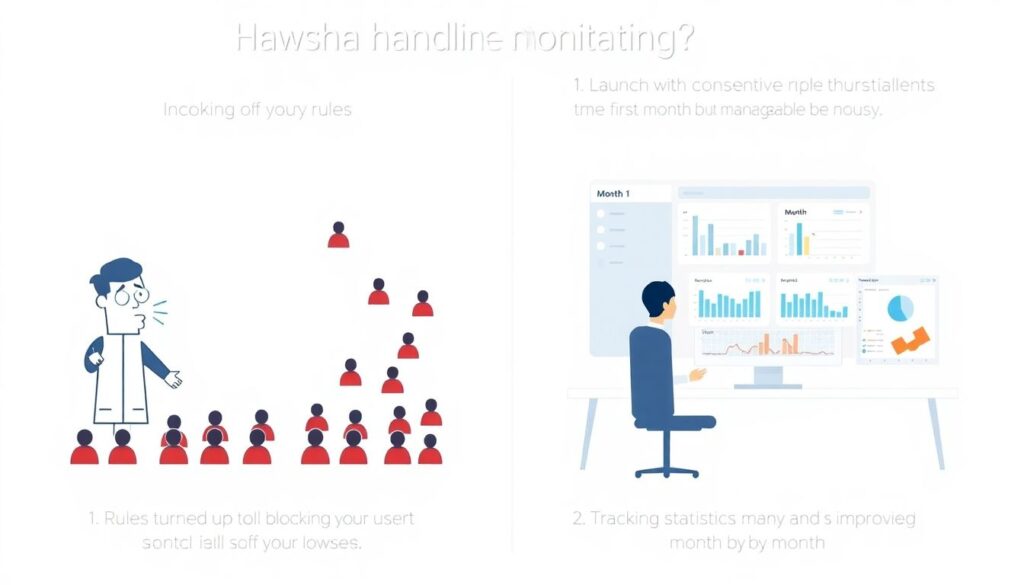
Beginners tend to either:
– Turn rules up to “insanely strict” and block half their users, or
– Turn everything down to avoid noise and basically not monitor anything.
A more realistic approach:
1. Launch with conservative thresholds and accept that the first month will be noisy.
2. Track statistics: how many alerts, how many true cases, how much analyst time.
3. Adjust rule thresholds only where you see clear patterns of false positives.
4. Add new rules slowly instead of switching on every vendor rule by default.
Expert tip:
Good teams review a subset of “closed as false positive” alerts monthly. If the same pattern shows up again and again (e.g., small transfers to a well‑known exchange), they adjust rules to stop flagging it. That’s how you keep monitoring sharp without overwhelming staff.
Common tuning mistakes to avoid
– Disabling a noisy rule instead of improving it – Better to change thresholds or add context (for example, ignore low‑value transactions to Tier‑1 exchanges) than to switch it off entirely.
– Not segmenting by user type – Institutional clients and retail users rarely behave the same; treat them differently in your rules.
– Never revisiting sanctions logic – Sanctions environments change quickly; your worst risk is using last year’s configuration.
—
Step 6. Combine on‑chain and off‑chain signals
Why on‑chain alone is never enough
A wallet might look clean on‑chain but still belong to a fraudster using stolen IDs. Likewise, someone can pass KYC but route funds through mixers and high‑risk casinos.
Effective monitoring connects:
– KYC data (identity, location, occupation, income)
– Behavior data (login IPs, devices, velocity, trading style)
– On‑chain data (counterparty types, risk scores, transaction graphs)
This is where integrated crypto AML KYC solutions for exchanges are strong: they feed KYC outcomes directly into transaction rules so that high‑risk users have lower alert thresholds.
Red flags that are easy to miss if data is siloed
Watch for patterns where the combination of signals is suspicious, even if each signal alone looks fine:
– New user with perfect KYC → Immediate large deposit from a wallet heavily exposed to scams and darknet markets.
– Long‑time low‑risk client → Suddenly starts interacting with mixers after a social‑engineering event or SIM‑swap.
– Corporate client → On paper a legitimate business, but all flows go to gambling sites and unlicensed brokers.
When in doubt, anchor decisions in a documented risk‑based approach: explain *why* the combination of factors makes the case high, medium or low risk.
—
Step 7. Train your people to think like investigators
Tools don’t replace human judgment
Even the best crypto compliance monitoring software will raise ambiguous alerts. Analysts have to make calls under uncertainty.
Train them to:
– Reconstruct transaction paths visually using blockchain analytics for compliance and risk management, not just read a risk score.
– Ask “what’s the plausible story here?” instead of staring at numbers.
– Recognize common scam, fraud, and money‑mule patterns specific to crypto.
– Document their reasoning clearly for future audits or law‑enforcement requests.
What to include in regular training
– New regulatory guidance in your main jurisdictions
– Emerging techniques: new mixers, privacy tools, cross‑chain bridges
– Case studies from your own alerts: what you missed, what you caught early
– Short refreshers on your escalation and freezing policies
Expert note:
The best crypto compliance teams keep a small internal “case library” of anonymized real alerts — good, bad, and ugly. New joiners learn ten times faster from this than from a 40‑page policy manual.
—
Practical tips for beginners so you don’t get stuck
Start small, but be intentional
You don’t have to implement a global‑bank‑level program on day one. You do need something coherent.
For early‑stage or smaller crypto businesses:
– Pick one reliable blockchain analytics provider and connect it to your systems.
– Define 5–10 core rules that match your biggest risks (sanctions, scams, large withdrawals, mixers, high‑risk countries).
– Implement basic KYC & sanctions checks at onboarding, and refresh on changes (e.g., name appears on a new list).
– Make a one‑page workflow for handling alerts and freezes — simple but explicit.
Things that will hurt you later if you ignore them now
– No logs of who approved what and when
– No version history of your rules
– No formal link between your risk assessment and the controls you actually run
– Relying on manual spreadsheets as “case management”
Fixing these after a regulator or bank asks questions is painful and expensive. Setting them up early, even in a lightweight way, is much easier.
—
Red flags that your monitoring isn’t working (yet)
You might have shiny dashboards and still be exposed. Watch for these warning signs:
– Analysts constantly override the same alerts without any rule changes.
– You can’t say how many high‑risk users you have, or how many cases are open.
– Your vendor’s default rules haven’t been edited in months.
– Banking partners start asking more probing questions about your controls.
– Investigations feel like “starting from scratch” every time.
If any of this sounds familiar, you don’t necessarily need more tools — you probably need better tuning, clearer workflows, and documented responsibilities.
—
Bringing it all together
Monitoring compliance risk in crypto markets is not about checking a box for auditors. It’s an ongoing loop:
1. Understand your real risk profile.
2. Turn it into concrete, testable rules.
3. Support those rules with the right mix of KYC, analytics, and monitoring technology.
4. Build workflows so alerts lead to real decisions, not inbox clutter.
5. Tune constantly based on data and real cases.
6. Train your people to think critically and document their judgment.
If you treat compliance as a living system — not a one‑off setup — you’ll be far better prepared for regulators, banks, and institutional partners, while actually reducing fraud and abuse on your platform.
That’s how serious players in crypto do it today, and how you can grow into that standard step by step.