
Why ethics and accountability suddenly matter so much in AI-assisted market research
AI has turned market research from slow and expensive into fast and always-on. That’s powerful—and risky. When algorithms decide which customers to listen to, which segments matter, and which insights drive spend, ethical blind spots quickly turn into reputation, legal, and trust problems.
This article walks through what ethics and accountability actually mean in AI-assisted market research, and, more importantly, how to bake them into day‑to‑day workflows rather than policy PDFs that nobody reads.
Key concepts: getting the language straight
Ethics vs accountability vs compliance
Let’s untangle three terms people love to mix up:
– Ethics – “Should we do this?”
Internal principles about fairness, respect, and transparency in how you collect, analyze, and act on data.
– Accountability – “Who answers when something goes wrong?”
Clear ownership for AI decisions, from model choice to how insights are used in campaigns or product changes.
– Compliance – “Are we allowed to do this?”
Following laws and standards: GDPR, CCPA, ePrivacy, industry codes, internal policies. This is where ai market research compliance and data privacy become very real, not just legal buzzwords.
Ethics goes beyond compliance. A practice can be legal and still be manipulative or unfair. Accountability connects the two: someone has to own the gap between “allowed” and “right.”
What “ethical AI in market research” actually covers
When people talk about ethical ai in market research, they usually mean four things:
– How data is collected
– How models are trained and validated
– How outputs are interpreted and used
– How participants and customers are affected over time
You can think of it as:
> People → Data → Models → Decisions → Impact
Ethics runs across this entire chain, not just at the moment you ask for consent.
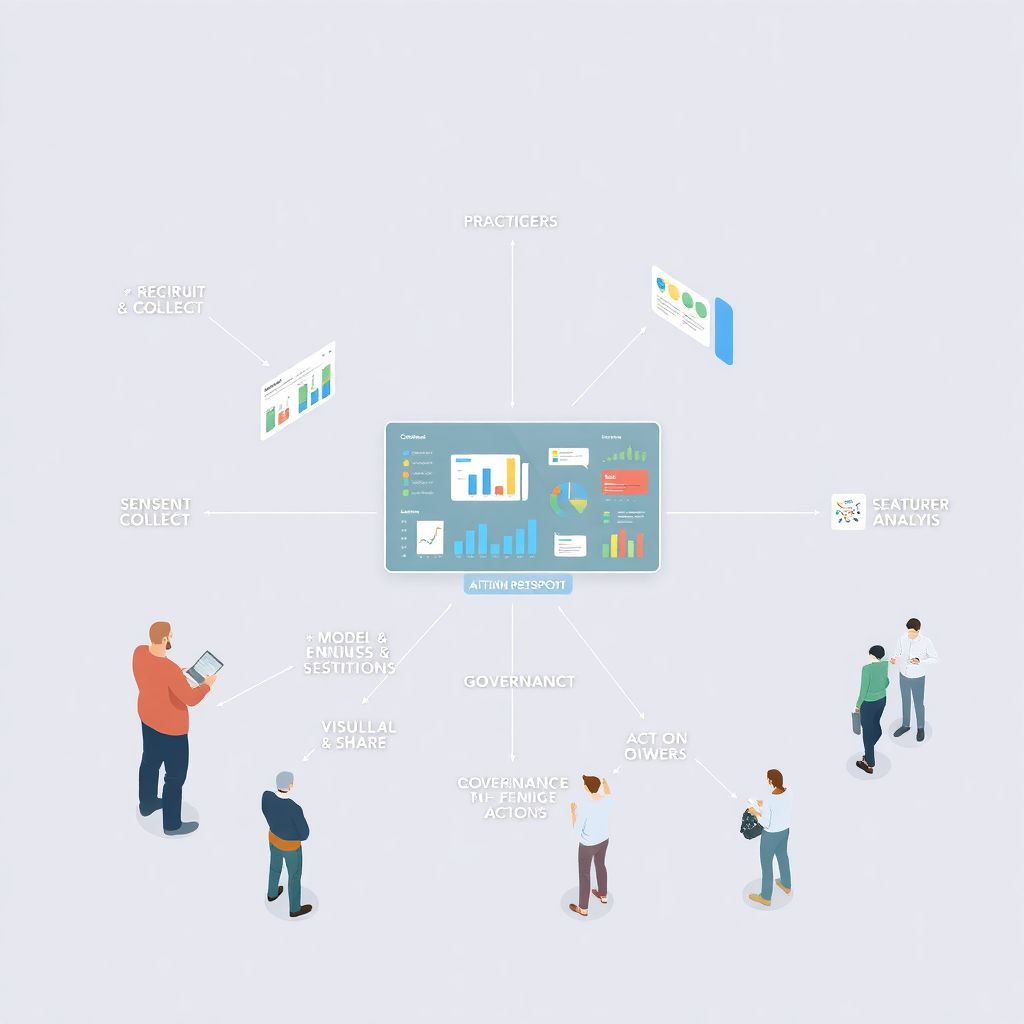
A simple text diagram: the AI research pipeline with risk points
Let’s visualize a typical AI-assisted workflow using a text diagram:
“`
[Recruit & Collect] –> [Clean & Enrich] –> [Model & Analyze] –> [Visualize & Share] –> [Act on Insights]
Risk hotspots:
– Recruit & Collect: consent quality, bias in who joins
– Clean & Enrich: over-enrichment, re-identification
– Model & Analyze: biased models, spurious correlations
– Visualize & Share: misleading charts, overconfidence
– Act on Insights: harmful targeting, exclusion
“`
If you only focus ethics on “Act on Insights”, you’re already too late.
Why AI changes the ethics equation in market research
Scale, speed, and opacity
Traditional research was slow and manual. A flawed survey design hurt, but the damage was limited. AI flips this:
– Scale – A single flawed classifier can mislabel *millions* of open‑end responses or social posts.
– Speed – Dashboards update in real time; bad assumptions spread through the org before anyone sanity‑checks them.
– Opacity – Complex models and vendor “secret sauce” make it hard to see where bias creeps in.
That’s why ai-powered market research platforms with governance features are increasingly important: not for the buzzwords, but because you need built‑in controls, audit logs, and clear roles to keep up with the pace of automation.
Comparison with traditional (human-only) research
Traditional research:
– Pros: transparent methods, easier to challenge, richer qualitative judgment.
– Cons: limited sample sizes, slower iterations, higher cost, more human error in coding and analysis.
AI-assisted research:
– Pros: handles huge data volumes (social, CRM, behavioral), faster turnaround, consistent coding, broader pattern detection.
– Cons: subtle biases hidden in models, “black box” logic, the illusion of precision, risk of dehumanizing respondents into “data exhaust.”
Ethics isn’t about choosing one or the other; it’s about augmenting humans and staying honest about what AI can and can’t do.
Clear definitions of the main ethical challenges
Bias and representativeness
Definition: Systematic skew in which groups are visible, how they’re interpreted, or how heavily they’re weighted.
In AI-assisted market research, bias can enter when:
– Your training data over‑represents vocal segments (e.g., heavy social media users).
– Language models misunderstand slang or dialects.
– Sentiment analysis is tuned on one market and deployed globally.
The practical problem: you end up optimizing products and communication for whoever the model “hears” the loudest.
Transparency and explainability
Transparency is being open about how insights are generated.
Explainability is the ability to give a human‑understandable reason for a model’s output.
If a model tags a segment as “high churn risk” but you can’t explain why, you still need to decide:
– Do we change pricing for them?
– Do we target them with special offers?
Without at least a high‑level explanation, you’re gambling with customer fairness and trust.
Privacy, consent, and data minimization
When you enrich survey data with CRM, browsing, or location data, you risk crossing lines that respondents didn’t anticipate.
The key questions for each data element:
– Is it necessary for the research objective?
– Was it clearly explained at consent?
– Can it be aggregated or anonymized instead?
Data minimization is your friend: if you don’t collect it, it can’t leak, be misused, or become tomorrow’s legal headache.
Diagram: three lines of accountability
Here’s a simple way to think about accountability layers:
“`
Line 1: Practitioners
– Researchers, analysts, marketers using AI insights
Line 2: System Owners
– Data science, IT, vendors managing models & platforms
Line 3: Governance
– Legal, compliance, ethics committees, senior sponsors
Flow:
Practitioners ↔ System Owners ↔ Governance
Feedback loops:
– Escalation of issues
– Model performance reviews
– Policy updates
“`
If any of these lines is missing, “accountability” exists only in slide decks.
Practical guidelines: building ethics into daily workflows
1. Start with a simple ethics checklist for every AI research project
You don’t need a 40‑page policy. You need a five‑minute gate no project can bypass. For example:
– What decision will this insight influence?
– Who could be harmed or unfairly excluded?
– Are we mixing data sources in ways respondents wouldn’t expect?
– Which model(s) are we using, who selected them, and when were they last validated?
– Who signs off if we change how the model is used halfway through the project?
This kind of checklist quietly becomes your guidelines for ethical use of ai in customer data analysis—practical, not aspirational.
2. Choose *responsible*, not just “smart,” AI tools
When evaluating responsible ai tools for consumer insights, don’t stop at accuracy demos. Ask vendors:
– Can we see sample training data sources or, at least, types and geographies used?
– How do you test for bias across demographics and languages?
– Do you provide model cards, documentation, or validation reports?
– Can our governance team access audit logs of who ran what, when, and with which parameters?
If the answer to governance questions is vague, assume ethics hasn’t been a priority in the product.
3. Set guardrails for generative AI in research
Generative AI (e.g., drafting surveys, summarizing interviews) is handy but can quietly distort reality.
Use it for:
– First drafts of questionnaires and discussion guides
– Clustering and summarizing verbatims
– Hypothesis generation (“What else might explain this pattern?”)
Avoid using it blindly for:
– Fabricating “synthetic respondents” as if they were real people
– Auto‑writing verbatim “quotes” for reporting
– Making final calls on sensitive topics (e.g., vulnerable groups, financial stress)
Always keep a human in the loop for interpretation and narrative.
Concrete practices for AI-assisted surveys and qualitative work
AI in survey design and analysis
AI can help spot leading questions, duplicated concepts, or missing answer options. But it doesn’t know your brand risk. You still do.
Practical moves:
– Run an AI quality check on questionnaires, then manually approve or reject suggestions.
– For open‑end coding, have humans periodically review a sample where the model is least confident.
– If segment‑level decisions are on the line (e.g., price changes for a region), don’t rely solely on AI clustering; validate segments with at least one alternate method.
AI on social, reviews, and unstructured data
Listening tools that classify sentiment, drivers, and topics at scale are powerful. Use them carefully:
– Label “low confidence” outputs so analysts know where to be skeptical.
– Track performance over time: slang, memes, and platforms evolve; your model must, too.
– Be explicit when reporting: “Social sentiment is model‑estimated and should be viewed as directional, not exact.”
A short footnote like that can save you from treating noisy, biased data like a census.
Governance features that actually help (and aren’t just buzzwords)
What to look for in AI platforms
When people talk about ai-powered market research platforms with governance features, useful capabilities usually include:
– Role‑based access control – not everyone needs to see raw PII or training data samples.
– Usage logs – track which models were used, on which datasets, for which projects.
– Model versioning – so you can say, “This report used Model 2.3, validated on [date].”
– Configurable retention policies – so data doesn’t live forever “just in case.”
If a platform makes it easy to spin up new models but hard to see who is using what, you’ve traded convenience for risk.
Lightweight internal governance
You don’t need a giant ethics board. You need:
– A clear owner: a small AI/insights governance working group.
– A fast path to escalate questionable use cases.
– Regular reviews of high‑impact models (e.g., attrition prediction, pricing sensitivity, credit‑related research).
Think of it as a standing meeting that asks, “Are we still comfortable with how these models are used?” rather than “Let’s rewrite our entire policy.”
Examples: what good and bad look like in practice
Example 1: Targeting a vulnerable segment
Scenario: AI suggests that people with certain financial stress markers are highly responsive to upsell campaigns.
– Unethical use: You boost upsell campaigns to those profiles, squeezing short‑term revenue from people least able to afford it.
– More ethical path: You reframe: offer budgeting tools, lower‑risk products, or educational content; you deliberately cap aggressive upsell exposure for this group.
Key point: the model simply found a correlation; accountability lies in what you choose to do with it.
Example 2: Misinterpreting cultural sentiment
Scenario: Your sentiment model, trained mostly on US/UK English, flags a trending phrase in another language as “negative,” pulling down brand scores in that region.
– Bad outcome: Leadership panics, shifts spend, and draws conclusions about “brand crisis,” all based on misclassification.
– Better approach: Local researchers review a sample, correct the label, and your team logs a model gap: “Low reliability for [language/region] until retrained.”
This is where transparency and explainability quietly protect you from strategic overreactions.
Making ethics operational instead of aspirational
Build habits, not just policies
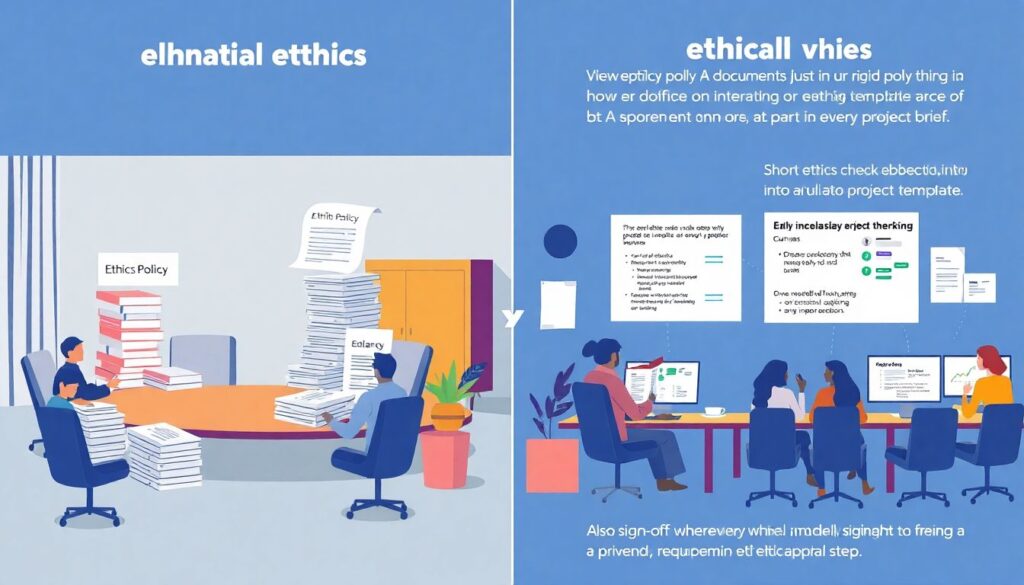
Ethical AI often fails because it’s framed as a “policy thing” rather than a “how we work” thing. To make it real in AI-assisted market research:
– Bake a short ethics check into every project brief template.
– Require sign‑off whenever a model’s purpose changes (e.g., from insight exploration to individual‑level targeting).
– Celebrate people who raise concerns—don’t treat them as blockers.
Small routines beat big manifestos.
Keep humans at the center
AI should widen whose voices are heard, not narrow them. If your models systematically under‑represent certain groups, you’re not “data driven”; you’re just efficiently biased.
Accountability means:
– Being able to explain how you reached a conclusion.
– Being prepared to revise or roll back a model‑informed decision.
– Being willing to leave money on the table if the only way to get it is to cross lines you’re not proud of.
Handled this way, ethical ai in market research isn’t a brake. It’s risk management and brand protection wrapped into smarter, more resilient decision‑making.