
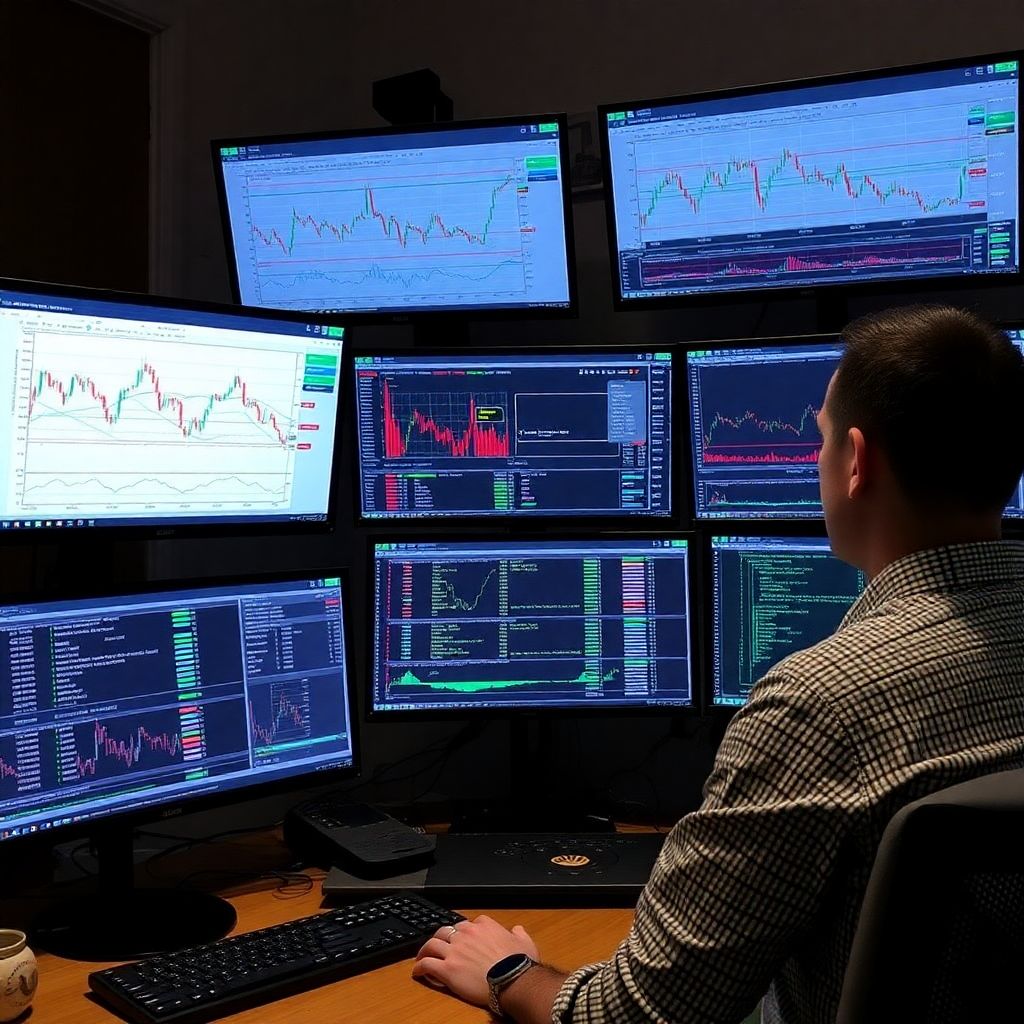
A robust crypto backtest carefully defines strategy rules, uses clean and survivorship-free data, realistically models trading costs and execution, and validates results with risk, drawdown, and overfitting checks. Use repeatable, versioned code, verify assumptions explicitly, and always challenge results with stress tests and out-of-sample performance before risking real capital.
Core validation checklist for crypto backtests
- Strategy rules, universe, and assumptions are written down, unambiguous, and reproducible.
- Market data is clean, time-aligned, and free of obvious lookahead and survivorship bias.
- Execution model includes spreads, fees, slippage, partial fills, and latency where relevant.
- Risk metrics (max drawdown, volatility, exposure) are tracked alongside returns.
- Parameters are validated with cross-validation or walk-forward, not just a single backtest.
- Performance is decomposed (by asset, regime, trade type) and stress-tested under adverse scenarios.
- Implementation is portable to your crypto trading strategy backtesting software or live stack.
Precisely define strategy logic, trading universe and assumptions
Backtesting is appropriate when your rules are objective, data is available, and you plan to automate or systematize decisions. It is not appropriate for discretionary, news-driven calls or illiquid microcaps where historical execution would have been impossible.
Preparation checklist: strategy specification
- Write the full entry, exit, and position sizing logic as if you were implementing an automated crypto trading bot with backtesting.
- Fix the exact trading universe: exchanges, pairs, quote currency, stablecoins vs fiat.
- Choose the timeframe (tick, 1m, 5m, 1h, 1d) and session rules (24/7 vs filtered hours).
- State allowed order types: market, limit, post-only, reduce-only.
- Decide fee model: maker/taker tiers, VIP discounts, or a conservative flat assumption.
Quick yes/no validation for strategy definition
- Can another person code your rules without asking clarifying questions? If not, refine.
- Are you using only information available at the decision time (no future candles, no future funding rates)?
- Have you fixed rebalancing and evaluation times (e.g., at candle close) and documented them?
- Is your universe realistic w.r.t. minimum liquidity and exchange access you actually have?
Source, clean and validate crypto market data
You need consistent OHLCV or tick data, funding rates and premiums for derivatives, reliable corporate actions for token events (splits, airdrops, redenominations), and full fee schedules when possible. A quantitative crypto trading platform with robust backtesting often bundles these, but you still must validate.
Preparation checklist: data and tools
- Decide on data granularity: tick, trades, or aggregated candles.
- Choose at least one primary data provider and one independent source for spot checks.
- Ensure access to historical order book snapshots if your strategy is spread/market-impact sensitive.
- Confirm time zone, daylight saving handling, and timestamp precision (ms vs ns).
- Pick storage format: Parquet/Feather/Arrow for columnar analytics or a time-series database.
What you will typically need
- Exchange or aggregator API keys for bulk historical data downloads.
- Local storage with enough space and bandwidth for multi-year multi-pair data.
- Scripting environment (Python/R/TypeScript) or the best crypto backtesting tools for algorithmic trading that expose data-cleaning functions.
- Reference lists of delisted coins and symbol changes to handle survivorship and mapping.
- Fee schedules and historical funding rate data for perpetual futures strategies.
Data validation mini-checklist
- Check for missing candles or long gaps per symbol and timeframe.
- Detect and flag extreme outliers and obvious bad ticks (e.g., zero or negative prices).
- Verify that volumes and notional values look plausible given market history.
- Align timestamps across exchanges and data types (price, funding, index values).
- Ensure that every asset in your universe existed and was tradable during the backtest period.
Model execution: latency, slippage and order mechanics
Before the detailed steps, confirm this short preparation checklist for safe execution modeling.
Preparation checklist: execution modeling
- Clarify whether you model spot, perpetual futures, or options; mechanics differ.
- Decide on a conservative latency assumption (e.g., one bar, fixed milliseconds, or queue position rules).
- Gather historical spreads and depth to build slippage assumptions.
- Define what constitutes a fill or partial fill in your simulation.
- Ensure your code separates signal generation time from order execution time.
-
Separate signal time from execution time
Generate signals at one timestamp and execute trades at a later, realistic timestamp to avoid lookahead bias.- Example: signal at 5m candle close, execute at open of the next candle with slippage.
- Verify that the engine never uses future prices to decide past trades.
-
Model order types and matching rules
Implement different behaviors for market, limit, and stop orders consistent with your target exchange.- Market orders: fill fully at worst of (best price + slippage model).
- Limit orders: fill only if price trades through your limit; consider queue priority simplifications.
- Stop orders: trigger when price touches the stop, then behave like market/limit by design.
-
Incorporate realistic fees, spreads and slippage
For each trade, subtract exchange fees and apply spread/slippage based on volatility and size.- Perpetuals: include both taker/maker fee and funding payments over holding time.
- Use higher fees and slippage than you expect live; this is a safety margin.
-
Respect liquidity and position size constraints
Ensure that position changes do not exceed a reasonable fraction of historical volume or book depth.- Cap notional per trade or fraction of average daily volume.
- For smaller venues, assume partial fills or missed entries during thin liquidity.
-
Simulate latency and order lifetime
Add delays between signal and order, and between order placement and cancellation/expiry.- Use constant or distribution-based latency (e.g., small random delays).
- Limit order lifetime: cancel unfilled orders after N bars or on signal reversal.
-
Verify execution logs and reconcile PnL
After a test run, inspect trade-by-trade logs and make sure PnL aggregates correctly.- Cross-check position, cash, and margin snapshots at multiple timestamps.
- Ensure no position flips or size changes happen without an explicit order event.
Concise code-style illustration
This Python-like pseudocode highlights separation of signal and execution:
# t: candle index
signal[t] = rule(candle[t-1])        # uses only past data
if signal[t] != position[t-1]:
    order = create_order(signal[t])
    fill_price = apply_slippage(candle[t].open)
    position[t], cash[t] = execute(order, fill_price, fee_model)
Risk controls, position sizing and drawdown testing
Validation checklist: risk and sizing discipline
- Position sizing logic is explicit (e.g., fixed fraction of equity, volatility targeting, risk-per-trade cap).
- Leverage limits are enforced per-asset and portfolio-wide, including derivatives exposure.
- Max loss per trade and per day/week/month is bounded by hard rules, not just preferences.
- Max drawdown is recorded over time, not only as a single final number.
- Equity curve and underwater (drawdown) curve are inspected visually for regime shifts.
- Portfolio concentration limits prevent excessive exposure to correlated coins or sectors.
- Margin calls or liquidation scenarios are simulated for levered strategies.
- Risk metrics such as volatility, downside deviation, and exposure per asset are logged each period.
- Scenario tests include major crypto events: exchange failures, sudden delistings, large gaps.
- Position sizing in the backtest matches what your broker or exchange actually allows.
Prevent overfitting with cross-validation and walk-forward tests
Common mistakes that create false confidence
- Using a single in-sample period to tune many hyperparameters, then reporting only the best run.
- Reusing test data for repeated tweaks, turning it into another training set.
- Choosing indicators or features after inspecting which ones would have worked historically.
- Ignoring regime differences between early bull markets, long bear phases, and sideways periods.
- Reporting only compound annual growth and ignoring stability metrics like Sharpe ratio changes over time.
- Not re-running the strategy on new, unseen data after making parameter adjustments.
- Failing to limit the total number of variants tested in your crypto trading strategy backtesting software.
- Optimizing take-profit/stop-loss grids so finely that tiny parameter shifts kill performance.
- Skipping walk-forward testing when deploying to an automated crypto trading bot with backtesting capabilities.
- Ignoring correlation and redundancy among features, which inflates apparent predictive power.
Practical safeguards against overfitting

- Split your data into multiple folds by time (e.g., alternating bull/bear sections) and validate across them.
- Use walk-forward: optimize on a rolling window, then test on the next segment; repeat over the history.
- Constrain model complexity: fewer parameters, simpler rules, and coarser parameter grids.
- Track performance stability: how often the strategy fails catastrophically across folds.
- Document every change and why you made it, so you can see when you are curve-fitting.
Report, attribute and stress-test performance metrics
Comparative view: metrics and failure modes
| Aspect | Healthy backtest behavior | Typical failure mode | Mitigation / tool choice hint |
|---|---|---|---|
| Return trajectory | Smooth-ish equity curve with periods of flat or negative performance | Monotonic sharp rise with no meaningful drawdowns | Re-check for lookahead; validate on another exchange or data set |
| Drawdowns | Visible and repeatable drawdowns aligned with volatile regimes | Tiny or no drawdowns despite aggressive leverage | Audit execution costs; raise slippage and fees in your engine |
| Trade distribution | Many modest wins and losses, few outliers | Performance driven by a handful of extreme trades | Stress-test by removing top N trades; consider simpler rules |
| Parameter sensitivity | Neighboring parameter values perform similarly | Only a narrow spike of parameters yields profit | Coarsen grids, use cross-validation, and limit tuning passes |
| Implementation portability | Results reproducible in at least one other framework | Strategy works only in one quantitative crypto trading platform with robust backtesting | Replicate logic using a different backtester or light custom code |
Alternatives for reporting and validation
-
Framework-native analytics dashboards
Many of the best crypto backtesting tools for algorithmic trading ship built-in analytics for returns, risk, and attribution. Use these when you want fast iteration and are willing to trust battle-tested metrics, but still export raw results for independent checks. -
Custom notebook-based analysis
Export trades and equity curves to notebooks (Python/R) and implement your own charts, risk metrics, and regime breakdowns. This is suitable when you need custom attribution (e.g., by signal type, volatility regime, or stablecoin vs non-stablecoin exposure). -
Lightweight, independent verification scripts
Build a minimal, separate PnL calculator that reads only executed trades and prices and re-computes balances. Run it alongside your main crypto trading strategy backtesting software to catch accounting inconsistencies and confirm that reported performance matches basic arithmetic. -
Paper-trading and forward simulation
Once historical tests look solid, run the same logic in a paper-trading or sandbox environment. This validates that the backtest assumptions about latency, order behavior, and fees align with live exchange behavior before deploying capital.
Practical clarifications and common implementation pitfalls
How to backtest cryptocurrency trading strategies safely on leveraged products?
Explicitly model margin, funding costs, and liquidation rules using the exchange's specifications. Cap leverage, simulate large intrabar moves, and ensure the backtest halts or liquidates positions when margin thresholds are breached.
Do I need tick data, or are candles enough for my crypto strategy?
Use candles for higher timeframe, low-frequency systems where intrabar paths do not affect entries or exits. Use tick or trade-level data when strategies depend on microstructure, spreads, or very tight stops relative to volatility.
How should I choose crypto trading strategy backtesting software?
Prioritize accurate execution modeling, transparent data handling, ease of scripting, and integration with your live stack. Test small strategies across at least two platforms to see whether core results broadly agree before trusting either.
What is the safest way to connect a backtested strategy to an automated crypto trading bot with backtesting support?

Use the same order types and sizing logic that were used in your backtests, and start with low size in a paper or sandbox mode. Monitor discrepancies between expected and realized fills and PnL, then iterate slowly.
Can I rely only on a quantitative crypto trading platform with robust backtesting?
Use platform results as a strong starting point, but always export trades and recompute key metrics independently. This double-checks accounting, fees, and edge cases that a generic engine might handle differently than you expect.
How do I avoid accidentally using future information in my logic?
Design your pipeline so signals only access data up to the previous bar's close, and enforce a one-step delay to execution. Add assertions in code that forbid reading future timestamps relative to the decision time.
How long a history do I need for a meaningful backtest?
Prefer coverage that includes both strong bull and deep bear markets, plus at least one sideways period. If history is short for a new asset, reduce leverage and treat results as preliminary until more data accumulates.