

Why liquidation and exits matter more than entries
Most people obsess over entries and narratives, but in practice your PnL is defined by exit discipline and execution quality. When we talk about practical crypto token liquidation strategies, we’re really talking about how to turn volatile on‑chain numbers into stable off‑chain purchasing power with minimal slippage, tax drag, and counterparty risk. In 2020–2022 many wallets showed 7–8‑figure peaks that never translated into real money because holders had no predefined sell framework, panicked in drawdowns, or got stuck in illiquid tokens and congested L1s. A robust exit playbook treats every position as a pipeline: on‑chain asset → routing and bridges → venue selection → quote quality → settlement and banking rails → reporting. Skip any step and you introduce failure modes, from failed transactions to frozen accounts or outright hacks.
A simple mental model: your edge isn’t just picking winners, it’s converting paper gains into durable capital with as few hops and trusted intermediaries as possible.
Comparing core liquidation approaches
At a high level you have three families of approaches: centralized exchanges, on‑chain DEX routes, and OTC or peer‑to‑peer flows. CEX liquidation is operationally simple and good for large caps: you transfer tokens in, sell into deep order books, then withdraw fiat or stablecoins. DEX‑first flows shine for long‑tail tokens that never get listed on majors; you route via aggregators like 1inch or CoW to minimize price impact, then bridge to a liquid stable on a major chain. OTC desks and RFQ aggregators sit in the middle, giving you size and custom settlement terms without moving the market. In practice, sophisticated traders blend them: DEX for initial derisking, CEX for final fiat off‑ramp, and OTC for blocks that would nuke the books if market‑sold.
The key trade‑off: CEX/OTC give better depth and operational convenience; DEX flows give you custody control and censorship resistance.
Safety, custody, and counterparty risk
If you’re wondering how to cash out crypto tokens safely, think in layers of risk: smart‑contract risk, bridge risk, venue risk, and banking risk. One real case from 2022: a DeFi fund tried to exit a mid‑cap token via a non‑battle‑tested bridge to “save gas”; the bridge paused due to an exploit right after they locked 7‑figures, freezing their exit for weeks into a falling market. Contrast that with another desk that segmented its exits: they swapped into a major stable on the origin chain, then used two independent, audited bridges with capped size per transfer, finishing the last leg on a Tier‑1 CEX with KYC already cleared. Same market, wildly different outcomes. Safety isn’t a single choice; it’s a series of caps, whitelists, rehearsed cold‑to‑hot signing flows, and pre‑approved off‑ramps that you test with small amounts before scaling.
Assume that anything that can fail will fail at the exact moment you try to exit size.
Profit‑taking frameworks and case examples
You can’t discuss the best crypto exit strategy for investors without separating systematic profit‑taking from discretionary de‑risking. A classic framework for liquid majors uses banded scaling: for example, you decide that for every 2x from entry, you sell 20–25% of the original position, moving proceeds into stables or BTC/ETH. One early‑stage angel I worked with in 2021 turned a $50k seed allocation into $1.4M realized, while still riding optionality, by pre‑committing to sell tranches at 5x, 10x, and 20x regardless of market sentiment. In contrast, a similar‑sized investor with a “diamond hands” mentality watched a paper $3M peak collapse to under $300k because their only rule was “sell when it feels euphoric,” and euphoria always felt like it might run one more leg. Systematic rules don’t maximize tops; they maximize capital actually captured.
Your goal isn’t to nail the exact high; it’s to exit in a band where the risk‑reward no longer justifies your exposure.
For mid‑caps and volatile narratives, a practical sell altcoins profit taking strategy blends price‑based triggers with time and liquidity constraints.
On‑chain vs CEX: pros and cons in practice
Pure on‑chain exits give you custody and composability but expose you to MEV, sandwich attacks, and pool depth limitations. During 2021, a fund trying to unwind a 7‑figure position in an illiquid DeFi token via a single Uniswap v2 pool took over 20% slippage because they didn’t simulate trade impact; a MEV bot then arbed the price back, effectively extracting their mistake as profit. The fix would have been to use an aggregator with RFQ support, split orders into time‑weighted chunks, and route across multiple pools. On the CEX side, we’ve seen a different failure pattern: accounts frozen mid‑exit due to missing compliance docs or using flagged counterparties on the deposit side. The professional approach is boring: pre‑clear your accounts, maintain ongoing communication with account managers, and keep redundancy across at least two large venues plus one regional alternative.
Never assume your “trusted” path will be available on the exact day everyone else tries to exit through the same door.
Designing a portfolio‑level exit plan
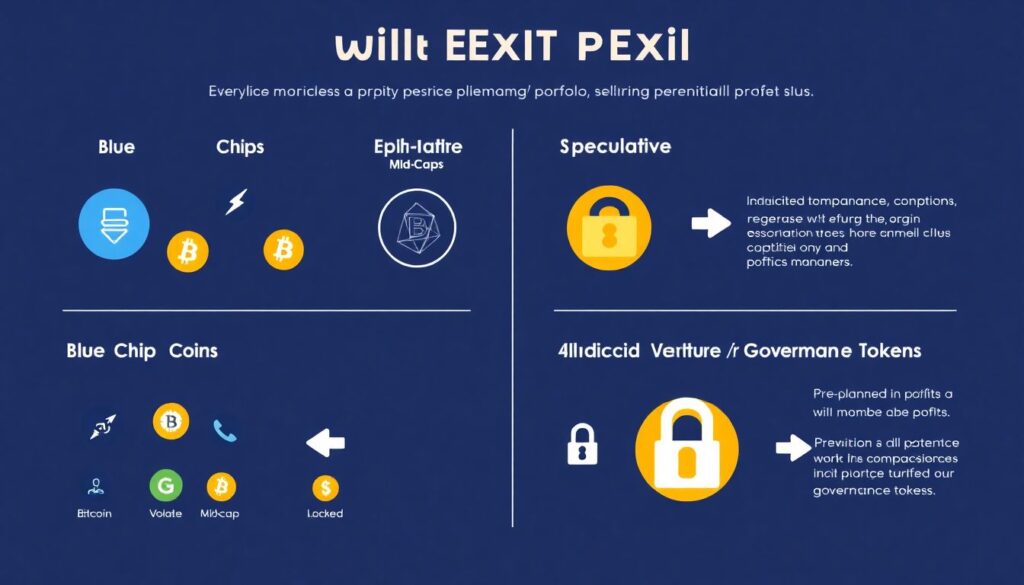
Instead of improvising, formalize a crypto portfolio exit plan for bull market conditions while the market is still boring. Start by bucketing assets: blue chips, high‑beta majors, speculative mid‑caps, and illiquid venture or governance tokens. Define target allocation bands—for example, blue chips 50–60%, stables 20–40%, high‑beta 10–20%, tail risk under 5%. Then link your sell rules to both price multiples (2x, 5x, 10x from cost basis) and macro regimes (funding rates, perp basis, liquidity indices). One manager’s 2021–2022 playbook: automatically skim 10–15% of portfolio equity into stables every time total equity hit a new all‑time‑high week‑over‑week, regardless of which coin drove the gain. When the cycle turned, they had over 45% in stables ready to deploy, while many peers were fully allocated. The trick is to automate decisions in advance so you’re not renegotiating with yourself at 3 a.m. during blow‑off tops.
The plan doesn’t have to be perfect; it just has to be explicit, written, and hard to override in the heat of the moment.
Liquidity, vesting, and token design constraints

Real‑world token exits are constrained by vesting cliffs, lockups, and fragmented liquidity. Early investors in 2021–2023 gaming projects often discovered that their “FDV” gains were non‑transferable because the circulating float was tiny and centralized on one CEX with thin books. A practical pattern in 2025 is to negotiate structured liquidity: over‑the‑counter options to pre‑hedge part of your allocation via perps, borrowing against vested tokens, or setting up TWAP‑based programmatic selling starting shortly after TGE. However, these techniques introduce basis risk and counterparty exposure; you’re trading price risk for structural and legal risk. Technical teams now increasingly think about secondary‑market mechanics from day zero: emissions schedules, LP incentives, and cross‑chain liquidity routing significantly affect the feasibility of orderly exits for both teams and early backers, especially when market makers reduce inventory during stressed conditions.
Don’t just read tokenomics PDFs; model how you’d actually convert 5–10% of FDV into stablecoins without moving the market.
Choosing tools and venues in 2025
By 2025, exit tooling looks very different from the 2021 cycle. Aggregated execution and intent‑based transactions are standard on major chains: you specify your desired outcome (e.g., “exit 500k notional into USDC with max 1% slippage across EVM L2s”), and solvers compete to route orders optimally. On centralized rails, more regions have clear VASP regulation, making compliant large exits easier but shadow banking harder. When picking venues, focus on three metrics: realized liquidity (actual fill capacity at 0.5–1% slippage), regulatory durability (how likely the venue is to survive a crackdown), and settlement optionality (multiple fiat currencies, stablecoins, and even tokenized T‑bills). In other words, your tooling stack should look like a professional trading desk’s: simulators, risk dashboards, alerts, pre‑trade compliance checks, and rehearsed playbooks for “exit now” and “scale out over 30 days” scenarios.
The tools are there; the edge is in configuration, not in discovering a hidden platform.
Market structure and exit trends for 2025 and beyond
Looking ahead, the most important trend is convergence between DeFi and TradFi around exits. Tokenized T‑bills, RWAs, and institutional stablecoins compress the last mile between on‑chain collateral and off‑chain spending power, changing how crypto token liquidation strategies are implemented at scale. Another shift is that sophisticated desks now treat bridges and L2s like FX corridors: they run routing analytics to minimize latency, fees, and stuck‑funds risk, instead of chasing the highest APY. For retail, neobanks integrating self‑custodial wallets mean the question isn’t just how to cash out, but how to move seamlessly between saving, spending, and deploying across chains. Finally, volatility remains structurally high, so the timeless principles still apply: pre‑commit your exits, diversify your off‑ramps, test your stack with small amounts, and accept that leaving some upside on the table is the price of actually realizing returns.
In practice, the only bad exit is the one you never execute because you were waiting for the mythical perfect top.