

Narratives Move Faster Than Prices. Data Moves Slower — Use That
Crypto isn’t just a market; it’s a story factory.
One tweet, one screenshot of an “alpha” dashboard, one dramatic thread — and suddenly billions in capital rotate from one narrative to another: AI coins, RWAs, meme seasons, L2 wars, you name it.
This “narrative velocity” is both the opportunity and the trap.
If you want to navigate wild crypto market narratives with data, you need to accept a paradox: by the time a story reaches you on X/Telegram, the price reacts faster than your emotions, but slower than the underlying data. Your edge is learning to trust the data over the story.
Let’s break this down systematically, but in plain language — and then I’ll offer some non‑obvious tactics for surviving (and thriving) in this chaos.
Why Narratives Dominate Crypto (And Why That’s Dangerous)
Narratives dominate crypto because fundamentals are:
– Hard to measure
– Technically complex
– Often not directly linked to cash flows (yet)
So traders default to stories:
– “This chain will be the next Solana”
– “This meme is the new DOGE”
– “Restaking will remake DeFi”
Meanwhile, real numbers — daily active addresses, liquidity depth, protocol fees, stablecoin flows — get ignored until it’s usually too late.
This is exactly where data gives you a defensive (and sometimes offensive) edge: it lets you quantify how much of a narrative is already priced in, and how much capital has actually moved to support it.
Statistical Reality Check: What the Data Actually Says
1. Volatility vs. Participation
Crypto’s notorious volatility isn’t just a meme. Over multi‑year periods, major assets like BTC and ETH have consistently shown annualized volatility often 3–5x higher than large-cap equities. But here’s the more interesting part: that volatility usually clusters around narrative shifts, not just macro events.
Examples:
1. Launch of major L2s → spikes in gas usage, bridge activity, and speculative flows.
2. Meme seasons → huge on-chain transaction counts with relatively low average transaction value.
3. New DeFi primitives → TVL surges concentrated on a handful of protocols while the long tail stays dead.
If you’re not using crypto market analysis tools that can show you volatility side‑by‑side with user activity and liquidity, you’re basically trading a storybook, not a market.
2. Liquidity Is the Hidden Narrative
Statistically, thin liquidity is a far more reliable predictor of brutal drawdowns than “bad tokenomics” or “weak community.” On-chain you can see:
– Concentration of token holdings (whales, insiders, VCs)
– Depth of liquidity pools on DEXes
– Slippage for modest trade sizes
– Presence (or absence) of supporting market makers
Narratives that ignore liquidity metrics tend to end in the same way: violent pump, brutal exit liquidity event.
Short version: Illiquid + narrative‑heavy = danger zone.
Forecasts: Where Narratives and Data Are Trending
Macro Direction: Data Is “Winning” Slowly

Looking ahead, three medium-term trends stand out:
1. On-chain transparency is becoming investable.
Institutional players increasingly require traceability of flows (stablecoins, tokenized assets, staking yields). This makes raw narrative‑only plays less attractive over time.
2. Regulation will punish purely speculative narratives.
Projects that can’t justify their token design with on-chain usage or revenue data will face more scrutiny. Tokens with demonstrable utility, fee flows, or real usage will have a structural advantage.
3. Data literacy will be as basic as “reading a chart.”
Just like TA became the baseline for retail traders, basic on-chain reading — supply unlocks, holder distribution, protocol health — will be a minimum skill, not a niche.
So the edge shifts from “I heard the narrative first” to “I can verify the narrative faster than others.”
Economic Aspects: How Narratives Misprice Risk and Value
Narratives are basically temporary consensus hallucinations about future cash flows and network value. They often misprice:
– Risk — people ignore tail risks (smart contract risk, liquidity black holes, regulatory clampdowns) when hype is high.
– Time — markets assume adoption or revenue will arrive in months, when in practice it may take years.
– Reflexivity — token price itself influences real metrics (TVL, user growth, dev activity) and then feeds the narrative again.
When you overlay real data — e.g., protocol revenue, fees, or actual retention — on top of these narratives, two patterns repeat:
1. Some assets are narrative-rich but data-poor: lots of tweets, thin revenue, mercenary liquidity.
2. Others are data-rich but narrative-poor: steady fees, sticky users, boring branding.
You don’t need to be a genius economist to see where the asymmetric opportunities sit long term.
Industry Impact: Data Is Quietly Reshaping Crypto
1. From Vibes to Dashboards
Once, traders followed influencers and Discord “alpha” channels. Now they also follow dashboards, scorecards, and feeds coming from every major on-chain crypto data analytics platform.
This changes behavior:
– Dev teams design tokenomics aware that unlocks and emissions will be scrutinized.
– Market makers and funds track wallet behavior, not just headlines.
– Retail users slowly learn that whales front‑run narratives, not follow them.
The industry is drifting — slowly but clearly — from pure speculation toward something closer to quantified speculation.
2. Data‑Native Products Are Becoming Infrastructure
You see this in:
– Risk engines that react in real time to sudden liquidity drains.
– Dashboards that track protocol solvency and collateralization.
– Smart alerts that fire when whale wallets start moving.
The more the industry leans into this, the less viable it becomes to run a pure “trust me bro” narrative play. That’s healthy, even if it hurts the easy pumps.
Tools of Survival: How to Turn Data Into an Edge
Let’s make it actionable. You don’t need a PhD. You need a simple, repeatable routine.
1. Build a Minimal On-Chain Checkup Ritual
Before entering a narrative trade, run a quick 5‑point checklist:
1. Holder concentration
– Are top 10 wallets sitting on a massive portion of supply?
– Are they labeled (CEX, team, VC, smart money) or just anonymous EOAs?
2. Liquidity health
– What’s the DEX liquidity for the token?
– What slippage do you get for a 1–5k trade? For 50–100k, if that’s your size?
3. Real usage
– Is there protocol fee generation?
– Are users interacting for non-speculative reasons (e.g., actual application usage)?
4. Token emissions and unlocks
– When do big cliffs hit?
– Are narratives ramping right before a known unlock (a huge red flag)?
5. Smart money behavior
– Are known funds or repeat winning wallets accumulating or distributing?
You can do most of this with mainstream dashboards or custom setups using crypto market analysis tools. The goal isn’t perfection; it’s to avoid the most obvious landmines.
2. Use Signals, Not Prophecies
Many traders blindly follow algorithmic alerts. Better approach: treat crypto trading signals based on onchain data as hints, not instructions.
For example:
– A signal that “smart money is accumulating token X” might mean:
→ Check if this aligns with a new narrative being whispered, or with a quiet build‑up before news.
– A signal of big outflows from a major protocol might mean:
→ Start risk‑reducing or at least stop adding to the position.
Data signals should prompt investigation, not replace thinking.
Unconventional (But Effective) Ways to Use Data in Narrative Markets

Here are some less obvious tactics that go beyond “check a dashboard and trade.”
1. Bet on Narrative Failure, Not Just Narrative Success
Most people ask: “Which narrative will pump next?”
A sharper question: “Which popular narrative cannot be sustained by actual on-chain metrics?”
Strategy:
1. Track the top 2–3 narratives dominating CT.
2. Compare:
– TVL growth vs. price growth
– User growth vs. marketing hype
– Revenue/fees vs. FDV
3. When price growth massively outpaces fundamentals and concentration is high, treat it as a candidate for:
– Hedging
– Shorting (if you know what you’re doing)
– Simply staying away while others become exit liquidity
You’re not just chasing winners; you’re identifying future losers early.
2. Hunt for “Data Divergence Plays”
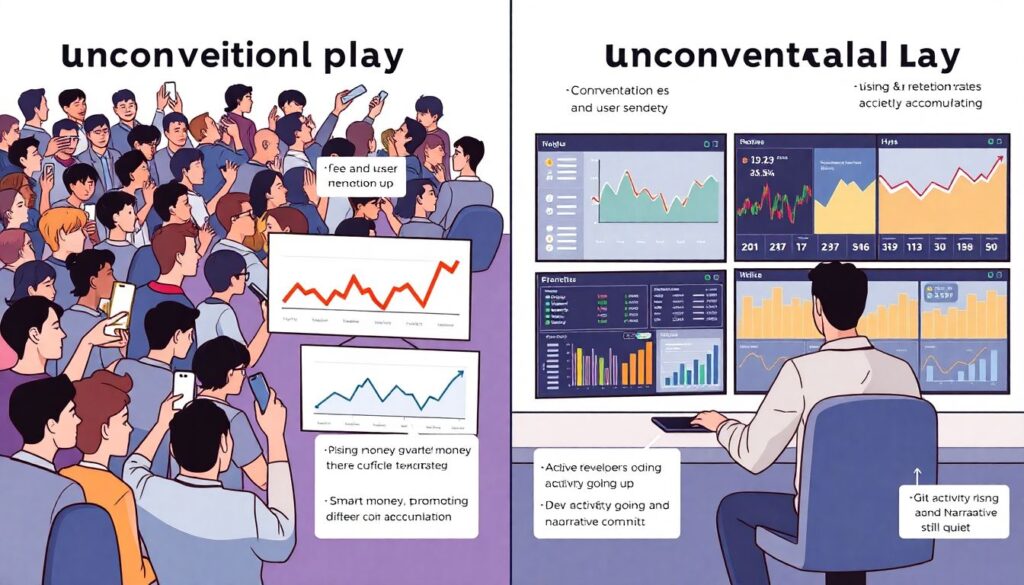
Conventional play: buy when narrative hits your feed.
Unconventional play: buy when data improves before narrative does.
Example patterns:
– Fees and retention trending up for weeks, but CT is silent.
– Smart money wallets quietly accumulating, but influencers shilling something else.
– Dev activity surging, but price chopping sideways.
This is where an on-chain crypto data analytics platform becomes a discovery engine, not just a risk dashboard. You’re literally farming time arbitrage: the delay between data changing and the story catching up.
3. Build a “Narrative Failure Watchlist” and Recycle Winners
Wild idea: instead of just a watchlist of tokens you like, maintain a list of narratives that broke:
– Past “ETH killers” that never killed ETH
– DeFi 1.0 projects that over‑diluted
– Failed L1s that lost developers and users
Then periodically:
1. Revisit their data (TVL, dev activity, upgrades, governance changes).
2. Ask: Is something structurally different now, or is this just a zombie pump?
This keeps you from chasing reheated narratives and helps identify genuine comebacks before they trend again.
Choosing the Right Data Stack (Without Getting Overwhelmed)
Too many people try to use 10 dashboards and end up using none. Better to pick a tight stack.
1. One general analytics suite
– For chain‑wide stats, protocol overviews, and standard metrics.
– This is often the best crypto analytics software for traders who want a “hub” to work from.
2. One specialized on-chain explorer or custom setup
– For wallet-level stuff: whale watching, unlock tracking, airdrop farming logic.
3. One alerting system
– Set alerts for specific metrics: liquidity drains, volume spikes, smart money movements.
If your tools don’t help you:
– Avoid blowups
– Detect quiet accumulation
– Understand whether a narrative is over‑extended
…then they’re mostly décor.
Designing a Data‑Driven Playbook for the Next Cycle
Here’s a practical framework you can actually follow:
1. Define your universe.
– Are you playing majors, mid‑caps, DeFi, memes, real‑yield, L2s?
– Narrow down; data is only useful if it’s focused.
2. Map narratives to metrics.
– If the claim is “X is the future of DeFi”: watch revenue, TVL quality, retention.
– If the claim is “X is a new L1/L2 standard”: watch dev activity, daily active users, gas patterns.
– If the claim is “X is community‑powered”: watch unique wallets, distribution, governance participation.
3. Use blockchain data driven crypto investment strategies.
– Define in advance what you need to see on-chain to:
– Enter a position (e.g., sustained fee growth + liquidity depth)
– Size up a position (e.g., smart money inflows, growing retention)
– Exit (e.g., liquidity thinning + distribution from top wallets)
4. Always separate “trade” from “thesis.”
– Trading: short‑term exploitation of narrative momentum, tightly risk‑managed.
– Thesis: long-term conviction backed by fundamentals and consistently improving data.
If you mix them, you either over‑size trades or under‑size real investments.
Final Thought: Data Doesn’t Kill Narratives — It Tells You When to Care
Narratives will always run crypto. That’s not a bug; it’s part of why the space is so explosive and experimental.
But if you rely only on stories, you’re volunteering to be the last buyer in someone else’s data‑driven plan.
Using data isn’t about being “cold and rational” all the time. It’s about giving your emotions something concrete to argue with:
– “Yes, this sounds amazing — but are users actually here?”
– “Yes, this is hyped — but is liquidity deep enough for my size?”
– “Yes, the chart is pumping — but who’s distributing into this?”
The wild part of the market isn’t going away. Your job is to move one step up the food chain: from narrative consumer to narrative auditor.
That’s where survival starts — and where real edge begins.