
Why “Protocol Exhaustion” Is Suddenly on Every Trader’s Radar in 2025
Most traders in 2020–2021 never even heard the phrase “protocol exhaustion”. Fast‑forward to 2025, and it pops up in research notes, X (Twitter) threads, and in advanced on-chain dashboards. The market finally realized: protocols get tired too — not in a human sense, but in terms of capital, incentives, and user attention.
In simple terms, protocol exhaustion is the moment when a blockchain protocol, DeFi app, or any on-chain system runs into the limits of its own design: rewards dry up, liquidity stops growing, users stop showing up, or the tokenomics can’t support the yield anymore. That “tired” phase creates very specific trading patterns — and if you learn to read them, you stop being exit liquidity and start positioning on the right side of the move.
Let’s unpack what this means for you in 2025 and how you can actually build a protocol exhaustion trading strategy instead of just doomscrolling charts after each rug‑adjacent collapse.
—
What Is Protocol Exhaustion in Plain English?
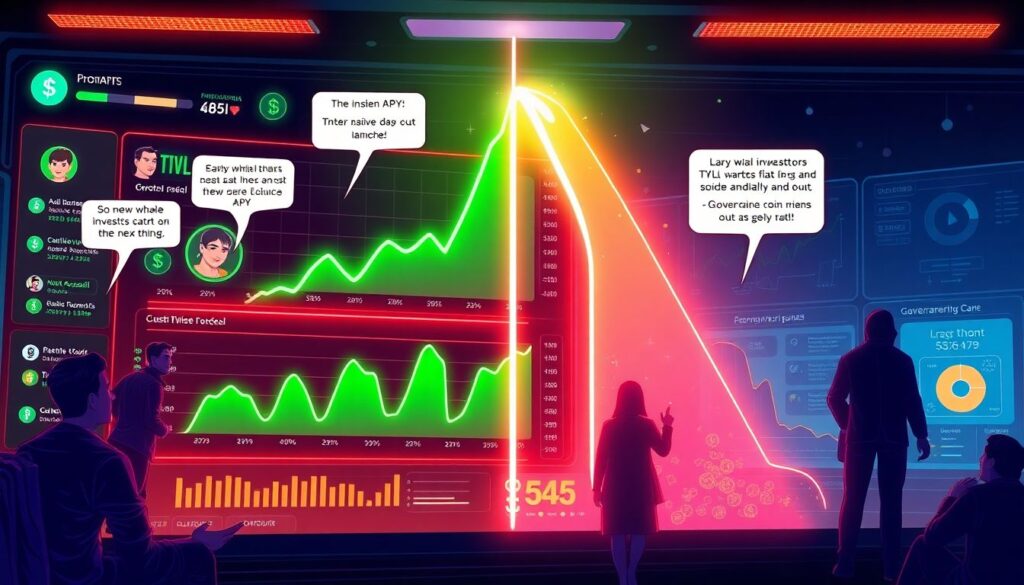
Forget the jargon for a second. Picture this:
A new DeFi protocol launches.
APYs are insane.
TVL rockets.
Every CT influencer calls it “the next big thing”.
For a while, it works. Then:
– Incentives are cut or halved
– New deposits slow down
– Early whales start claiming and selling
– Governance can’t push through new upgrades fast enough
– The narrative shifts to the “next meta”
That turning point — when growth stops being organic and becomes purely incentive‑driven or even negative — is what many quants and on-chain analysts now describe as protocol exhaustion.
It’s not just “price down”. It’s when the internal engine of the protocol loses fuel: fees, users, dev attention, incentive budget, or token demand. That’s where trading opportunities appear for people who can recognize the pattern before everyone else reads about it in a post‑mortem.
—
Modern Context: Why 2025 Is Different
The market today isn’t the wild 2021 bull or the brutal 2022 washout. In 2025:
– TVL is more concentrated on a smaller number of blue-chip protocols
– Regulators watch token emissions and staking yields more closely
– On‑chain data is much more transparent (and easier to analyze with AI tools)
– Capital is pickier — mercenary liquidity moves faster than ever
Protocols don’t get endless second chances anymore. When a major chain or DeFi app hits exhaustion, the unwind is faster, more brutal, but also more predictable if you know where to look.
That’s exactly what turns protocol exhaustion from a vague theory into something you can trade around.
—
Key Trading Clues: What Exhaustion Looks Like on the Chart and On‑Chain
You don’t need PhD‑level math to spot exhaustion. You need to watch the right combination of price, liquidity, incentives, and behavior.
Here are the big clues:
1. Reward compression
Incentive APRs go down, not because the protocol became safer or more efficient, but because the emissions budget is literally running out or being cut. You see this across farms, staking pools, and L2 sequencer rewards.
2. Flat or declining active users
Unique users and active wallets plateau while reward programs keep running. New money is not rotating in, just the same players cycling rewards.
3. TVL resilience… then sudden cracks
TVL holds steady for weeks even as incentives shrink — often a sign whales are waiting to dump on the first scare. Then one event (a governance proposal, bug, exploit on a related protocol, or macro shock) triggers a swift outflow.
4. Governance fatigue
Proposals to “revive” the protocol get more desperate, more complex, and less effective. Discussions drag, implementation lags. Community energy fades, even if the token price hasn’t fully reflected it yet.
5. Narrative migration
Attention quietly shifts to a new meta — RWA, restaking, AI‑DeFi, modular rollups, whatever’s hot in 2025. The old protocol still “works”, but it’s not where the smartest builders are experimenting anymore.
When several of these line up together, you’re not just looking at a dip — you’re staring at a likely exhaustion phase.
—
Protocol Exhaustion Indicators for Crypto Trading: What Traders Actually Use
Traders in 2025 don’t just stare at candlesticks; they combine chart signals with on‑chain telemetry. Some practical protocol exhaustion indicators for crypto trading include:
– TVL vs. incentives ratio
If incentives are being cut but TVL doesn’t leave, that often signals a lag before a bigger outflow.
– Liquidity depth vs. volume
When volume dries up but liquidity pools remain deep, it suggests LPs are trapped or slow‑moving. This can set up sharp price gaps once they finally exit.
– Net emission vs. buy‑side demand
Is the market absorbing token emissions naturally (e.g., stakers, product usage), or are rewards mostly farmed and dumped?
– User cohort decay
Are new users replacing old ones, or is everyone “loyal” simply because they’re still farming the last crumbs of rewards?
These don’t give a perfect signal alone. But in combination, they form a playbook you can systematize — not just a vibe check.
—
How to Trade Protocol Exhaustion Signals Without Getting Wrecked

Let’s talk execution. Knowing that a protocol is “tired” is one thing. Acting on it is where money is made or lost.
When people ask how to trade protocol exhaustion signals, the mistake is looking for a single magical indicator like an RSI level. In reality, it’s more like a sequence of conditions that gradually builds conviction.
Here’s a simple way to think about it:
1. Early awareness phase
– You notice emissions being cut or governance arguing over rewards
– User growth flattens
– Price still holds near recent highs or in a wide range
Action: start reducing blind long exposure, trim size, tighten stops. You’re not shorting everything yet; you’re respecting the risk.
2. Structural cracks phase
– TVL starts leaking slowly over several weeks
– Volume fades; influencer coverage drops
– Dev teams talk about “pivoting” or “experimenting with new directions”
Action: avoid buying the dip blindly; consider hedging through perps or options. Position for volatility – stretched ranges often snap.
3. Acceleration phase
– A clear trigger hits: exploit, failed upgrade, rejected proposal, regulatory concern
– Liquidity gaps appear, spreads widen
– Funding on perps flips aggressively as late traders pile in
Action: this is where a well‑planned protocol exhaustion trading strategy pays off. You’re not improvising — you already mapped out where you’d cut, where you’d short, and where you’d cover.
4. Post‑exhaustion complex phase
– Panic subsides, but usage stays low
– “Revival” proposals float, sometimes combined with token reverse splits, fee overhauls, or chain migrations
Action: selectively look for asymmetric rebound trades only if fundamentals *truly* change. Most exhausted protocols never fully recover — but some do with brutal tokenomics restructures, providing deep value trades.
The point isn’t to nail the exact top. It’s to avoid overstaying on exhausted protocols and position yourself around the major regime shifts.
—
Inspiring Examples: Traders Who Turned Exhaustion Into Edge
No need to name specific tickers here, but you’ve seen versions of this play out:
– A once‑dominant DEX on a legacy chain slowly bled TVL as restaking and L2 perps stole attention.
Traders who tracked the emissions schedule saw that liquidity mining was set to end in Q3 2024. They rotated out months before the final emission cliff, while social media was still celebrating “resilient TVL”. When the last emissions hit and yields dropped below competing platforms, liquidity evaporated, price followed, and those early rotators had dry powder to deploy into the new hot primitives.
– A hyped L1 with aggressive inflation and huge ecosystem fund support started showing flat user growth despite increasing grants.
On‑chain, a few funds were clearly distributing into every bounce. Traders watched the data instead of the marketing. They shorted perps with defined risk once a key ecosystem grant program ended and network fees stayed flat. When the narrative finally broke publicly, the move had already started — and they were positioned early.
These aren’t lottery wins. They’re repeatable patterns when you respect exhaustion as a normal part of protocol life, not a black‑swan event.
—
Case Studies: Projects That Survived Exhaustion
Not every exhausted protocol is destined for the graveyard. Some reinvent themselves — and those reinventions can be insanely profitable if you’re patient and observant.
Case 1: From Over‑Incentivized to Fee‑Sustainable
A large 2023‑era DeFi money market hit the obvious ceiling: emissions were too high, token price sagged, and users only stayed for the yield. In 2024, they:
– Slashed emission schedules
– Introduced real‑yield sharing from protocol revenue
– Tightened risk parameters after a few near‑miss exploit events
– Improved mobile UX to attract non‑degen users
Price didn’t moon instantly. For months, it chopped sideways in a boredom zone. But on‑chain data gradually showed a better mix of organic users, new depositors who never qualified for emissions, and fee revenue finally outpacing token sell pressure. Traders who tracked that shift — instead of staring only at legacy charts — caught a multi‑X move when the market recognized the turnaround in early 2025.
Case 2: L2 That Refused to Fade
One Ethereum L2 looked like it was done in late 2023: rival chains were eating into its TVL, its token emitted heavily, and user growth stalled. In 2024, it embraced modularity, partnered with AI‑oriented dApps, and leaned hard into real‑world assets.
By mid‑2025:
– On‑chain volume channels shifted from memecoin mania to high‑margin institutional flows
– TVL stopped relying on airdrop farmers and started coming from treasuries and funds
– Dev activity picked up as better tooling and grants targeted niche, high‑value apps
On a chart, it looked like “dead chain revives”. Under the hood, it was a full protocol economic reset. Traders who studied protocol exhaustion understood this wasn’t the same exhausted system from a year before; it was a new engine under the same hood.
—
Developing Your Own Protocol Exhaustion Playbook
Turning this into a repeatable edge means you can’t just react emotionally to token dumps. You need a system.
Here’s a simple framework to get started:
1. Choose your universe
Track 10–20 protocols you genuinely understand: a mix of L1s, L2s, DEXes, lending markets, and newer DeFi categories. Depth beats breadth.
2. Define key metrics per protocol
For each one, decide which numbers signal health vs. fatigue: active addresses, fees, emissions, retention, TVL concentration, dev activity.
3. Schedule regular reviews
Once a week or month, review those metrics with fresh eyes. Is this protocol growing on fewer incentives or only surviving thanks to them?
4. Set your thresholds in advance
Decide: “If emissions drop by X and TVL doesn’t adjust within Y weeks, I’ll start reducing exposure or hedging.” Pre‑commit so you’re not negotiating with yourself in a panic.
5. Backtest your logic
Use historical data from past cycles to see how your signals would have performed. Refine. Cut what doesn’t help. Keep what consistently warned you about upcoming breaks.
Your goal is to build checklists, not hunches. Emotion is expensive in this game.
—
Learning Faster: Courses, Tools, and Communities
If you want structured learning, an advanced order flow and protocol exhaustion course can compress years of mistakes into a few weeks of study — especially if it combines:
– Order book and CEX flow with DEX swaps and on‑chain trends
– Historical exhaustion examples from multiple cycles
– Practical risk management and hedging techniques
You don’t have to stop there, of course. In 2025, we’ve got powerful dashboards and AI‑aided analytics that democratize what used to be hedge‑fund‑only tooling.
Some directions to explore:
– On‑chain analytics platforms that show token distribution, emissions, TVL flows, and cohort retention in near‑real time.
– Governance aggregators that help you follow proposals across major protocols without diving into every forum daily.
– Discords and research‑oriented communities focused on data, not hype, where traders share their exhaustion theses and stress‑test each other’s logic.
If you combine these with your own journaling and backtesting, you’ll grow much faster than jumping from one narrative to the next.
—
Finding the Best Trading Platforms for Protocol Exhaustion Analysis
You don’t need 10 accounts with every exchange under the sun. For serious analysis and execution around exhaustion, look for this combo:
– Solid derivatives offering (perps, options) so you can hedge or short with size
– Deep liquidity on majors and key DeFi names
– Good data APIs and latency if you’re semi‑systematic or run bots
– Integrations or easy exports into your favorite on‑chain analytics stack
The best trading platforms for protocol exhaustion analysis are the ones that make it easy to both *see* the regime change and *act* on it with defined risk. Often it’s a blend: one platform for data and on‑chain insight, another for actual execution.
Nothing stops you from starting small: a CEX account, a couple of major DEXes, one or two on‑chain dashboards, and a spreadsheet or notebook. The edge is not in the shiny UI; it’s in how consistently you process and act on the data.
—
Actionable Steps: Leveling Up From Here
If you want this to become more than “interesting theory”, here’s a simple 5‑step plan you can start this week:
1. Pick 5–10 protocols you already hold or trade.
2. Write down what protocol exhaustion would look like for each (in bullet points).
3. Set alerts or dashboards for those exact metrics.
4. Decide in advance how you’ll respond if your exhaustion conditions start triggering.
5. Review monthly: Did any protocol move closer to exhaustion or away from it? Adjust your positions accordingly.
That’s it. Over time, this process trains you to see cycles inside the market, not just tickers going up and down.
—
Closing Thoughts: From Being the Exit Liquidity to Reading the Cycle
In 2025, protocols age faster than ever. Incentive budgets burn out. Narratives spin up and die in months. The players who survive — and actually grow — are the ones who treat protocol exhaustion as part of the natural lifecycle, not as random bad luck.
You don’t have to catch every top or bottom. If you can:
– Recognize when a protocol’s internal engine is running out of fuel
– Rotate out before the worst phase of the unwind
– Occasionally spot the rare, genuine reinvention and ride the comeback
…you’re already playing a different game from the majority.
Use these ideas to craft your own protocol exhaustion trading strategy, combine it with responsible risk management, and let time work in your favor. Markets will keep delivering new protocols, new metas, and new exhaustion cycles. Your edge is how quickly you learn to read them — and how calmly you act when everyone else only reacts.