
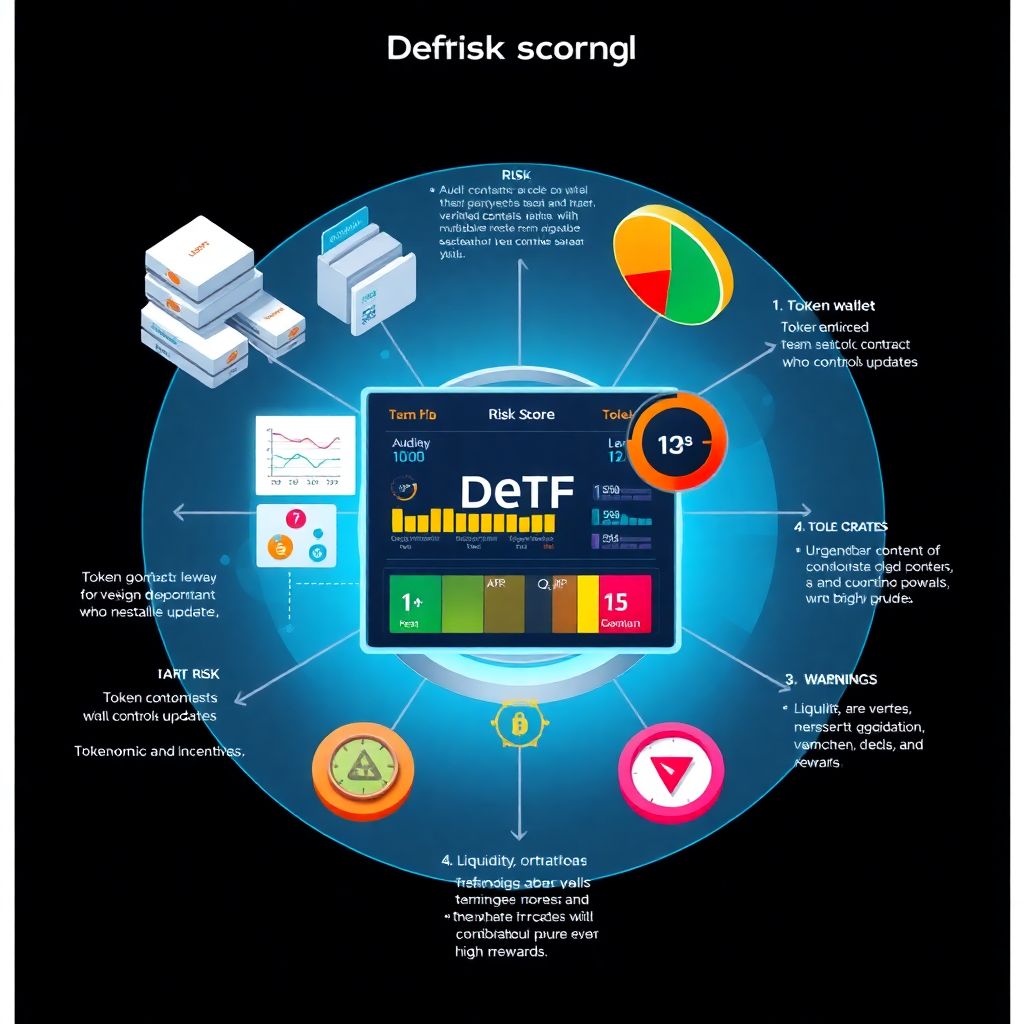
Understanding DeFi Risk Scoring
What Risk Scores Actually Measure
DeFi risk scoring is basically a translation layer between messy on-chain data and a single, digestible number that even a beginner can compare across protocols. Behind that number usually sits a model that aggregates smart contract vulnerabilities, liquidity depth, collateral quality, governance parameters and market volatility into a normalized score. Some systems use weighted metrics, others rely on probabilistic models, but the core idea is the same: estimate the likelihood and potential impact of a loss event. When you see a score, you should treat it not as a guarantee, but as a structured opinion based on explicit assumptions and data sources that can and do change as the protocol evolves over time.
Types of Risk in DeFi
Before you touch any yield farm or lending pool, it helps to decompose “risk” into categories instead of treating it as a vague feeling. You have smart contract risk, which covers bugs, upgrade logic and admin keys; economic risk, tied to token design, collateral ratios and incentives; market risk, driven by volatility, liquidity and oracle reliability; and operational or governance risk, reflecting how decisions are made, how upgrades are executed and how transparent the team is. A practical scoring approach forces you to walk through each of these dimensions, assign a qualitative or quantitative rating, and then aggregate them into a personal view rather than chasing only APR or total value locked.
Step-by-Step: How to Evaluate a DeFi Protocol
Step 1: Check Smart Contract Security
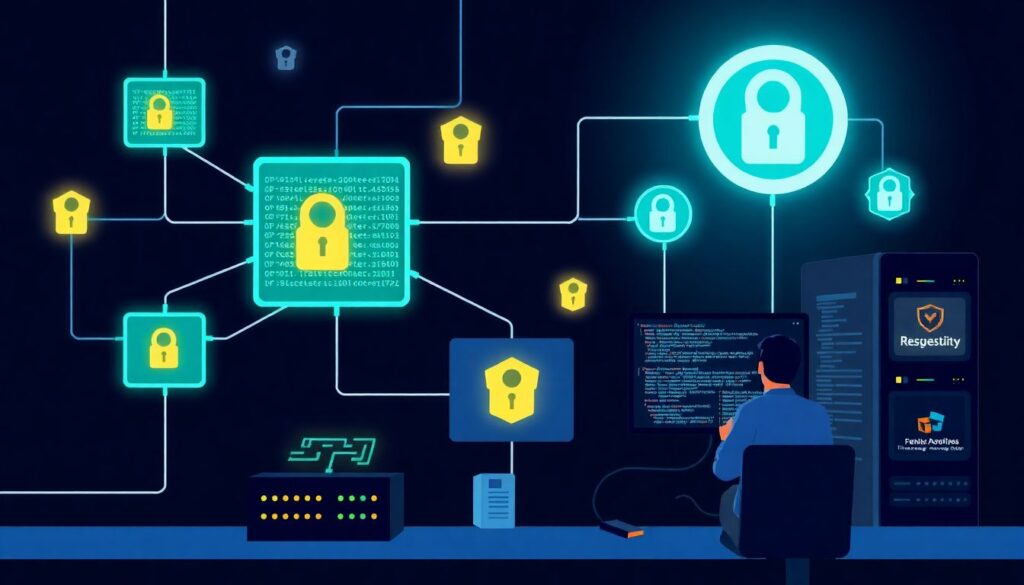
Your first step in learning how to evaluate DeFi protocol risk is to treat smart contracts as critical infrastructure, not magic boxes. Start by checking whether the code has been audited and by whom; reputable DeFi security audit services typically publish detailed reports with severity ratings, remediation notes and links to updated commits. Look at whether the contracts are upgradeable and who controls upgrade rights; multisig setups with transparent signers are generally safer than opaque admin wallets. For beginners, even just verifying that the contracts are verified on explorers and that no single address can arbitrarily drain funds already filters out a large portion of high-risk projects pretending to be legitimate.
Step 2: Analyze Tokenomics and Incentives
Once basic security is acceptable, move to tokenomics, because broken incentives can be as dangerous as buggy code. Examine how rewards are emitted, whether there is heavy reliance on inflationary tokens, and who holds the majority of supply. If insiders or the team control a dominant share with short vesting, they can nuke the market and your position. Look at fee structures, buyback policies and collateral ratios where relevant, especially in lending and stablecoin systems. Sustainable yield usually comes from real fees or lending demand, not from endlessly printing governance tokens. A solid risk score will penalize protocols where rewards depend on constant user growth rather than on robust underlying cash flows and rational incentive design.
Step 3: Liquidity, Oracles and Market Risk
Next, address liquidity and oracle exposure, because they determine how easily your position can implode under stress. Check the depth of trading pairs on major DEXes and CEXes; thin liquidity means slippage, price manipulation and fragile collateral values. Oracles are another core input: if a protocol relies on a single price feed or a custom oracle without battle testing, an attacker can misprice collateral and siphon funds. Evaluate the volatility of supported assets and concentration of liquidity across pools; highly correlated collateral baskets amplify downside in market crashes. In your personal scoring model, protocols with deep liquidity, redundant oracles and conservative collateral policies should sit at the top of your allocation, even if they advertise lower nominal yields.
Step 4: Team, Governance and Operational Risk

Finally, assess the human layer: team credibility, governance design and operational discipline. A protocol might have clean code but a chaotic upgrade process or poor incident response. Review the governance token distribution, voting thresholds and emergency powers; if a small clique can change critical parameters overnight, you face serious governance risk. Transparent teams that publish post-mortems, run bug bounty programs and keep public roadmaps tend to be more robust. On the flip side, anonymous teams are not automatically scams, but for beginners, stacking multiple uncertainties rarely ends well. In your DeFi risk scoring, bake in a discount for opaque operations and overly centralized governance, even when everything else appears technically sound.
Using Tools and Platforms
Automated Risk Scoring Platforms
You do not have to build a full quantitative framework from day one; there are already some of the best DeFi risk scoring platforms that aggregate on-chain metrics, audit data and governance events into accessible dashboards. These services typically assign letter grades or numerical scores and sometimes break them down by categories like smart contract, counterparty and market risk. Use them as starting points, not oracles of truth. Compare scores across platforms to see where opinions diverge, and read the methodology sections carefully. When a platform openly documents its assumptions, data inputs and update frequency, you can better judge when its output is relevant and when you need to override it with fresh context from news feeds or protocol governance forums.
Using DeFi Risk Assessment Tools in Practice
Beyond global ratings, more granular DeFi risk assessment tools let you simulate liquidations, analyze collateral compositions and visualize protocol dependencies. For example, you can inspect which assets back a specific stablecoin, how much exposure it has to a single chain, or how a drop in ETH price cascades through lending markets. When you plug your wallet into these tools, they can label your positions by risk tier and show “what-if” scenarios for price shocks. The practical workflow for a beginner is simple: before opening or increasing a position, run it through such a tool, check the flagged risks and decide whether you are comfortable with potential drawdowns or if you should downsize, hedge or avoid the position altogether.
DeFi Portfolio Risk Management Tools
At portfolio level, specialized DeFi portfolio risk management tools help you see aggregated exposure rather than isolated bets. These dashboards pull positions from multiple wallets and chains, tag them by protocol and asset type, and sometimes estimate value-at-risk under stress scenarios. This matters because you might think you are diversified across five protocols, but in reality all of them rely on the same stablecoin or oracle, creating hidden concentration. Use these tools to identify clusters of correlated risk and to rebalance toward more resilient combinations of assets and protocols. Over time, your goal is not to eliminate risk, which is impossible, but to align it with your real risk tolerance and investment horizon based on data instead of intuition.
Practical Case Studies
Case 1: “Safe” Stablecoin Farm That Wasn’t
Consider a beginner who parked most of their capital in a seemingly conservative stablecoin farm advertising modest yields. The protocol had a clean interface and claimed multiple audits, but the user skipped reading details and ignored independent scores that flagged oracle risk as elevated. The stablecoin relied on thinly traded collateral and a single price feed, which attackers later manipulated, causing under-collateralized minting and a rapid depeg. Within hours, the farm’s TVL collapsed and withdrawals were gated. Post-mortem analysis showed that existing DeFi risk scoring models clearly penalized the oracle design, but the user focused purely on “stablecoin” and “audited” labels. This case illustrates why even low APR products still demand full-spectrum risk evaluation.
Case 2: High APR Pool with Hidden Governance Risk
Another real-world pattern involves liquidity pools with sky-high APRs paid in governance tokens that look attractive at first glance. An investor jumped into such a pool, encouraged by dashboards promoting it without mentioning governance centralization. Under the hood, a small team-controlled multisig could change fee parameters and reward distribution without community consent. After initial hype, the team quietly passed a proposal redirecting a large share of emissions to their own wallets and increasing withdrawal fees. Token price crashed, and pool participants were effectively diluted. Risk scoring platforms that weighted governance risk heavily had assigned this protocol a low composite rating, largely due to admin key control and opaque decision-making, which the investor chose to ignore.
Case 3: Surviving a Market Crash with Risk Scores
On the positive side, risk scoring can act as a defensive filter during black swan events. During a sharp market drawdown, one user had systematically allocated only to protocols with conservative collateral factors, deep liquidity and redundant oracles, all of which ranked high on several scoring dashboards. While yields were moderate, their positions remained solvent as risk engines liquidated users with riskier leverage elsewhere. Protocols with weaker risk profiles suffered cascading liquidations, oracle desynchronization and governance drama. By pre-selecting venues based on structural resilience rather than headline APR, this user experienced drawdowns but avoided catastrophic loss. The lesson is that consistent attention to multi-dimensional risk scores can pay off precisely when markets become chaotic.
Common Mistakes and Beginner Tips
Red Flags and How to Avoid Them
Newcomers often treat data as decoration rather than as a decision engine, leading to recurring mistakes. Common red flags include undocumented or unverifiable audits, opaque admin key structures, aggressive token emission schedules and total reliance on a single oracle. Another trap is conflating TVL with safety; large numbers can disappear quickly when design flaws are exploited. To avoid these pitfalls, treat every new protocol as guilty until proven otherwise: demand clear documentation, audit trails, governance transparency and coherent economic design. Cross-check several scoring platforms, skim community discussions and look for unresolved critical issues. If something feels rushed, overly promotional or impossible to understand, step back; in DeFi, missed opportunities are cheaper than irreversible losses.
Building Your Personal Risk Checklist
Over time, transform all this into a repeatable personal checklist instead of ad hoc judgments. For each protocol, ask the same structured questions about smart contract audits, upgradeability, token distribution, liquidity depth, oracle architecture and governance processes, and then map those answers to a simple internal scoring grid you actually respect. Combine this with external DeFi risk assessment tools and platform ratings to triangulate a more robust view. Document your reasoning for every major position so that when conditions change—new audits, governance disputes, market shifts—you can quickly reassess. As your skills grow, you will move from blindly trusting tools to using them as inputs into your own disciplined risk framework, which is ultimately the most sustainable edge a DeFi participant can build.