

Why privacy-preserving on-chain analytics matters right now
If you work with blockchain data, you’ve probably felt the tension between transparency and privacy. Public ledgers are fantastic for auditability, but the moment you start stitching addresses, events and off-chain signals together, you’re a step away from full user de-anonymization. At the same time, regulators, investors and security teams demand better visibility, more granular on-chain analytics, and continuous risk monitoring. Building a privacy-preserving on-chain analytics workflow is essentially an attempt to square that circle: you want enough detail to detect abuse, ensure compliance, and optimize products, but you want to avoid creating an internal “surveillance machine” that can be abused, leaked or subpoenaed into something your users never signed up for. That balance doesn’t appear automatically; it has to be designed into your data pipeline from the first log you collect to the last dashboard a stakeholder sees.
A short historical detour: from cypherpunk ideals to compliance dashboards
In the early Bitcoin days, on-chain analytics was almost an academic hobby. People scraped block explorers, ran simple scripts and posted graphs on forums. There were no polished on-chain analytics tools for blockchain data, and “privacy” mostly meant using new addresses and maybe Tor. As Bitcoin and later Ethereum gained traction, law enforcement agencies noticed that transparent ledgers are an investigative goldmine, and specialized analytics companies started offering clustering heuristics, exchange tagging and transaction graph analysis. That marked the shift from hobbyist curiosity to professional intelligence tooling built for compliance teams, investigators and trading desks, often with little regard for user privacy or data minimization. Over the last few years, pressure from GDPR-style regulations, institutional risk teams and privacy-oriented communities has pushed the ecosystem towards more responsible designs, where teams look not only for powerful dashboards but also for privacy-preserving blockchain analytics solutions that do not turn every query into a permanent record about individual users.
Core principles of a privacy-preserving on-chain analytics workflow
If you want your analytics stack to respect users while still being operationally useful, you need to internalize a few architectural principles. The first one is strict separation between raw blockchain data and any form of user identity. Raw on-chain events are pseudonymous by default; risk escalates drastically the moment you join them with KYC records, IP logs or marketing identifiers. The second principle is data minimization: just because your node or indexer can capture every op-code, log and mempool transaction doesn’t mean you should keep it indefinitely or expose it to every internal team. Expert teams treat data fields as liabilities and actively strip or aggregate information that is not essential for their use cases. The third principle is access compartmentalization: fine-grained role-based access control, query auditing and differential surface areas for devs, analysts and compliance officers reduce the chance that a curious employee or compromised account can reconstruct sensitive user journeys.
Threat modeling as the starting point

Before you even pick tools, it helps to run a simple but honest threat model workshop. Ask yourself who might realistically try to misuse your analytics stack and how. That includes not only external attackers and chain surveillance firms, but also over-enthusiastic marketing teams, partners who get access to data exports, and future-you facing a regulatory request you didn’t anticipate. Map your data flows: where does blockchain data enter, where does it get enriched, which systems store it, and who can query it with arbitrary filters. Security architects who have done this a few times advise writing down specific abuse scenarios, such as “analyst correlates KYC account with DeFi gambling patterns and shares internally for non-business reasons” or “partner gets a ‘sample dataset’ that can be easily deanonymized using public mempool archives.” Once you spell these out, the need for privacy guards in your on-chain analytics workflow becomes much less abstract and directly influences your tool choices and governance policies.
Choosing tools: what to look for (and what to avoid)
When people start building analytics, they often reach for whatever is easiest: generic data warehouses plus some ETL scripts and a favorite BI dashboard. That can work, but if you care about privacy, you want a slightly different feature checklist. Modern teams increasingly prefer on-chain analytics tools for blockchain data that integrate with privacy primitives instead of bolting them on later. In practice, that means products or open-source stacks that support data masking at ingestion time, column-level access control, strong audit logs for every query and support for pseudonymization, tokenization or aggregation before data hits your primary analytics store. For external products, you’ll also want to know whether vendors can see your queries or derived labels, because that can leak sensitive information about your users and your business strategy.
– Support for field-level encryption or tokenization of user-linked attributes
– Rich role-based permissions and query logging built into the analytics engine
– Native aggregation features (e.g., histograms, sketches) to avoid per-user exports
At the same time, do not underestimate the value of specialized privacy-preserving blockchain analytics solutions that focus on compliance and risk scoring without forcing you to hand over full-identifiable datasets. Some of these platforms allow you to send hashed identifiers, partial transaction features or cohort-level summaries and receive risk indicators back, so you get strong signal without shipping your entire user graph to a third party. This hybrid pattern—local detailed processing combined with external privacy-preserving scoring—is becoming a common expert recommendation for institutions that want the benefits of both depth and confidentiality.
Key capabilities to demand from vendors
When you evaluate vendors, whitepapers and demo dashboards are not enough; you should interrogate the underlying data governance model. Established experts recommend formulating a checklist that covers both functionality and privacy posture. If you are picking the best on-chain analytics platforms for crypto compliance, go beyond marketing claims about “GDPR readiness” and ask specific questions: Can you enforce per-team schemas that hide granular address-level views from non-compliance personnel? Does the platform support anonymized exports for data science experiments? How easy is it to rotate or fully delete identifiers that become legally sensitive? Furthermore, if you adopt an external SaaS platform for graph analysis, clarify whether they retain derived datasets linked to your organization, how long access logs are kept and whether they offer encrypted customer-managed keys. This is where blockchain data analytics software with privacy features can genuinely differentiate itself by showing concrete mechanisms rather than vague statements about security.
– Ability to run on-premise or in your VPC to keep raw blockchain data in-house
– Customer-managed encryption keys and hard deletion workflows for sensitive entities
– Clear documentation of data retention, secondary usage and subcontractor access
Designing the pipeline: from raw chain data to safe insights
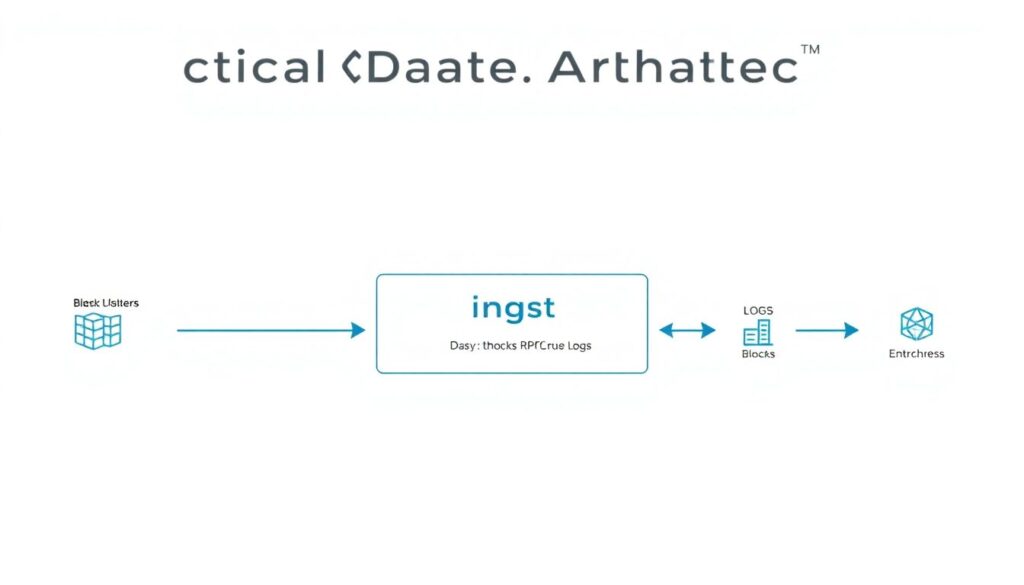
Let’s walk through a practical architecture that teams can adapt. At the entry point, you have node infrastructure or third-party RPC providers feeding raw blocks, transactions and logs into your ingest layer. Here you normalize events, parse ABI, and enrich with chain-specific metadata. Crucially, this is where you decide whether to attach any user identifiers at all. Experienced practitioners strongly suggest delaying identity joins as long as possible. Instead of tagging each transaction with a user ID at ingestion, keep a separate, tightly controlled service that can map user accounts to one or more addresses when an authorized query legitimately needs it. That way, your main analytics warehouse only holds pseudonymous address-level views, significantly reducing exposure in case of breaches or internal misuse. You can still compute aggregates, fraud signals and cohort analytics without knowing which address belongs to which person.
Segmentation of environments and data domains
Another design tactic that shows up repeatedly in expert playbooks is environment segmentation. You don’t want the same database powering product dashboards, ad-hoc investigation queries and machine learning experiments. Instead, you can maintain at least three logical domains: a raw chain data lake, a curated pseudonymous analytics store, and a highly restricted identity-join environment. In the raw domain, you keep block-level and transaction-level artifacts with minimal retention guarantees and heavy access controls. The curated store is optimized for common queries, with columns standardized and any user-linked fields stripped or bucketed. The identity-join environment might be a separate service or schema where only a handful of vetted processes run—think automated sanctions screening or court-ordered investigations. By forcing flows between these layers to go through reviewed pipelines instead of SQL free-for-all, you make it structurally difficult for anyone to casually bridge the gap between blockchain pseudonyms and real-world identities.
Techniques for preserving privacy while still getting value
Beyond structural design, there are concrete privacy techniques you can embed into your on-chain analytics workflow. One simple but underused method is aggregation by design. Instead of giving stakeholders tables of address-level time series, expose metrics aggregated per cohort (e.g., per country, wallet tier, product segment) with thresholds that hide small groups. For more advanced needs, techniques such as differential privacy let you add mathematically calibrated noise to query results, so you can share macro patterns—like average position sizes or churn rates—without revealing individuals. Another emerging technique is secure multi-party computation or homomorphic encryption for joint analysis with partners, although in practice this is still niche and often expensive. For most teams, privacy wins come from disciplined pseudonymization, one-way hashing of internal identifiers, and consistent suppression of rare-value combinations that could re-identify someone when combined with chain records and public mempool traces.
Integrating with enterprise monitoring and operations
If you work in a larger organization, your on-chain data does not live in a vacuum; it intersects with SIEM systems, ticketing tools and compliance workflows. This is where enterprise on-chain monitoring and analytics services often enter the picture. The challenge is to integrate them without turning your ops center into a voyeuristic window into individual user behavior. Instead of streaming full transaction traces and user IDs into your SIEM, consider streaming only alerts: “high-risk interaction with sanctioned address,” “suspicious mixing pattern,” “unusual volume spike in Tier-3 wallets.” Map those alerts to internal case IDs, and keep the mapping to specific users in a separate vault-like system that only compliance officers can access. Security teams who’ve gone through audits repeatedly emphasize that “need to know” should be enforced technically, not just in policy documents. Metrics for uptime, latency and gas usage can be entirely divorced from personally identifiable data, so there’s no excuse for exposing extra fields in monitoring pipelines.
Real-world implementation patterns and examples
To make this less abstract, imagine a crypto exchange building its analytics stack from scratch. They start by deploying indexers and streaming normalized blockchain events into a warehouse. Analysts get access to tag clusters—cold wallets, hot wallets, internal liquidity addresses—but user-level mappings live in a separate identity service. When they integrate external on-chain analytics tools for blockchain data, they configure those tools to receive only address clusters and behavioral features, not customer names or emails. For AML checks, the exchange connects to a specialized risk-scoring provider that offers privacy-preserving blockchain analytics solutions: sensitive user identifiers are hashed client-side, and the provider returns category-level risk ratings rather than full user profiles. Product teams query aggregated views like “daily deposit distribution by chain and user tier,” while only the compliance unit can temporarily bridge from an alert back to specific KYC accounts under well-logged procedures.
Another example is a DeFi protocol that wants usage analytics without operating a centralized KYC registry. They rely fully on public blockchain data and treat every wallet as an autonomous actor. Their main risk is not exposing identities, but rather over-collecting metadata such as IP addresses or device fingerprints in their web app and then joining that with wallet behavior. The team adopts a strict data minimization policy: they drop or truncate network identifiers at the edge, avoid third-party trackers, and expose only highly aggregated stats to the public—say, distribution of positions by size buckets or protocol interactions by time of day. When they integrate blockchain data analytics software with privacy features, they enable options like automatic redaction of low-activity addresses in exported reports, and they enforce that no raw user event logs leave their infrastructure except as anonymized research datasets. This gives analysts enough signal to improve tokenomics and UX while significantly lowering the risk of accidental deanonymization.
Common misconceptions that derail privacy efforts
Teams often walk into this topic with some flawed assumptions. One frequent misconception is “it’s just addresses, so it’s already anonymous.” In reality, addresses become identities the moment they interact with exchanges, bridges or KYC services; your own logs and marketing tools can then make the linkage trivial. Another misleading idea is that encryption at rest magically solves privacy—while it is necessary, it does nothing against overly broad access permissions or over-detailed internal dashboards. Senior practitioners also warn against the belief that you can simply outsource responsibility to vendors: even the best on-chain analytics platforms for crypto compliance cannot offset a poor internal governance model if everyone in your company can run arbitrary joins. Finally, some product teams think that privacy and analytics are in direct conflict, and that preserving user confidentiality will inevitably kill insights. In practice, once you adopt aggregation, pseudonymization and strict scoping, the quality of your decisions barely suffers, while your blast radius in case of leaks shrinks drastically.
Expert recommendations for getting started
People who design privacy-conscious data platforms for a living tend to converge on a small set of practical recommendations. First, write down your “analytics charter” before you write code: specify what questions you want to answer, what you explicitly will not track, and how long you keep sensitive artifacts. Second, assign clear ownership—ideally a joint responsibility between security, data engineering and compliance—so no single team can unilaterally relax privacy constraints. Third, choose your stack with privacy in mind from day one; retrofitting access control and masking to an already sprawling warehouse is painful and error-prone. Fourth, treat queries themselves as sensitive assets: log them, periodically review for abuse, and educate analysts that certain join patterns are off-limits without extra approval. And finally, revisit your design regularly; regulations, user expectations and on-chain forensics capabilities evolve, so a workflow that felt safe in 2021 might be dangerously revealing by 2025.
Bringing it all together
Creating a privacy-preserving on-chain analytics workflow is less about finding a single magic product and more about orchestrating data flows, permissions and cultural norms so that powerful analysis never turns into unrestricted surveillance. You combine architectural separation of data domains, careful tool selection, and privacy-aware techniques like aggregation and pseudonymization, and you back them with governance that actually has teeth. When you do this well, you end up with a stack where engineers, analysts and compliance officers all get the insights they need, while users are protected from unnecessary exposure and your organization is better insulated against legal and reputational fallout. In a space where everything on-chain is permanent, treating your analytics design as a first-class privacy concern is not an optional luxury; it is part of building infrastructure that deserves users’ trust over the long term.