
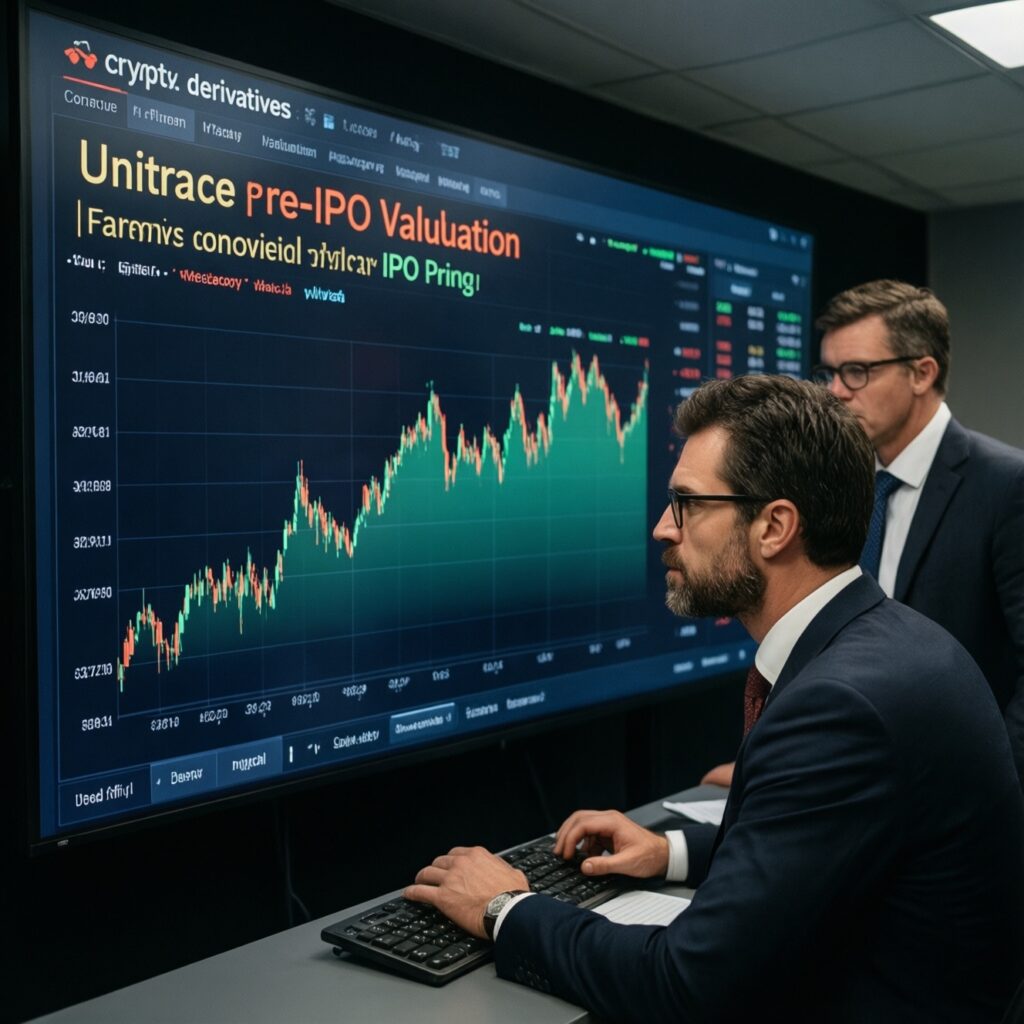
Crypto derivatives markets are already putting a price tag on Unitree that's dramatically higher than what public investors are being offered. On Hyperliquid, traders in pre-IPO perpetual futures are implying a valuation close to $38 billion-roughly four times the company's expected public-market worth-setting the stage for a potentially harsh "convergence" once the stock begins trading.
Unitree, the Hangzhou-founded robotics firm established in 2016, has set its Shanghai STAR Market offer at 150.80 yuan (about $22.37) per share. That figure effectively defines the Unitree IPO price and pegs the company at about $9 billion. Yet the synthetic markets on Hyperliquid were trading around $92-$94, according to an Allium analysis, suggesting a far richer Unitree IPO valuation than the official deal terms.
The premium reflects how intensely investors are watching China's robotics champions. Unitree develops four-legged and humanoid robots used across research, industrial tasks and consumer applications. In Allium's numbers, the company posted $253 million in revenue last year-up 335%-and shipped more than 5,500 humanoid robots, metrics that help explain why speculators are willing to price a major upside before the bell even rings. Retail demand also looks extreme: reports indicate the offering was oversubscribed around 8,000 times, with trading expected to start between Aug. 17 and Aug. 21.
What's different this time is where the pre-debut excitement is being expressed. Hyperliquid became a major onchain venue for perpetual futures-leveraged contracts without an expiry date-originally built for crypto assets. Over time, that same plumbing has been extended into other categories, from commodities such as oil and gold to private companies approaching public listings. In other words, a market that started by betting on tokens is now making synthetic "pre-market" prices for firms like Unitree, as described in pre-IPO perpetuals pricing Unitree far above its IPO price.
It's crucial to understand what these contracts are-and aren't. Pre-IPO perps don't grant ownership, cannot be converted into shares, and don't let you buy Unitree IPO shares in any legal or direct sense. Instead, they create a speculative reference point: traders take long or short exposure to an implied valuation and expect the contract price to drift toward the real stock once a public reference market appears. That "painful convergence" can happen quickly, particularly when leverage is involved.
Recent listings have made this price-discovery game look surprisingly credible at times. Allium noted that a pre-IPO contract tied to Chinese memory-chip maker CXMT landed within 2.5% of its Shanghai opening print in July. Hyperliquid traders also anticipated that SpaceX's synthetic ticker (SPCX) would open above its stated $135 IPO price in June. Those wins have encouraged more participants to treat onchain pre-IPO markets as an early signal rather than pure noise.
Unitree has already seen meaningful activity across two markets on Hyperliquid-run by Trade.xyz and Paragon-with about $9.1 million in open interest and around $59 million in turnover. When both venues were active, prices stayed close, averaging only about 1.6% apart. Most recently, the $92-$94 zone implies more than 300% upside relative to the official Unitree IPO price, a gap big enough to create liquidation risk on both sides.
That's where the setup becomes dangerous for leveraged bulls. Even a strong debut could still be "bad" relative to the perp market. Allium's scenario analysis suggests that if Unitree opens around $45-double the IPO level-it would still be roughly 52% below current perp pricing and could liquidate about one-third of long exposure. At the other extreme, an opening near $128 (nearly 6x the IPO level) could wipe out an estimated 53% of short positions. If the stock opens close to where perps trade, liquidations should be minimal because neither side is meaningfully offside.
Positioning underscores how binary the first print may feel. On Trade.xyz, the larger of the two markets, exposure is close to balanced-about $6.5 million long versus $6.6 million short. Smaller accounts appear more skeptical: positions below $50,000 are roughly 70% short by value. With the market so tightly coiled, even a modest deviation between the opening stock trade and perp pricing can force one side out quickly.
For anyone trying to interpret the future Unitree Robotics stock price, it helps to separate hype from mechanism. A perp market can be efficient at aggregating opinion, but it also amplifies reflexivity: when traders see a high implied valuation, they may chase it, pushing prices further away from fundamental anchors. The larger the gap becomes, the more violent the eventual snapback can be-especially when leverage and liquidation engines are involved.
Another factor is timeline risk. Between allocation, listing windows, and the uncertainty of the very first on-exchange print, traders may be forced to hold positions longer than intended. In that period, funding rates, liquidity conditions, and sudden shifts in sentiment can move perp prices dramatically even without any new fundamental information.
There's also a behavioral trap: the buzz around an oversubscribed deal can make it feel "obvious" to invest in Unitree IPO, but IPO mechanics don't reward everyone equally. Allocation constraints mean most retail participants can't access meaningful size at the offer. That mismatch often pushes traders into substitutes-like perps-where execution is easier, but the risk profile is completely different.
Finally, traders should keep an eye on the link between public equity narratives and onchain instruments. If a large crowd treats pre-IPO perps as a de facto premarket, the synthetic tape may start influencing expectations in the actual stock, at least in headlines and social feeds. That feedback loop can increase volatility on debut day, turning the first session into a contest between the official pricing process and the onchain consensus. The dynamic around Unitree going public as Hyperliquid traders price in 4x upside shows how quickly crypto-native venues are expanding into Wall Street-style events-while keeping crypto-style leverage and liquidation risk at the center of the experience.